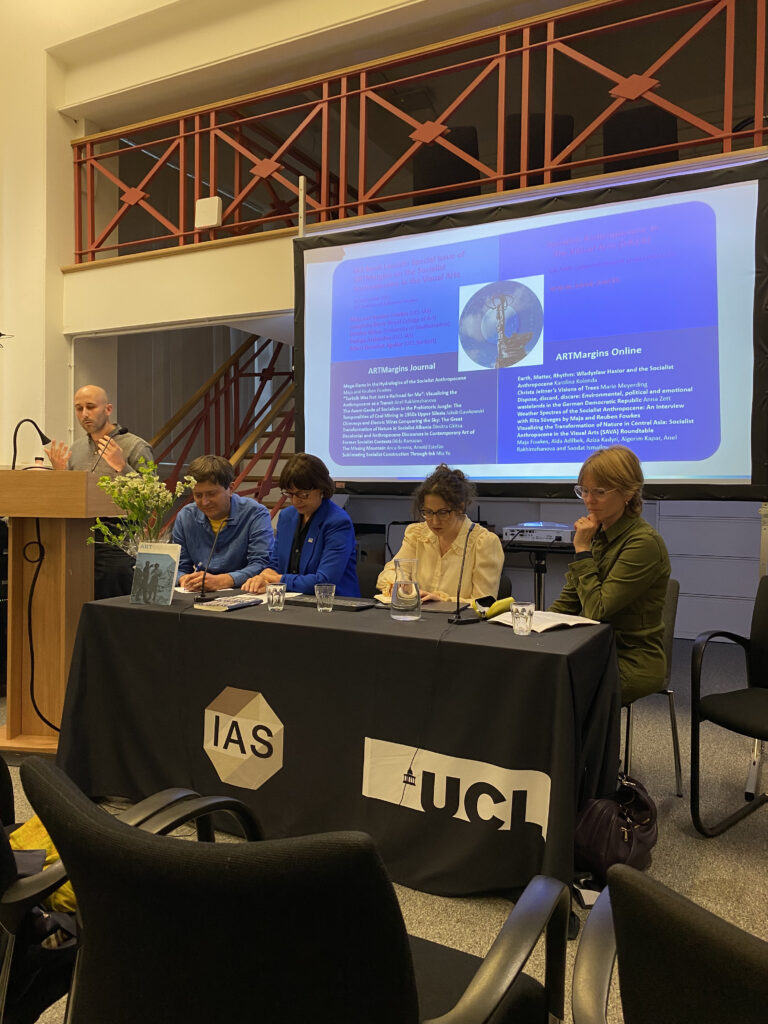
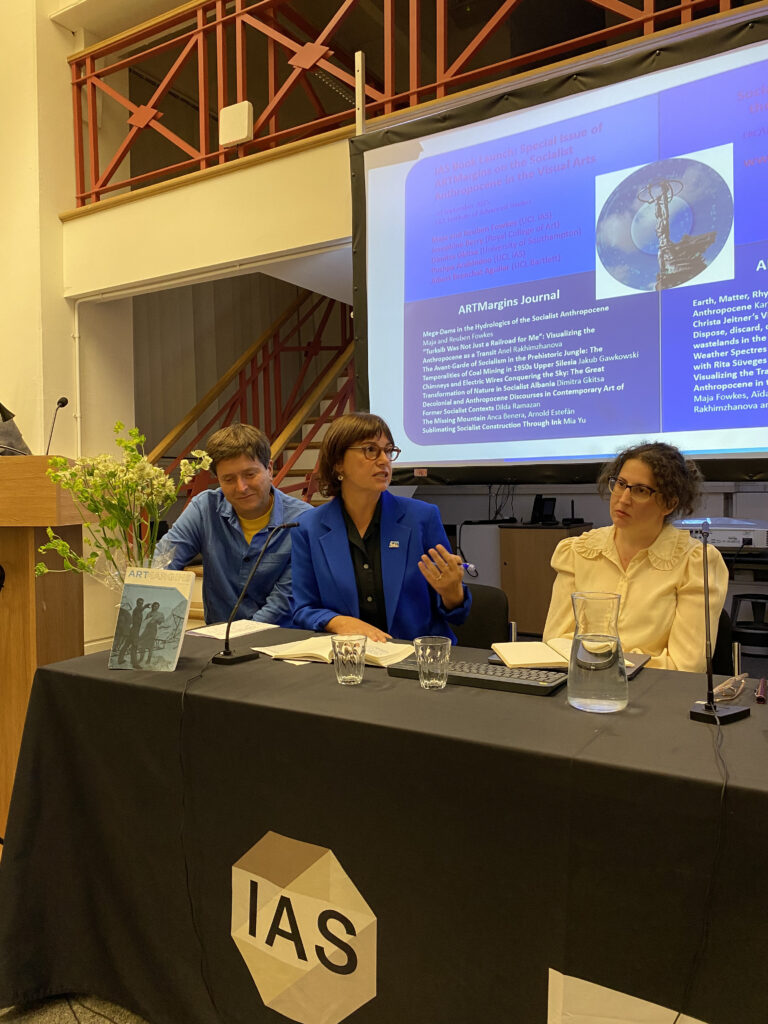
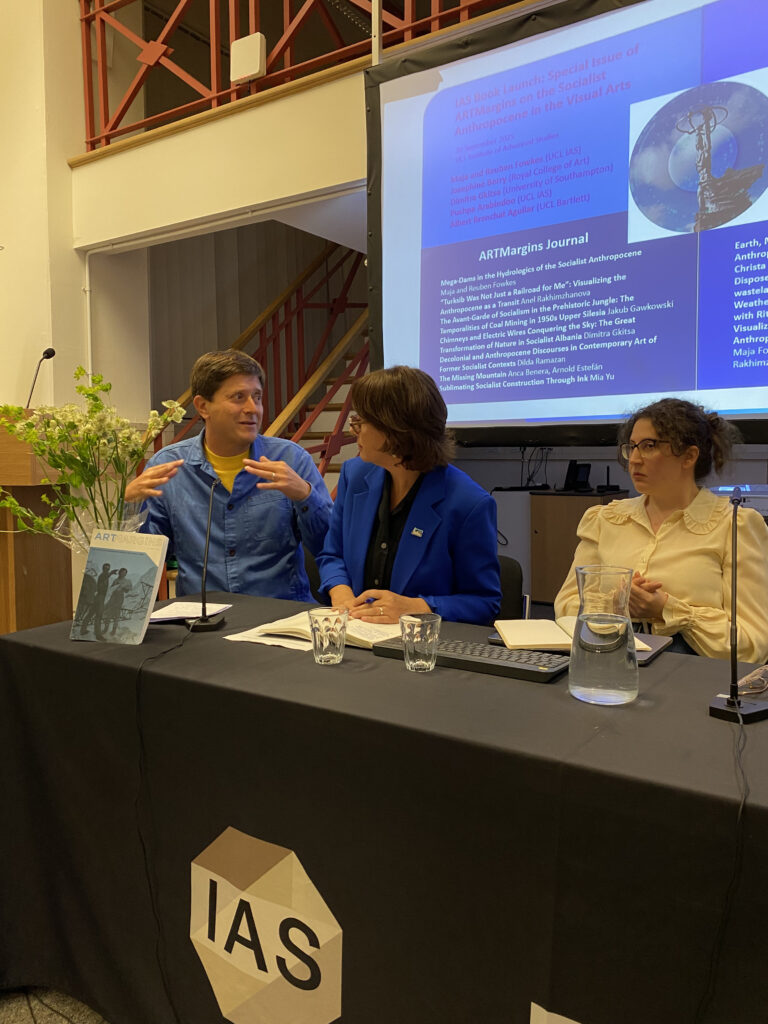
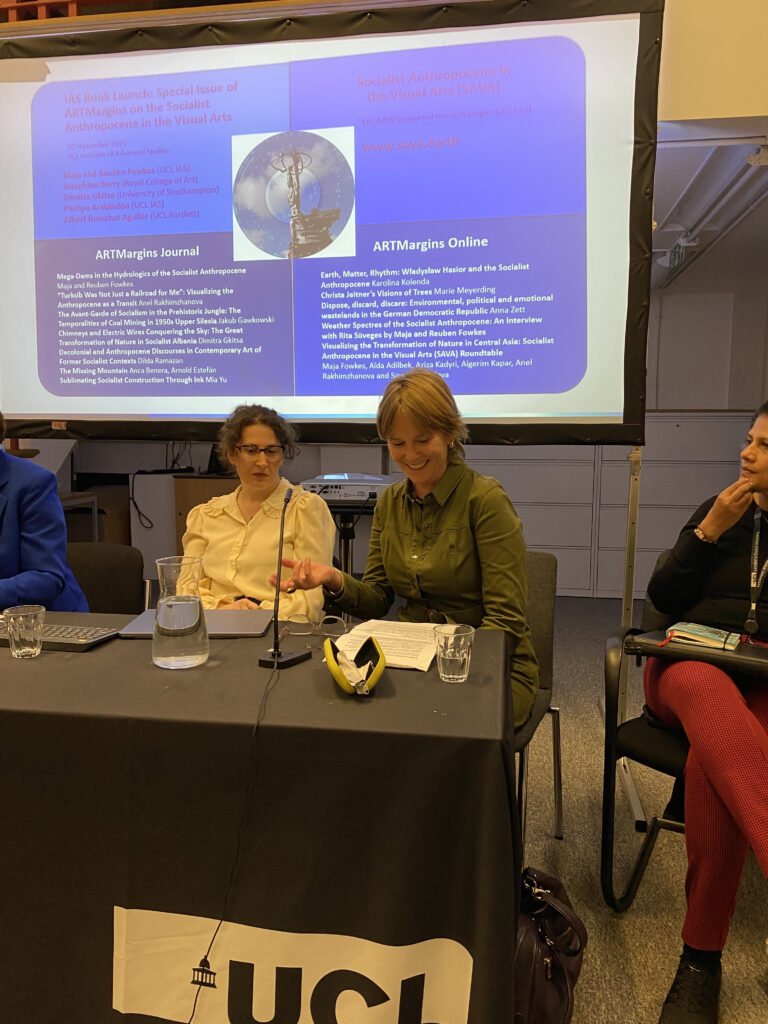
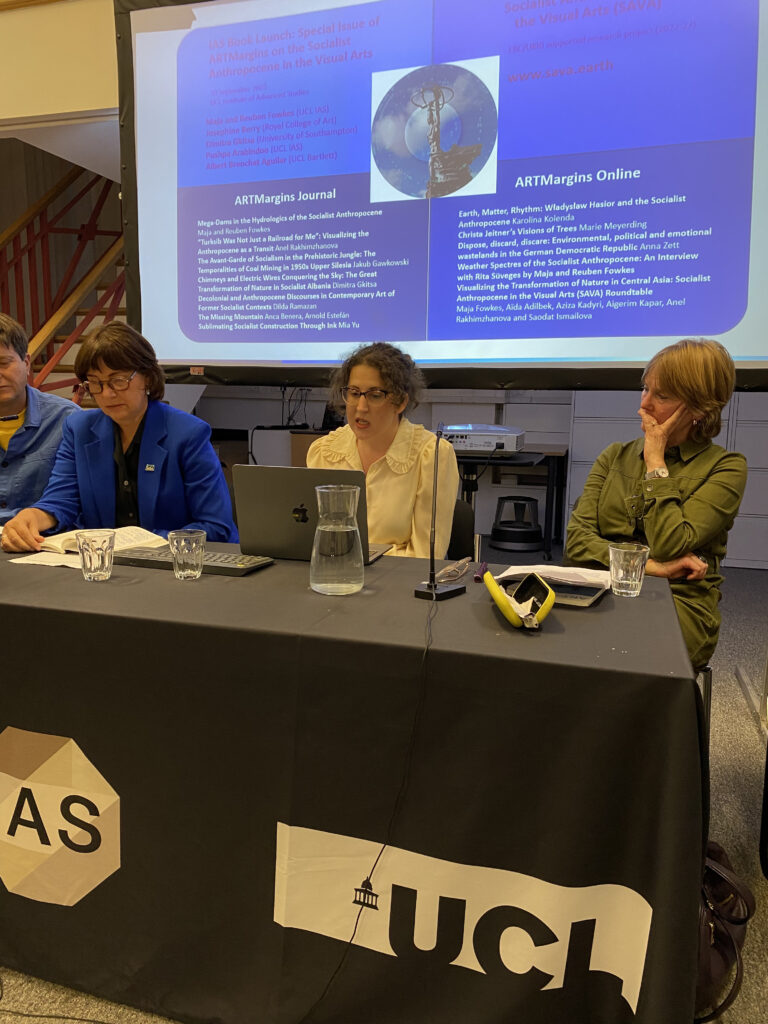
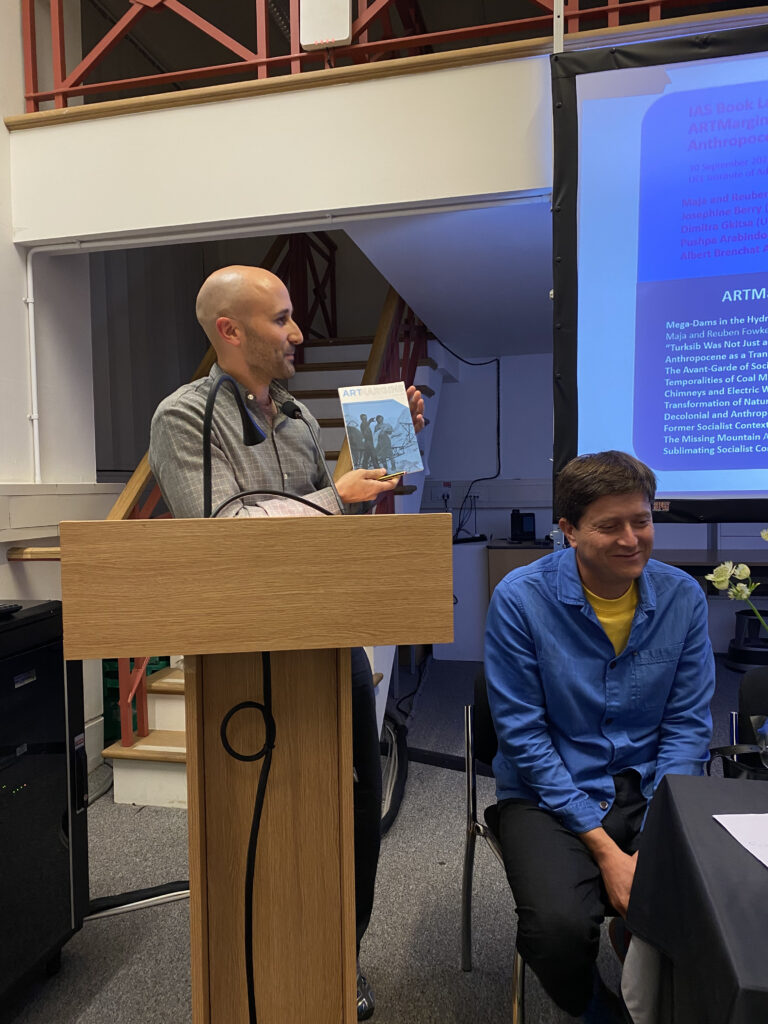
Join editors Maja and Reuben Fowkes for a presentation of the special issue on the Socialist Anthropocene in the Visual Arts in ARTMargins. The evening will feature responses from Josephine Berry (Royal College of Art), Dimitra Gkitsa (University of Southampton) and Pushpa Arabindoo (UCL IAS). The conversation will be moderated by Albert Brenchat Aguilar (UCL Bartlett), with an opportunity for informal exchange.
Free ticket registration: here
About the special issue
This special issue spanning ARTMargins Online and ARTMargins Print Journal is the fruit of the ERC/UKRI supported research project on the Socialist Anthropocene in the Visual Arts (SAVA), led by Maja Fowkes at the IAS Postsocialist Art Centre since 2022. The assembled findings investigate the records of the transformation of nature in socialist art history by discussing artworks that disclose the environmental impacts of the system’s extractivist, infrastructural, and terraforming interventions in the natural world. They also locate within socialist-era art practices the voicing of an ecological critique of the irredeemable costs of such progress-oriented development.
The contributions of contemporary artists finetune the optics for apprehending these exorbitant histories to reveal their multiscalar, transtemporal, geoengineered, and beyond-human dimensions that still shape the environment today. Across scholarly articles, artistic projects, a review, interview, commentary and roundtable, the contributors to this special issue are: Aïda Adilbek, Anca Benera and Arnold Estefán, Maja and Reuben Fowkes, Jakub Gawkowski, Dimitra Gkitsa, Saodat Ismailova, Aziza Kadyri, Aigerim Kapar, Karolina Kolenda, Marie Meyerding, Anel Rakhimzhanova, Dilda Ramazan, Rita Süveges, Mia Yu and Anna Zett. For access to the online materials and links to the contents of the print journal, see: https://artmargins.com/
Socialist Anthropocene in the Visual Arts (SAVA)
SAVA is a visual arts led interdisciplinary research project that challenges the West-centric discourses of the Anthropocene by asserting the constitutive role of the environmental histories of Socialism in the formation of the new geological age. Led by Dr. Maja Fowkes at UCL Institute of Advanced Studies, the project was selected for a Consolidator Grant by the European Research Council (ERC) and is funded by UK Research and Innovation (UKRI). www.sava.earth
ARTMargins
ARTMargins Print is a peer-reviewed tri-quarterly journal published by the MIT Press that publishes material related to the histories of 20th-century and contemporary art, art theory, art institutions, and curatorship. It places special emphasis on marginal histories and innovative critical and methodological perspectives. ARTMargins Online (AMO) publishes interviews, essays, reviews, and podcasts that analyze postwar and contemporary art of East-Central Europe in a global setting.
Speaker biographies
Drs Maja and Reuben Fowkes are art historians, curators and directors of the Postsocialist Art Centre (PACT) at the Institute of Advanced Studies, University College London. They work on the twentieth-century art history of socialism from Eastern Europe to Central Asia and contemporary artistic engagements with ecology, climate and the Anthropocene. Their publications include Art and Climate Change (Thames & Hudson, 2022), Central and East European Art Since 1950 (Thames & Hudson, 2020), a special issue of Third Text guest-edited by Reuben on the “Actually Existing Artworlds of Socialism” (2018) and Maja’s monograph The Green Bloc: Neo-avant-garde Art and Ecology under Socialism (CEU Press, 2015). Maja is Principal Investigator of the European Research Council (ERC) and UK Research and Innovation (UKRI) Consolidator Grant project on the Socialist Anthropocene in the Visual Arts (SAVA) (2022-27). Their teaching at UCL History of Art includes modules on Art History for a Climate Emergency and Contemporary Art and Climate Change, and they also contribute to an interdisciplinary module on Anthropocene Studies. Their curated exhibitions include “Colliding Epistemes” at Bozar Brussels (2022) and “Potential Agrarianisms” at Kunsthalle Bratislava (2021), and they led the Getty Foundation project Confrontations: Sessions in East European Art History (2018-22). They publish extensively in peer-reviewed journals, edited books, exhibition catalogues and on contemporary art platforms including Art Monthly, Texte zur Kunst and Springerin, and they co-host the SAVA podcast Left to be Desired.
Dr Albert Brenchat Aguilar is a Lecturer and the co-Director of Public Programme at the Bartlett School of Architecture, UCL. He has edited As Hardly Found: Art and Tropical architecture (Architectural Association Publications, 2025) and co-edited Wastiary: A bestiary of waste (UCL Press, 2023). He has published ‘Brutish Brutalism: Archaeology, anthropology, and architecture in the 2024 British Museum competition’ (arq: Architecture Research Quarlerly, 2025), ‘Funcitonal Environs: Austin Tetteh’s Situated World(mak)ing Planning Practice’ (Architecture Theory Review, 2023) and ‘A Burst of Architectural Plots: The diverging lives of Whipsnade Bungalows’ (Architecture&Culture, 2022) as well as in publications for the general public such as Scottish Left Review.
Dr Pushpa Arabindoo is an Associate Professor in Geography & Urban Design at UCL Department of Geography. She trained in architecture and urban design before completing her PhD in Planning from the London School of Economics which paved the way for an inter-disciplinary approach to addressing urban challenges. She is the Deputy Director of UCL Institute of Advanced Studies and Co-Director of UCL Urban Laboratory where she leads the research priority theme of Wasteland. She is also the co-convenor of the MSc Urban Studies. As an academic-practitioner, she pays close attention to the multiple modes of knowledge production debunking the theory/practice binary. This has led to creative collaborations including a photographer and a playwright.
Dr Josephine Berry is an art theorist, writer and editor. She teaches on the Contemporary Art Practice MA and supervises practice-based and thesis-only PhDs in the School of Arts & Humanities. Josephine Berry has a background in aesthetic politics with a particular focus on the intersections between art, site and (bio)power. She has researched and written on art’s relationship to globalisation, digital networks, neoliberalism and climate crisis. She is currently focused on the relationship between art and strategies of degrowth. She was Editor of Mute magazine, a print and online forum for ‘cultural politics after the net’, from 2004–14 and co-director of the Post-Media Lab, Centre for Digital Culture, Leuphana University, Germany (2012–14). She teaches on the Digital Media MA at Goldsmiths, University of London and has taught courses in Visual Culture at Imperial College.
Dr Dimitra Gkitsa teaches at the Winchester School of Art at the University of Southampton. She works at the intersection of memory studies, affect, contemporary art, curatorial practices, and post-socialist visual cultures. Gkitsa was previously the Alexander Nash Research Fellow in Albanian Studies at the School of Slavonic and East European Studies, University College London (2021-23). Her articles have appeared in Performance Research, Creative Industries Journal, and the Art Studies Journal of the Centre for Art Studies at the Academy of Sciences of Albania.
Documentation