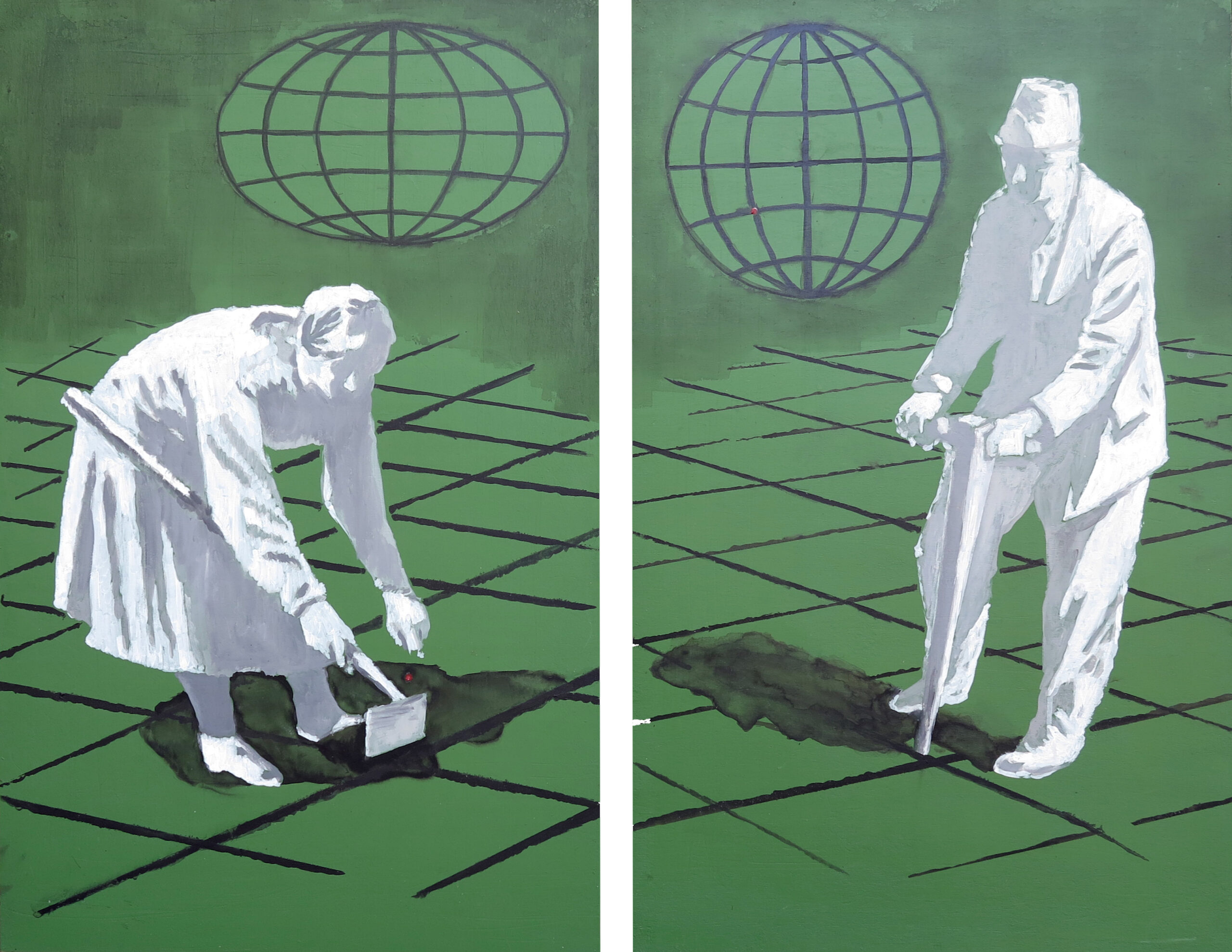
9.45 Registration
10.00 Introduction to the Socialist Anthropocene
Maja and Reuben Fowkes (SAVA UCL)
Chaired by Jan Burek (SAVA UCL)
10.20 Jakub Gawkowski (Central European University Vienna)
Temporalities of Coal Mining in 1950s Upper Silesia
10.50 Nikolay Erofeev (University of Kassel)
Extractive Assistance: Copper Mining, Socialist Development and Urban Planning in Cold-War Mongolia
11.20 Bogna Stefańska & Jakub Depczyński (Museum of Modern Art Warsaw)
Socialist Extractivist Pasts and Postanthropocene Futures in Poland: On Ecological Art and Postartistic Practices in Opolno-Zdrój
11.50 Hana Janečková (Academy of Fine Arts Prague)
Conservation, Care and Identification: Animal Extraction from Countries of Global South in Eva Koťátková’s The heart of a giraffe in captivity is twelve kilos lighter
12.20 Discussion
13.00 Lunch
Chaired by Reuben Fowkes (SAVA UCL)
14.00 Marija Drėmaitė (Vilnius University)
Dream Factories: Visualizing the High Industrial Period in the Baltic States
14.30 Victoria Donovan (University of St. Andrews)
Resisting ‘Resourcification’: Artist Engagement with Industrial Heritage as Resistance to Soviet and Russian (Re-)Colonial Epistemic Violence
15.00 Dimitra Gkitsa (Winchester School of Art)
Memory Matters: Revisiting Albania’s Post-Industrial landscapes and Wastelands
15.30 Discussion
16.00 Coffee break
Chaired by Maja Fowkes (SAVA UCL)
16.30 Andrija Filipović (Faculty of Media and Communication Belgrade)
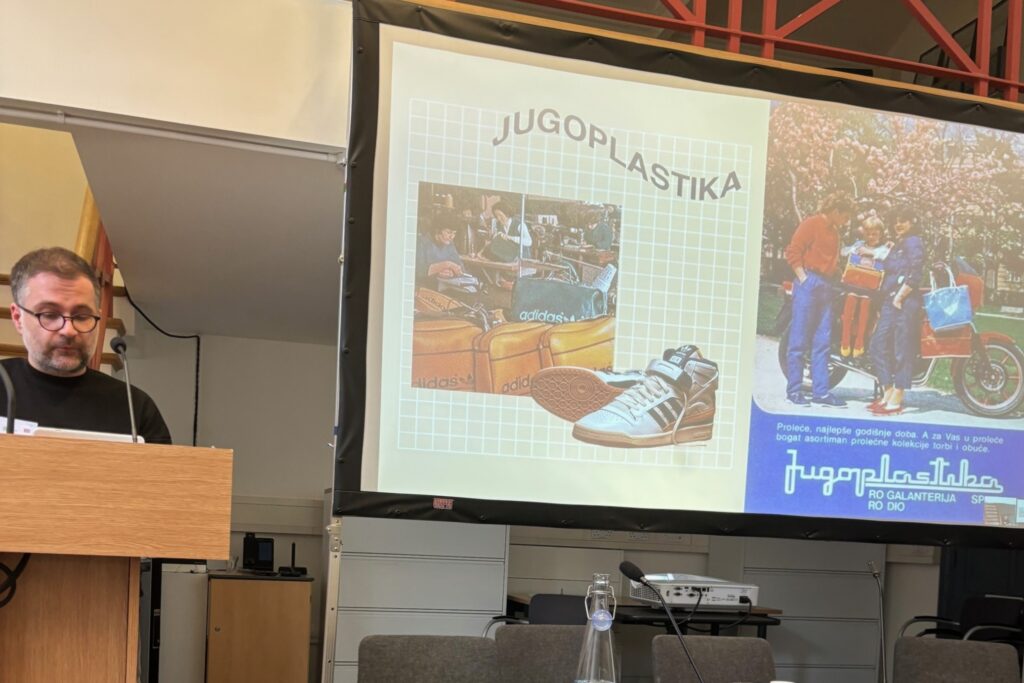
Yugoslav Petroaesthetics: On the (Non-)Use of Petrochemicals in Socialist Modernism and Neo-Avant-Garde Art
17.00 Inga Lace (Almaty Museum of Arts)
Evolving Attitudes: Industry, Technology and Nature in Soviet Latvian Artists’ Works
17.30 Anna Zett (Artist, Leipzig)
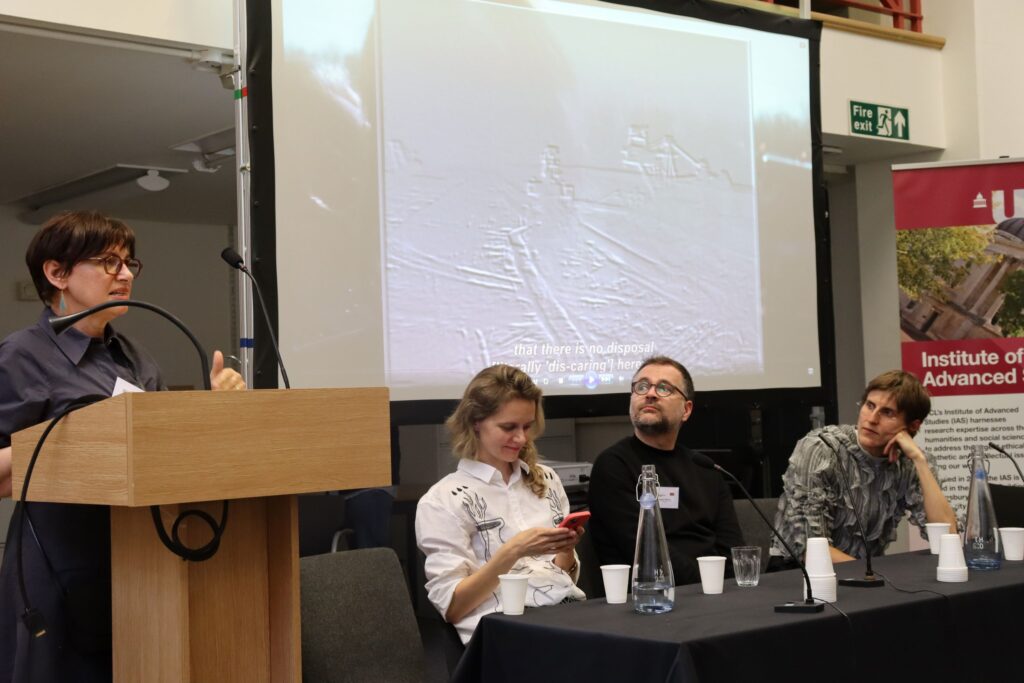
Dispose, Discard, Discare
18.00 Discussion
18.30 End
.
Chaired by Alex Petrusek (SAVA UCL)
10.00 Anel Rakhimzhanova (Performance Studies NYU)
Constructing TurkSib and Human (Im)mobilities: When a Transit Materializes in the Environment, Episteme and Method
10.30 Maja and Reuben Fowkes (SAVA UCL)
Mighty Dams in the Hydrologics of the Socialist Anthropocene
11.00 Sarah James (Liverpool School of Art and Design)
Radioactive Marxisms, Technocratic Dystopias & Socialist Ecofeminisms
11.30 Rita Süveges (Artist, Budapest)
Cloud Seeding – the Glare of the Silver Bullet
12.00 Discussion
12.40 Lunch
Chaired by Reuben Fowkes (SAVA UCL)
13.30 Agata Pietrasik (Freie Universität Berlin)
The Peasant Anthropocene: Images of Rural Life in SR
14.00 Rugilė Rožėnė (Vilnius University)
In Search of Authoritarian Landscape
14.30 Jérôme Bazin (Paris-Est Créteil)
Socialist Intensification as seen by Amateur Photographers
15.00 Discussion
15.30 Coffee break
Chaired by Maja Fowkes (SAVA UCL)
16.00 Karolina Kolenda (Institute of Art and Design Krakow)
Earth, Matter, Rhythm: Władysław Hasior and the Socialist Anthropocene
16.30 Marie Meyerding (Freie Universität Berlin)
Visions of Trees: Environmental Art and Surveillance in the Global GDR
17.00 Lenka Vráblíková (Goldsmiths University of London)
“The Czech Are Excellent Mushroom Hunters:” The Visual Politics of Fungi in (Post)Socialism
17.30 Discussion
18.00 A performative screening of fragments of Where Russia Ends (2024) and conversation with filmmaker Oleksiy Radynski and cultural researcher Philipp Goll.
19.00 Drinks
Jakub Gawkowski (CEU Vienna)
Temporalities of Coal Mining in 1950s Upper Silesia
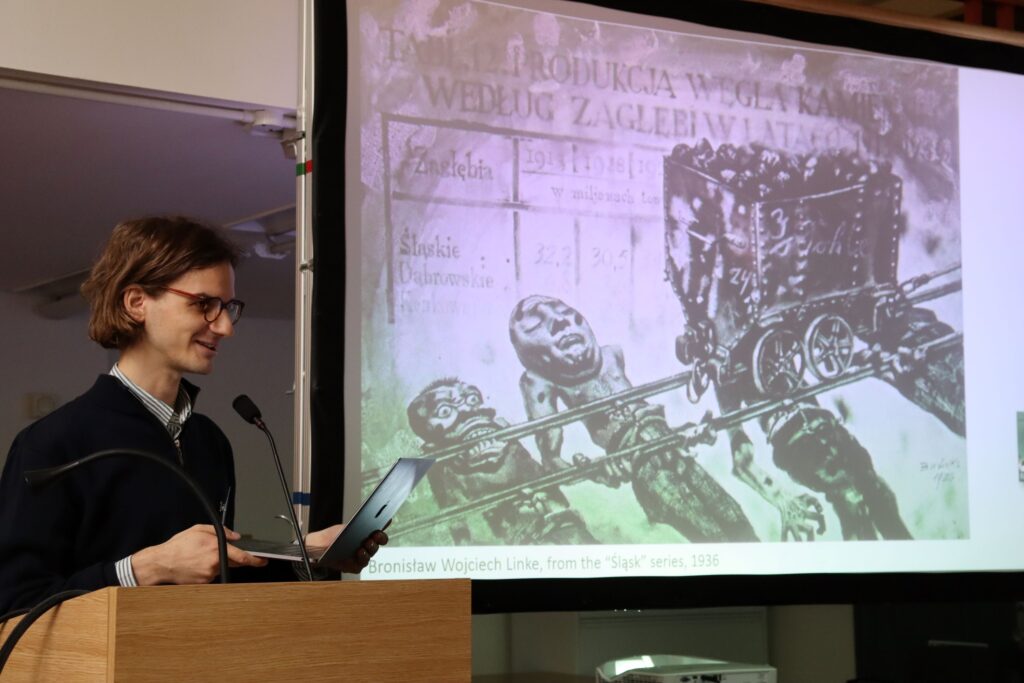
This presentation investigates artistic portrayals of coal mining in 1950s Polish Upper Silesia, examining the diverse temporal perspectives evoked by these visual representations. Despite the extractivist mining policies of Polish authorities during Stalinism, aimed at modernization through coal exploitation, mining emerges as a complex socio-cultural practice generating multiple, often conflicting temporal narratives. The study highlights regional artists’ practices to refine our understanding of their artistic and political positioning amidst individual, state, and environmental dynamics. Focusing on the period between 1953 and 1956 when Katowice was dubbed Stalinogród, and the subsequent artistic freedoms during de-Stalinization, it analyzes how socialist realist depictions of coal miners projected visions of collective emancipation and national prosperity. Contrasting these with the idiosyncratic approach of Grupa Janowska, a mining association of amateur painters inspired by occultism, the presentation centers on Teofil Ociepka’s work. Ociepka, an amateur self-taught artist and theosopher who mined at Giesche’s mine in Katowice, received official support while promoting unorthodox spiritual beliefs, blending the reality of Silesian miners with imagined flora and fauna representing not only pre-industrial, but pre-modern unity of nature and human being. Through this case-study, it elucidates the multiplicity of temporalities entwined with extractive industries, where past, present, and future narratives intersect.
Nikolay Erofeev (University of Kassel)
Extractive Assistance: Copper Mining, Socialist Development and Urban Planning in Cold-War Mongolia
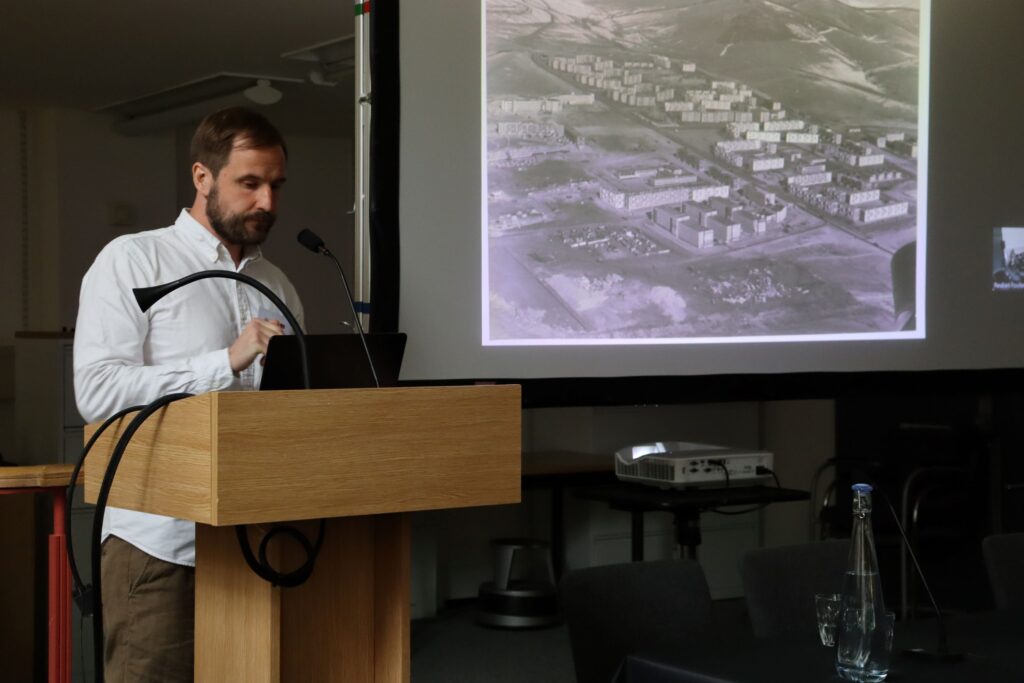
Extraction of natural resources was the foremost priority in the vision of Soviet industrialization. Development in remote regions, the establishment of new cities in the Far North and Central Asia aimed to explore resources in an economically viable manner. The international dimension of this endeavour is often overlooked. The burgeoning literature on ‘socialist globalisation’ discussed countless cases of material and immaterial encounters between actors from Eastern Europe and the Global South, often taking seriously claims of Soviet propaganda about anti-imperialists, “Friendship of People” and socialist solidarity. This paper, instead, proposes examining socialist development assistance through mineral resource extraction, revealing more pragmatic motives of East-South cooperation. Focusing on the case-study of Erdenet mining-processing plant, developed with the assistance of the Council for Mutual Economic Assistance, for the extraction of copper in 1976, this paper uncovers extensive extractive infrastructure in Mongolia – an expanding constellation of towns, storage and transportation centres, logistic and power infrastructure centred around the goal of extraction of copper. Erdenet, a multilateral project developed collaboratively by socialist countries, exposes grim motives beneath the claims about the international “Friendship of People”. Arguable, it was extraction that drove Soviet leaders’ ambition to integrate Eastern Europe with the Global South. While raw materials fell under Western embargo, the Soviet Bloc had to establish own markets for resources, exploiting former colonies in the Global South in the interests of the Soviet Union and Eastern European countries.
Bogna Stefańska & Jakub Depczyński (Museum of Modern Art Warsaw)
Socialist Extractivist Pasts and Postanthropocene Futures in Poland: On Ecological Art and Postartistic Practices in Opolno-Zdrój
In the paper we explore socialist extractivism in Poland and its long-lasting legacies and consequences, as they are experienced in a specific place: Opolno-Zdój, a former spa town located at the edge of the infamous “Turów” open-pit lignite mine and powerplant. Our investigation is guided by artists’ engagement with the town – the pioneering eco-art gathering “The Land of Zgorzelec: Science and Art in Defense of Natural Environment of Man” convened there in 1971 by leading Polish conceptual artists of the time, and contemporary transdisciplinary assemblies that take inspiration from the historical event to engage in current debates on climate crisis, Anthropocene and just transition. In the first part of the paper we explore the 1971 gathering, highlighting its participants critical approach to socialist extractivism and modernization paradigm. Instead of producing material artworks, they focused on discussion, exploration of landscape and using art to build relationships with the environment, raising issues such as overproduction, overconsumption and critique of development and technical advancement. In the second part we take a situated position and focus on assemblies that we have co-organized in Opolno-Zdrój since 2021. We show how contemporary artists and activist revisit the 1971 formula to demodernize it and work with the local community, that struggles with consequences of decades of extractivist slow violence. We ground our approach in the theories of postartistic practices and usology, mobilizing art to speculate, imagine and bring to life a vision of a better future for the town built on the ruins of the socialist Anthropocene.
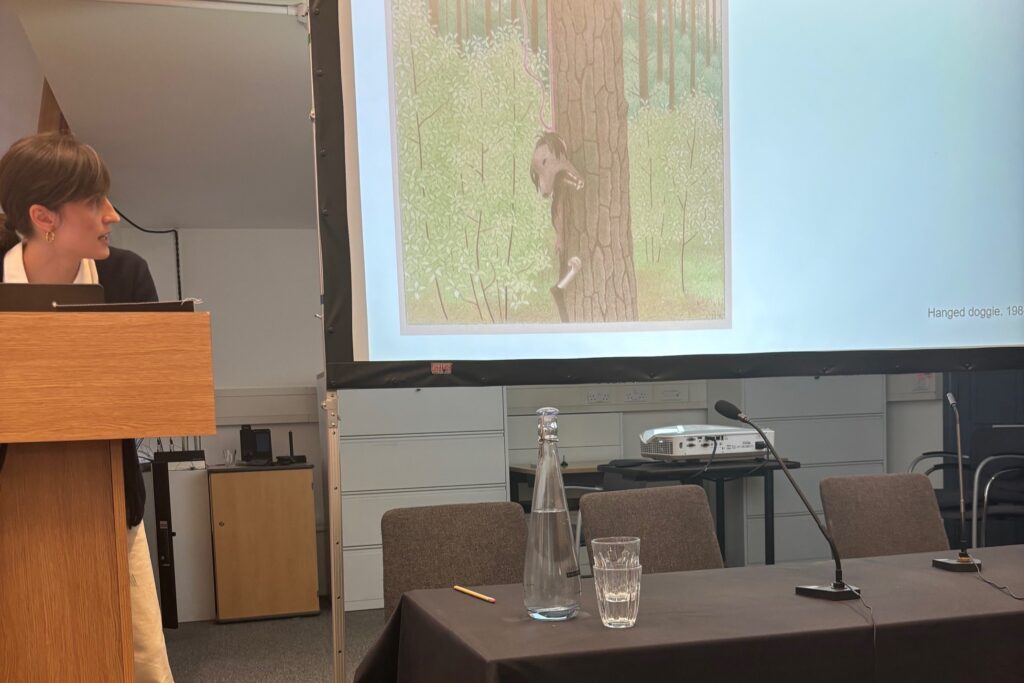
Hana Janečková (Academy of Fine Arts Prague)
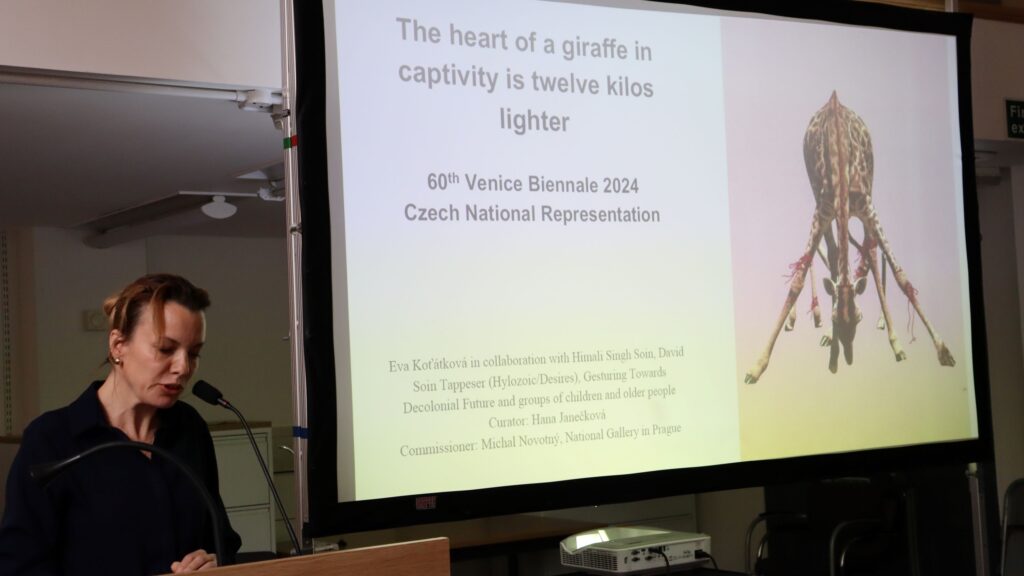
Conservation, Care and Identification: Animal Extraction from Countries of Global South in Eva Koťátková’s The heart of a giraffe in captivity is twelve kilos lighter
Lenka the giraffe was captured in Kenya in 1954 and transported to Prague Zoo to become the very first Czechoslovak giraffe. She survived only two years in captivity, after which her body was donated to the National Museum in Prague where it was exhibited until 2000. The paper will examine Lenka’s life and death – contextualizing it within the history of Czechoslovak of animal acquisition from the countries of the Global South – which is the subject of artist Eva Koťátková’s ongoing research towards her collaborative project for 60th Venice Biennale: The heart of a giraffe in captivity is twelve kilos lighter. Tracing records of an animal acquisition through historical material gathered from the archives of National Film Archive, National Museum and Prague Zoo, the paper will argue that while the desire to collect and own nature, animals and artefacts – even in the name of science – is an example of the violent subjugation of nature in colonial modernity, such an extraction of nature was unquestioned in the socialist policies and practices of animal acquisition. Using Andrew Baldwin’s concept of ‘anthropocene mobilities’, this paper will establish the complexities of socialism’s rejection and identification with the colonial project in East Africa by examining sources from socialist popular culture, and the practice and politics of scientific projects of animal conservation. It will discuss how and to what extent contemporary decolonial and ecological perspectives are articulated in Koťátková’s work with the visibility and erasure of such recent histories – especially the notion of how transformative pedagogy can play a part in reparation and restoration.
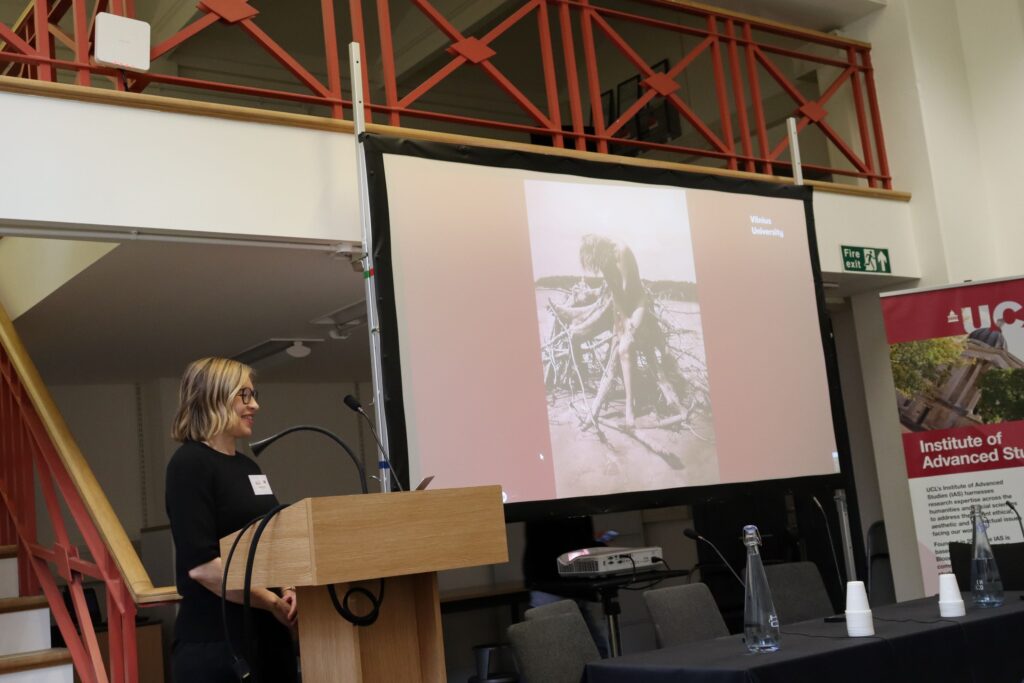
Marija Drėmaitė (Vilnius University)
Dream Factories: Visualizing the High Industrial Period in the Baltic States
The talk is based on a critical review of the exhibition Dream Factories? Industry and Modernism in the Nordic and Baltic countries 1945–1990 which was prepared by seven industrial heritage museums in the seven Baltic Sea countries (2007–2010). The aim behind the comparative analysis was the goals and representations of ‘high industrial period’ (concept by economic historian Maths Isacsson) in two different societal models, developed in the Nordic and Baltic countries after World War II: the Nordic social democratic welfare states (Norway, Denmark, Sweden and Finland), and the occupied Baltic Socialist Soviet Republics (Estonia, Latvia and Lithuania, commonly known as the Pribaltika region of the USSR). In spite of their ideological differences and national diversities, the countries on both sides of the Baltic Sea implemented radical industrialisation and modernization strategies. Despite the strikingly similar models and rhetoric concerning the discourse with industry as forming an ideal for the rest of society, discussion on differences (and how these can be traced) has become the main research question, especially defining the socialist industrialisation in the Baltic States.
Based on these findings the further critical analysis explores two cases – Elektrėnai (celebrated mono-industrial town of the power plant, 1960-1964) and Juknaičiai (an architectural award winning kolkhoz, 1964-1988) – and their visual representations in the context of the socialist Anthropocene.
Victoria Donovan (University of St. Andrews)
Resisting ‘Resourcification’: Artist Engagement with Industrial Heritage as Resistance to Soviet and Russian (Re-)Colonial Epistemic Violence
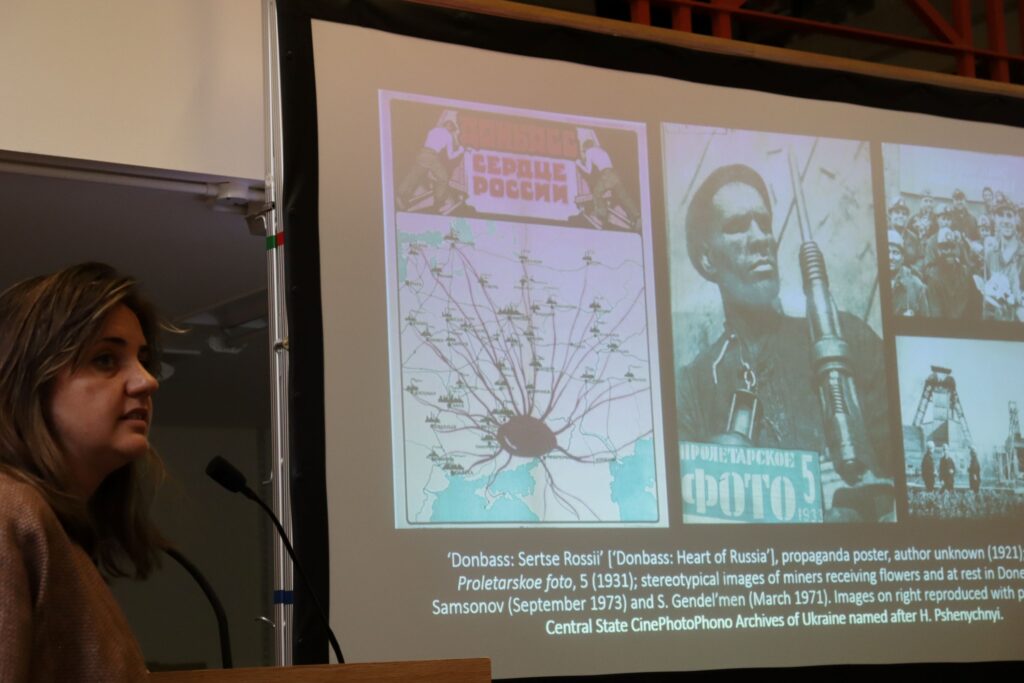
If as Achille Mbembe reminds us archives are infrastructures of colonial epistemic violence, Soviet industrial archives in Ukraine deal in specialist kinds of epistemic imperialism. Doubling as the dominant institutions of memory in many eastern Ukrainian ‘monotowns,’ industrial archives, and the celebratory words and images of extractivist practice they contain, manifest as the institutionalised and thus ‘authoritative’ meaning of these places. This epistemic reduction can be understood through what Asiya Bazdyrieva calls the ‘resourcification’ of Ukraine, its reduction in the economic and cultural imaginaries to a set of resources to be plundered and exchanged for profit. This ‘resourcifying’ logic continues to power Russia’s war against Ukraine today. The looting and destruction of archives, libraries, and museums is part of Russia’s continuing campaign to control Ukraine’s epistemic infrastructures, asserting hegemony over the meaning of its cultural space and environments.
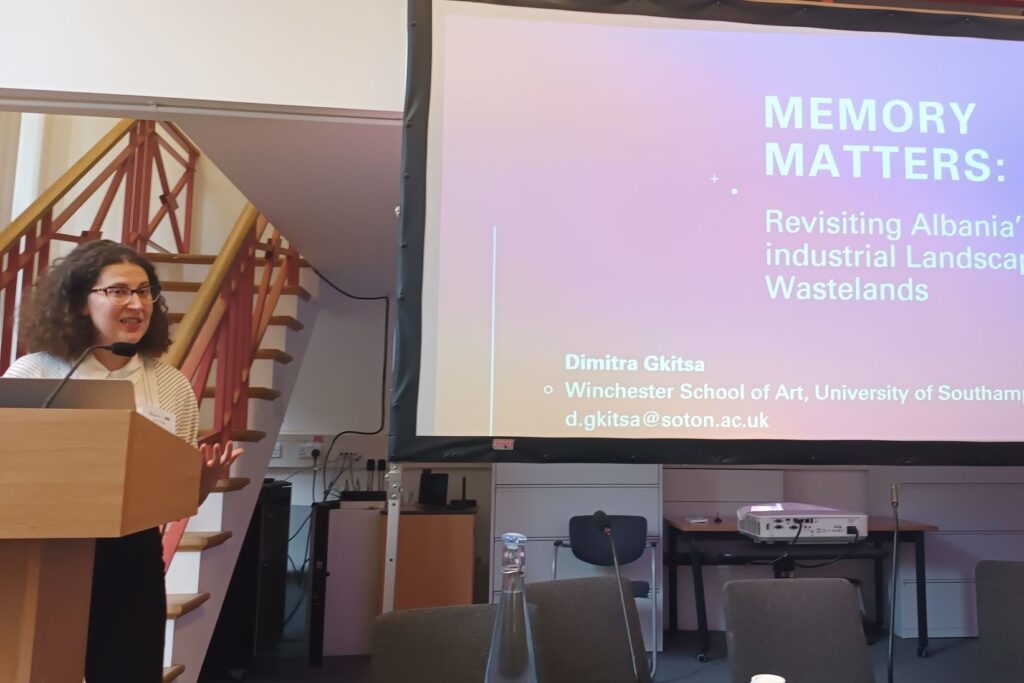
Dimitra Gkitsa (Winchester School of Art)
Memory Matters: Revisiting Albania’s Post-Industrial landscapes and Wastelands
During the socialist regime Albania experienced a period of intense industrialisation. Large industrial complexes were built on the outskirts of every major city. The north became a mining site for extracting ferro-chrome and in the south large wastelands were turned into farming. With transition former industrial giants were abandoned. The same state of emptiness is also present in rural towns that once were inhabited by factory workers and miners. In addition to bearing witness to the socio-political transformations that occurred during the transition from state socialism to neoliberal democracy, such as migration, working conditions and welfare rights, post-socialist wastelands contain also matters that are pertinent to the present and the present that is yet to come. How are we to approach post-socialist post-industrial wastelands in the present? What other alternative possible presents and futures can we re-imagine for abandoned ruined infrastructure? And more crucially, why does such an engagement with the past matter for the present? Focusing on case-studies from the socialist and post-socialist countryside of Albania, the paper proposes a different understanding of post-industrial infrastructure. Rather than belonging to a long gone past, toxic or contaminated wastelands are still matters of the present. In so doing, the paper analyses extractivist and mining infrastructure in the town of Bulqize as well as the largest industrial sites in the country, the Metallurgical Complex in Elbasan. The paper juxtaposes the socialist visual cultures produced around these sites as well as the ways in which contemporary artists re-visit such abandoned sites, re-engaging with their materiality and stories. Theoretically, the paper draws inspiration from Karen Barad’s notion of “spacetimemattering” to argue that ruined industrial infrastructures transgresses linear understandings of time and space. This becomes apparent considering the current precarity struggles for environmental justice in Albania. Engaging critically with the materiality of an inherited past is thus, an entanglement with all the “others” that are gone and those “others” that are yet to come.
Andrija Filipović (Faculty of Media and Communication Belgrade)
Yugoslav Petroaesthetics: On the (Non-)Use of Petrochemicals in Socialist Modernism and Neo-Avant-Garde Art
It did not take long after the Second World War for petrochemicals to be adopted and adapted for artistic use in Yugoslavia. Plastics were used as a material in neo-constructivism (Koloman Novak), while everyday plastic objects and styrofoam were used in signalism (Miroljub Todorović) and conceptual performance (Slavko Matković and others). Both approaches relied on what can be called the aestheticisation of petrochemicals – a set of practices that made the use of petrochemicals in the production of art not only possible but highly desirable for signifying progressiveness: in neo-constructivism, plastics pointed to the erasure of difference between art and science; in signalism, plastics became art through the reduction of linguistic signs; in conceptual performance, the use of petrochemicals disrupted the boundaries between life and art. Aestheticisation made petrochemicals an artistic medium at the same time when functionalisation made them the stuff of everyday life. There were also artistic practices that avoided the use of petrochemicals. The Clear Streams Family, a back-to-the-land artistic commune founded in 1977 near the village of Brezovica, insisted on using wood, stone and other naturally occurring materials. The aim of this paper, then, is to show how petromodern practices such as the fossil fuel extraction and the use of petrochemical products such as plastics and styrofoam came to be not only present but actively eschewed in Yugoslav art – how they formed what could be called a Yugoslav petroaesthetics through the functionalisation and aestheticisation of petrochemicals, and the resistance to these practices.
Inga Lace (Almaty Museum of Arts)
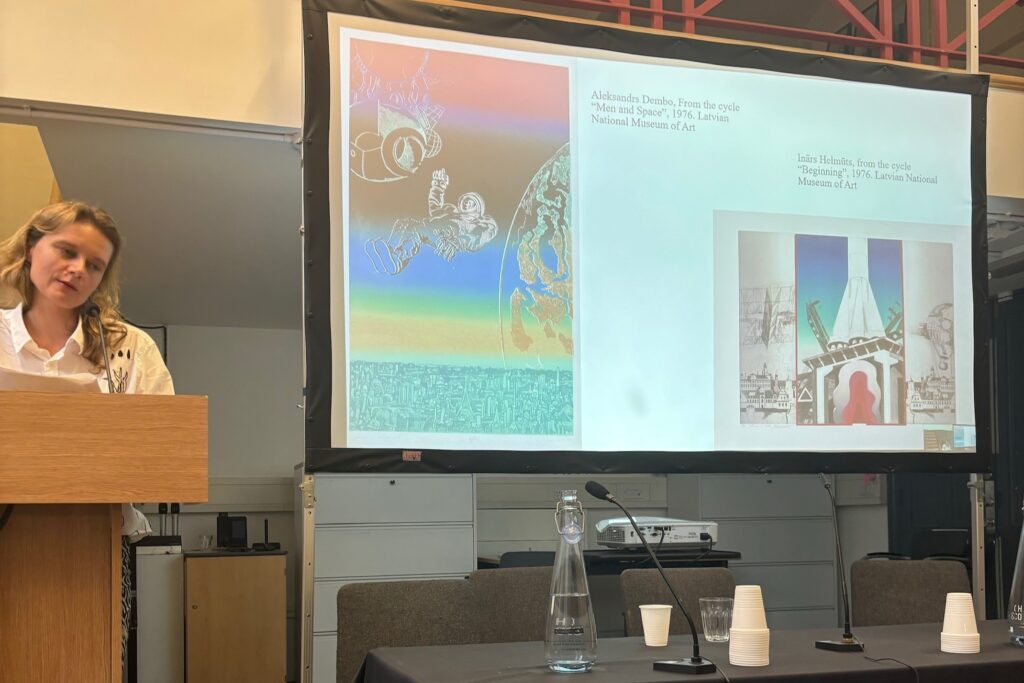
Evolving Attitudes: Industry, Technology and Nature in Soviet Latvian Artists’ Works
This paper will examine the work of Latvian artist Zenta Logina (1908-1983) and exhibition series “Science and Science Fiction”, tracing artists’ engagement with scientific research and industry, and evolving of eco-critical attitudes in their work. The starting point for the research is the graphic artists’ exhibition series “Science and Science Fiction” that ran from 1975 to 1982 in Riga. Alongside depictions of venues of science, industry, and technology, many of the works dealt with issues connected to environmental consequences created by technology and extractive attitude towards nature in the Soviet Union. Artists’ observations often came from actual connection to the industry, for example, prior to the exhibitions, in 1974, several graphic artists visited the reactor of the Nuclear Research Centre in Salaspils, Latvia. Moreover, Inārs Helmūts and Aleksandrs Dembo had gone to Senezh, the so-called ‘City of Stars’, Russia, where would spend a week meeting cosmonauts and visiting spaceships; and Artūrs Ņikitins’ cycle “Olaines biochemical factory Biolar” is an example of engagement with chemical industry. In the meantime, the work of artist Zenta Logina also deals with science, nature, and cosmos, however, with a seemingly different attitude. Her three-dimensional paintings and textile work embody a close link with ecology but does so in a much less programmatic manner. In her work, anxiety about the Earth, the planet and our shared future resounds on a larger, planetary scale. What does rereading of those works from an eco-critical perspective reveal about the environmental histories of Latvia within the Soviet Union?
Anna Zett (Artist, Leipzig)
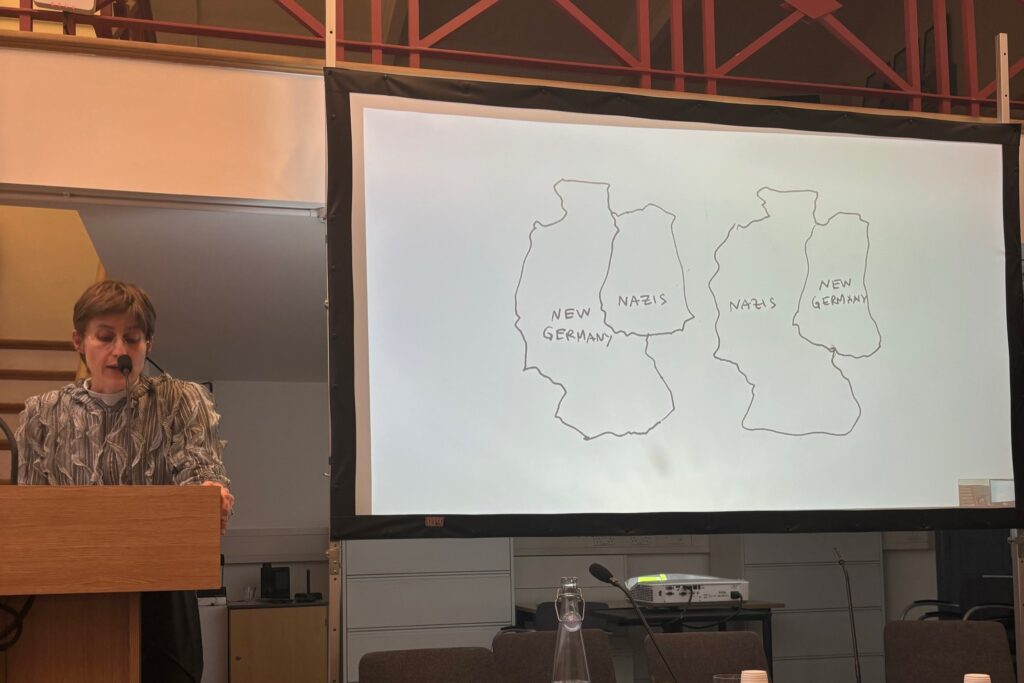
Dispose, Discard, Discare
In an everyday sense, disposal means throwing something away for good, that is to say, removing it from one’s personal realm of care or responsibility. This often involves drawing a boundary between inside and outside, private and public, object and abject, I and other, utopia and dump. During industrialization, privatization, and the development of global capitalism, the leftovers of extraction, production and consumption – worthless things and poisonous materials – ended up within the state’s realm of responsibility. I would argue that the way a state handles this unpopular, yet major public task, is indicative of its economic, ecological and political entanglements, and exposes the way this state tries to control its other problems, both internal and international. My case study for this research-based story is the GDR, a socialist state constructed within the ruins of Nazism and WW II, became a productivist utopia, turned into a material and emotional wasteland, until it was itself discarded in 1990. This story comes out of an artistic research at the GDR Opposition Archive in Berlin, where I looked into the East German environmental movement, encountered the West-East-garbage trade run by Stasi (the secret service), and began to disentangle the many symbolic, political and relational layers of this charged and discharged history. Based on published texts and video works, this lecture performs an analytical and associative act of care, proposing to look at waste as a political unconscious that overwhelmed the socialist state called German Democratic Republic.
Anel Rakhimzhanova (Performance Studies NYU)
Constructing TurkSib and Human (Im)mobilities: When a Transit Materializes in the Environment, Episteme and Method
The transformation of Turkestan and Hungry Steppe into a cotton colony during Tsarist and Soviet rule left a lasting imprint on the region’s topography, embedding its manufacturing logistics into railway projects. Both systems of power envisioned their mission civilisatrice in the region in making arid steppes and desserts bloom by transferring the flows of rivers and its “unpredictable and uncontrollable inhabitants” to which they attributed the fickle nature of Central Asian water. Railway tracks mark not only the vectors between the hydraulic and agricultural projects, some turned into contemporary ecological disasters, but also trace the routes of mass displacements, the sedentarization of nomadic populations, and labor migration in the topographic imagination of Central Asian modernities. This paper delves into the process and context of the Turkistan-Siberian Railroad (TurkSib) construction that encapsulated both the tangible and symbolic subjugation of Nature and the “backward” nature of its habitats in the forging of the socialist path. Apart from the collectivization policies, the scientific abstraction of the environment dominated discussions on the efficiency of pastoralist nomadism in the engineered future of blossoming steppes and deserts. The TurkSib, however, didn’t directly “make the desert bloom” or “nomads settle to the tracks of modernity”, it simply provided an acceleration to those transit initiatives both in imagination, industrial and agricultural plannings that were reflected in the human (im)mobility policies. Drawing on archival sources, visual culture studies, and ethnography of human geography along the railways, I propose to unravel the complex interplay between infrastructure development, environmental change, and precarious human mobilities in the shaping of the Socialist Anthropocenes in Central Asia.
Maja and Reuben Fowkes (SAVA UCL)
Mighty Dams in the Hydrologics of the Socialist Anthropocene
The hydraulic infrastructures of state socialism cannot be disentangled from the interwoven ecological, economic, social, political, colonial, embodied, experiential and more-than-human repercussions of the developmental histories they epitomize, and as such they continue to configure the geo-eco-political crises of today. The mighty dams of socialism were not just barriers to water flow, but sites of energy extraction, engines of industry, deliverers of agricultural intensification and enablers of urbanization, as well as sites of trauma and extinctions of species, places and biocultural diversity, weapons of mass destruction and exacerbators of climate breakdown. They are also retainers of aqueous pasts, sites of forgetting and erasure, markers of resistance, generators of solidarities and partakers in cosmological shift. Countering the unitary narrative of the construction of mega-dams as conduits of the socialist ideology of mastery over the Earth, as inscribed in the terraforming blueprint of the Stalin Plan for the Great Transformation of Nature, we draw on environmental art history to illuminate the manifold submersions, reroutings and corrosions of socialist hydrologics. How were water management processes disclosed in commissioned artworks and what was obfuscated in representations of hydropower? How were social and ecological anxieties contained in dam portrayals and in what sense did they anticipate coming catastrophes? What tactics have artists employed to trace the mnemonic properties of waterways, resurfacing strategic amnesias, engendering more-than-human consciousness and disrupting the unitary temporalities of socialist developmentalism? To what extent did socialist histories of hydroforming enter into relation with the economic afterlives of socialism and are they still harbingers of worlds to come?
Sarah James (Liverpool School of Art and Design)
Radioactive Marxisms, Technocratic Dystopias & Socialist Ecofeminisms
Within the Marxist cultural worlds of the GDR it is possible to chart an unexpected and counter-intuitive coming together of historical materialist futurist utopias, countercultural artistic experimentation and eco-feminist critiques – orbiting around the dreams, nightmares and fall-out produced by atomic radiation and nuclear energy. During the Cold War the GDR became the third largest uranium producer in the world, and the largest producer of uranium in the former Eastern Bloc countries under the influence of the USSR. The race for nuclear energy and nuclear weapons animated the ideological battles and geopolitical relations of the cold war, but radiation as a nuclear concept and its new atomic aesthetics also had an afterlife in East Germany’s cultural worlds – where the geopolitical developments and catastrophes of the nuclear industries were materialised and the epistemic, aesthetic and environmental ruptures they embodied for socialist modernity, Marxism, human-nature relations and ecological activism were interrogated and reimagined in philosophy, literature, theatre and visual culture. This paper will examine how nuclear energy was grappled with from Bertolt Brecht’s rewriting of his Galileo – retooled in the aftermath of Hiroshima; Ernst Bloch’s messianic Marxism and its atypical failure to see through the ideology of the ‘peaceful atom’; Carlfriedrich Claus’s poetics of radiation; Christa Wolf’s radical refiguring of the pastoral and romantic in light of Chernobyl; and Ruth Wolf-Rehfeldt’s global activist anti-nuclear mail art. It will also consider the uncanny cultural sites and visual economies of atomic research centres and uranium mines, as in Dresden’s Rossendorfer Reactor – which became the unexpected home to subcultural experimental artistic happenings – or the vast art collection commissioned by the secretive uranium mining company Wismut as part of its production of a cultural world, including schools, cinemas, leisure and cultural centres amounting to a ‘state within a state’ designed to contain its employees and compensate them for the dangerous and radioactive work.
Rita Süveges (Artist, Budapest)
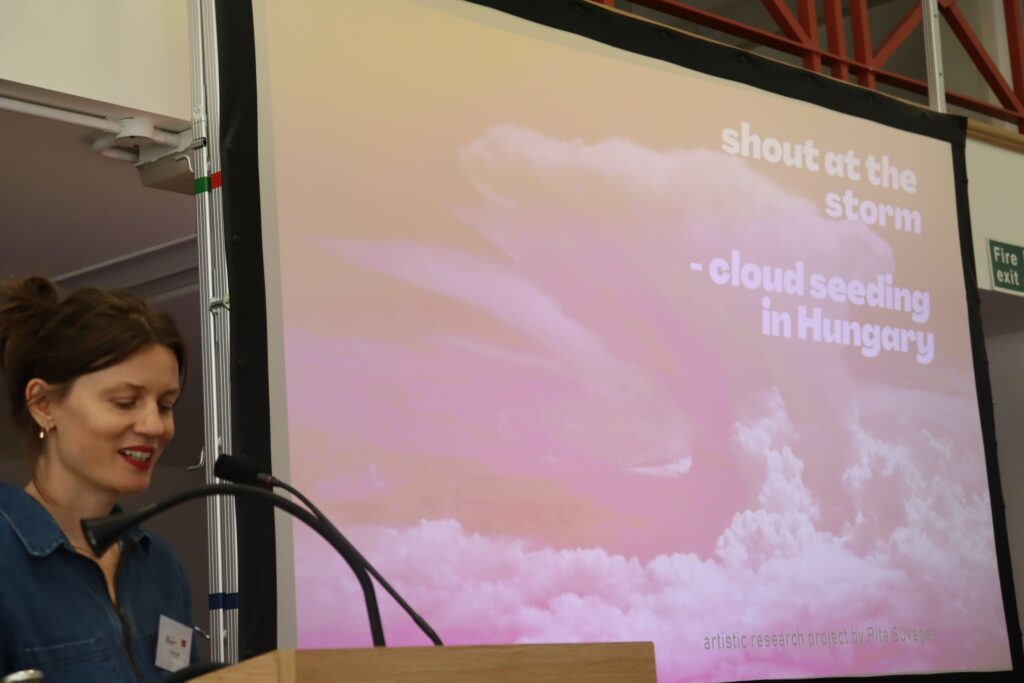
Cloud Seeding – the Glare of the Silver Bullet
The Hungarian animation series Mézga family introduced the fantastic Meteoromutomotor device to modify the bad weather they faced at a holiday, already in 1969. It reflected public sentiment, since national cloud seeding experiments started in the 1960’s. All in accordance to the postwar Soviet Union, that found new interests in weather and climate modification in the context of Cold War tensions, domestic needs in agriculture, and the ill-fated Stalin Plan for the Great Transformation of Nature. To solve the unintended consequences of human development technologically today – geoengineering is legitimized as a reactive risk-reduction fix. Yet its precursors were rather proactive attempts, such as regional weather modification techniques protecting crops. From folk and religious histories of storm demons to witches’ rituals, rainmakers and church bell ringing, science appropriated the initiative to control weather, and by now, reframed it as the silver bullet for the environmental crisis, the spoiled climate. The Hungarian Chamber of Agriculture is applying a countrywide cloud-seeding hail resistance system operating land devices in a 10 km grid. The hail cannons of the early 20th century were quasi-scientific scams. Nonetheless today’s cloud seeding proves questionable despite its highly materialistic methods: silver iodide reagent must be spread into cloud formations either through acetone evaporation or aircrafts. This paper sets out to analyze – through the artistic research on cloud seeding – how Stalinistic science took over the project of mastering nature from magic, focusing on cultural artefacts and ethnographic connections, in addition speculating on past and possible new environmental imaginaries of the Post-Socialist Anthropocene.
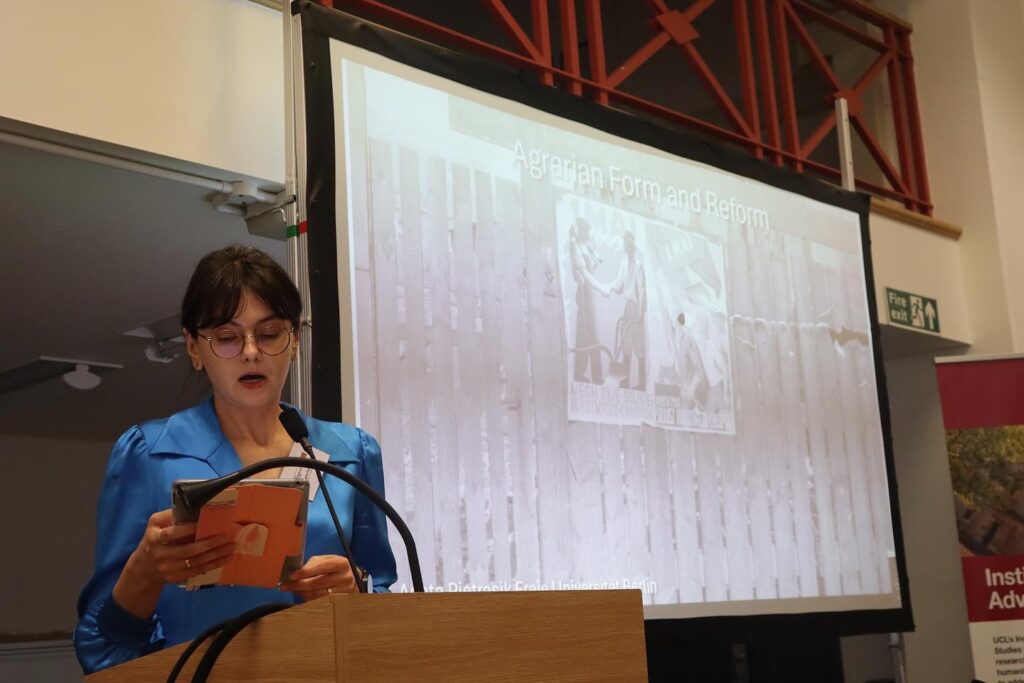
Agata Pietrasik (Freie Universität Berlin)
The Peasant Anthropocene: Images of Rural Life in SR
The beginning of communist rule in Poland after the Second World War was shaped by an unstable socio-political situation. The newly formed authorities, not wanting to rely solely on the Soviet Union to legitimise their rule, tried to inscribe the international postulates of Communism into local specificities. What distinguished Poland, especially from the industrial societies of Western Europe, was the fact that the social class that was to become the subject of the communist emancipatory struggle had to include not only the relatively small working class, but above all the peasantry. The late 1940s and 50s marked the beginning of radical changes in the countryside, such as increased educational efforts and the propagation of culture on a mass scale (traveling cinema and exhibitions). The subject of my paper will be the analysis of visual representations of these changes in socialist realist painting and photography in Poland. A task made all the more difficult by the fact that while the ethos of working class had a preexisting, leftist iconography, images of peasant life were closely associated with pastoral painting. In discussing the ways in which modernisation was represented in the countryside, I will not only focus on politicised images of the countryside that were important at the time, such as the painting “Our Land” by Andrzej Strumiłło. I will also explore the agency of rural artists, such as Felicja Curyło, who leveraged her artistic practice to expedite the electrification of her home village.
Rugilė Rožėnė (Vilnius University)
In Search of Authoritarian Landscape
In contemporary landscape studies, the prevailing interpretation of the modern human attitude towards nature as a mere resource proves inadequate when confronted with the legacy of socialist regimes. Grounded in materialist philosophy, communist ideology not only disregarded accountability toward nature but also toward human beings. Therefore, to achieve a deeper understanding of the processes of landscape changes that took place in Lithuania under Soviet occupation and their outcomes, the analysis of collective experiences and perceptions becomes crucial. Balancing between macro and micro scales, separate case studies importantly contribute to the concept of authoritarian landscapes. In this context, the life and work of self-educated artist Lidija Meskaityte (1926-1993) emerge. Due to childhood injuries, L. Meskaityte had difficulties moving and spent her entire life at her parents’ homestead in Smalininkai. In more than 700 miniature watercolors of her daily surroundings, she depicted the changes in the countryside caused by land amelioration, intensive agricultural activities, and even littering with great detail. However, in Soviet times, only a small group of idyllic scenes were presented to the broader audience, leaving the ideologically “uncomfortable” part of her creation, as well as complicated biographical moments, behind. L. Meskaityte’s story subtly uncovers the authoritarian nature of the socialist countryside modernization project, showing us a landscape in which the problematic aspects of its transformations, such as the impact on ecosystems, were neglected, the complexity of its experiences was suppressed, and representation – censored.
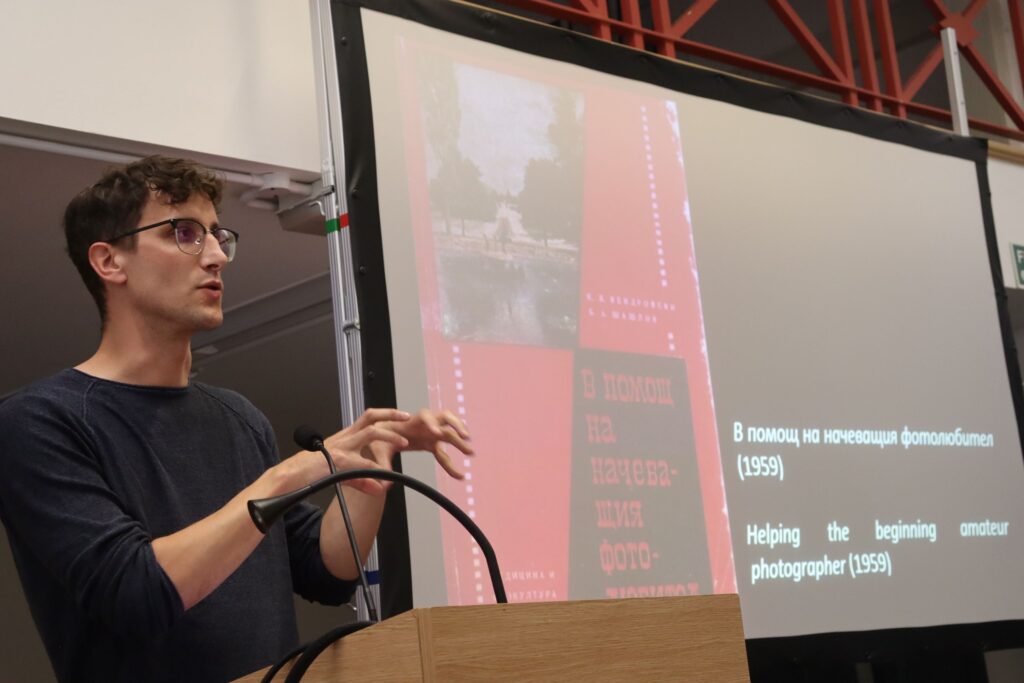
Jérôme Bazin (Paris-Est Créteil)
Socialist Intensification as seen by Amateur Photographers
In this talk, we will discuss a particular source: photographic albums preserved in regional archives in Bulgaria (we will present those from the Smolyan and Vratsa archives). The photographs were taken in the 1970s by local photographic clubs, to document life in the region, but also out of an interest in photographic art (it is part of the history of amateur clubs, lovers of photographic practice). In the albums, each page features between 10 and 20 small photographs, often resembling either a contact sheet or a page from a family album. Most of the images resemble those seen in the press at the time, created by the major national photographic agencies during the socialist era. But some of them intrigue and question.
We will focus on images that were simply captioned as “views” (изгледи), landscapes of the agricultural world. The photographers travelled through these two rural regions, each of which having particular characteristics (different topographies, different agricultural activities, different populations). The photographers were in a unique position, neither celebrating socialist productivism nor protesting against it from an ecological point of view. They saw agricultural transformation and its effects on nature, but also what did not change, agricultural intensification and its limits. We will situate this type of image in relation to other artistic creations in Bulgaria at the same time, realist works (for example the paintings of Kosta Leviev or Zlatyu Boyadjiev) and performances (for example those of Vesselin Dimov). Emphasis will be placed on the ambivalence of the discourse on the environment conveyed by this particularly rich visual material.
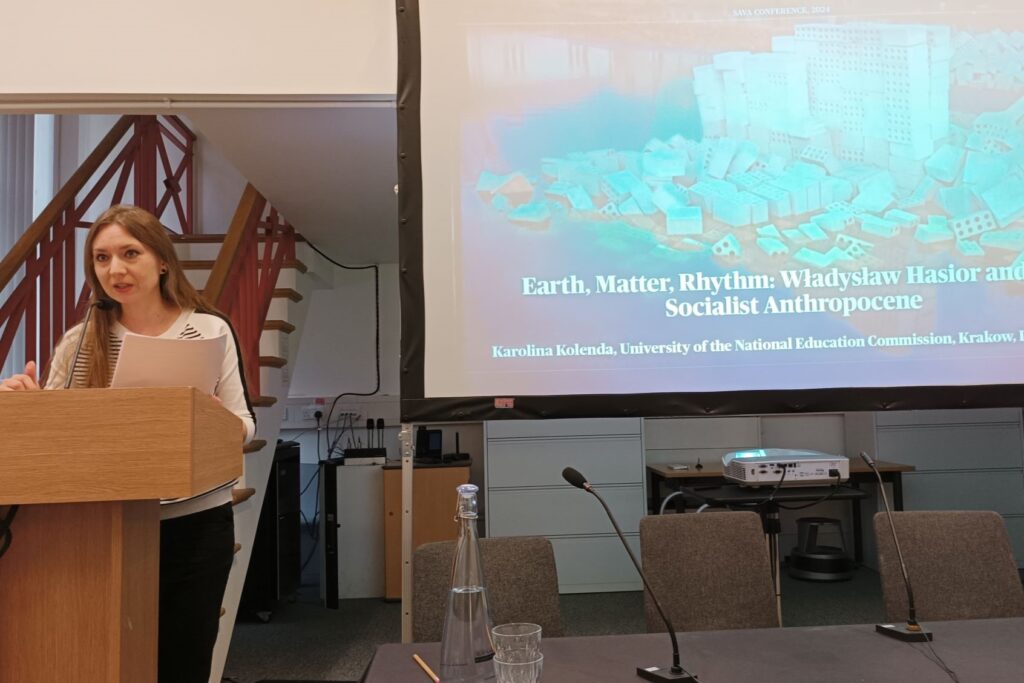
Karolina Kolenda (Institute of Art and Design Krakow)
Earth, Matter, Rhythm: Władysław Hasior and the Socialist Anthropocene
In Poland, the last decade has brought a growing number of art projects, exhibitions, as well as critical writing addressing climate change, anthropogenic transformation of nature, and the great acceleration. However, the art critical discourse embraces the West-centric narrative of the Anthropocene, while artistic practices discussed in the Anthropocene context are mostly by environmentally engaged artists working today. Although artists address environmental issues that are often local or region-specific (such as the Oder catastrophe, toxic waste in post-industrial and mining sites, the deteriorating condition of the Baltic Sea, etc.), the ideas that underpin their reflection are rarely rooted in the local or historical (Socialist) discourses around nature and environmentalism. On the other hand, the scholarship on the neo-avant-garde beginnings of environmental art in Poland is still in the early stages of development (with several promising studies underway). In this paper, I would like to focus on one of Poland’s seminal neo-avant-garde artists, Władysław Hasior, whose work has recently been studied in new contexts, while his practices reinterpreted as demonstrating a complex and often ambiguous relationship to nature, Socialist ideology, and the rural landscape. This was possible thanks to the publication of his vast photographic archive, produced over many decades and partly published in 1983 in the “Nowa Wieś” [The New Countryside] magazine as “Photo Notebook.” Focusing on several series of photographs from this archive and taking into consideration Hasior’s work with explicitly ecological message (“Ecological Alarm”, 1982), I will argue that the “Photo Notebook”, together with its attendant artist’s commentary, allows us to read his work as anticipating contemporary conceptions of nature (as natureculture), while his observations of the rural landscape as critical of its anthropogenic transformation during Socialism.
Marie Meyerding (Freie Universität Berlin)
Visions of Trees: Environmental Art and Surveillance in the Global GDR
Art in the late German Democratic Republic (GDR) was one of the central sites for addressing the increasingly pressing global environmental issues. The socialist government made every effort to conceal the consequences of large-scale environmental pollution. By 1981, 300,000 hectares of forest were damaged by pollution. The mass-reproduced images of Waldsterben (forest dieback) caused by acid rain demanded that the GDR take a stand on this environmental disaster. This was, however, met with a simple denial of the existence of Waldsterben in the GDR and a ban on the term as well as images of destroyed trees. In this presentation, I explore how women artists in the GDR of the 1980s dealt with this prohibition and brought lessons learned from Waldsterben to the centre of attention through their practice despite censorship and surveillance. I consider Ruth Wolf-Rehfeldt’s Mail Art, an artistic movement focused on sending smaller artworks internationally through the mail, and in particular her work Save Nature, which explicitly references this theme by depicting a protective hand from which small trees seem to grow. I further examine Christa-Maria Jeitner’s outdoor-hung textiles, delving into her time-intensive manual work with flax plant fibres, with a specific focus on her Macramés and their installation in trees. A study of Annemirl Bauer’s eco-feminist painted portraits with trees concludes the presentation. Through these three artists’ preoccupation with trees, I highlight the complex relationships between socialist governments and women artists dealing with local and global environmental issues in the global GDR through gendered political protests.
Lenka Vráblíková (Goldsmiths University of London)
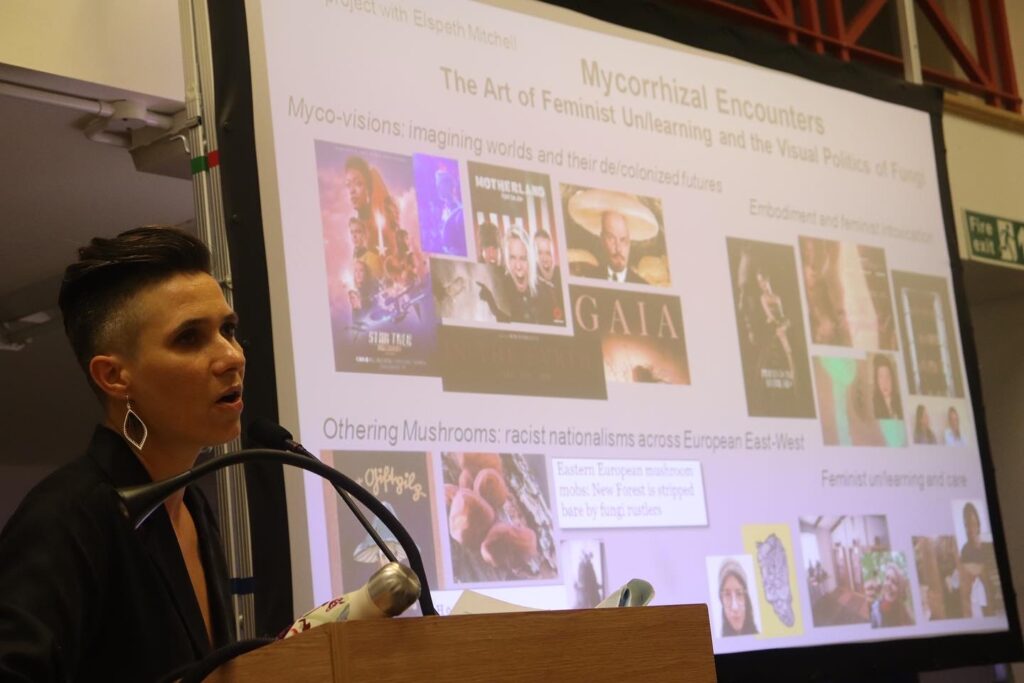
“The Czech Are Excellent Mushroom Hunters:” The Visual Politics of Fungi in (Post)Socialism
Mushroom foraging is a passion shared nationwide across all demographic and social groups of Czech society: over 70% of the population visit forests for mushroom foraging at least once a year, gathering almost 11kg of mushrooms per household. The paper explores how mushroom foraging as ‘nation’s precious hobby’ (Šiftová 2020) has figured in the negotiations of belonging in Czech (post)socialist cultural politics. The first part of the paper provides an analysis of the instrumental role mushrooms and their foragers have played in the articulation of Czech national identity and the country’s self-positioning within the broader frame of the current hegemonic geopolitics rooted in European colonialism. In the second part I close-read art works and other cultural practices that engage with fungi to envision new forms of belonging beyond the constraints of this hegemony, including art installation ‘Nothing Nowhere into Something Somewhere’ (Anetta Mona Chisa & Lucia Tkáčová, 2015) and poem ‘The Czech are Excellent Mushroom Hunters’ (Milan Kozelka, 2013).
The Other Side of the Pipeline
A performative screening of fragments of Where Russia Ends (2024) and conversation with filmmaker Oleksiy Radynski and cultural researcher Philipp Goll. Chaired by Tania Gómez (SAVA UCL).
Philipp Goll and Oleksiy Radynski will be in conversation around the film Where Russia Ends (2024) and discuss it in the context of ‘Leak. The End of the Pipeline’, a collaborative research project produced together with the artist Hito Steyerl at the Museum der Bildenden Künste Leipzig in April 2024. Taking up the development of the gas pipeline system between Siberia and (West) Germany since the 1970s, the exhibition consists of an installative video sculpture entitled Leak and the essay film Where Russia Ends, the contents of which intertwine and correlate. In their talk, they will reflect on the collaborative process during the making of Where Russia Ends, which departs from a question: ‘What’s happening on the other side of the pipeline?’
The film Where Russia Ends (2024) examines the often-overlooked history of colonialism and environmental destruction in the Russian-occupied territories of the indigenous peoples of Siberia. In 2022, previously unknown film footage was discovered in Kyiv Science Film Studios (Kyivnaukfilm). It documents numerous expeditions that a group of Ukrainian filmmakers undertook in the 1980s to various parts of Siberia and the Far North. This material forms the basis for the reconstruction of the erased history of the numerous imperialist wars that Russia waged against its later colonies. Where Russia Ends examines the manifold forms of complicity that played a role in this, shedding light on the ideology of exploitation and development of natural resources. The film is a collaboration between filmmaker Oleksiy Radynski and researcher Philipp Goll.
.
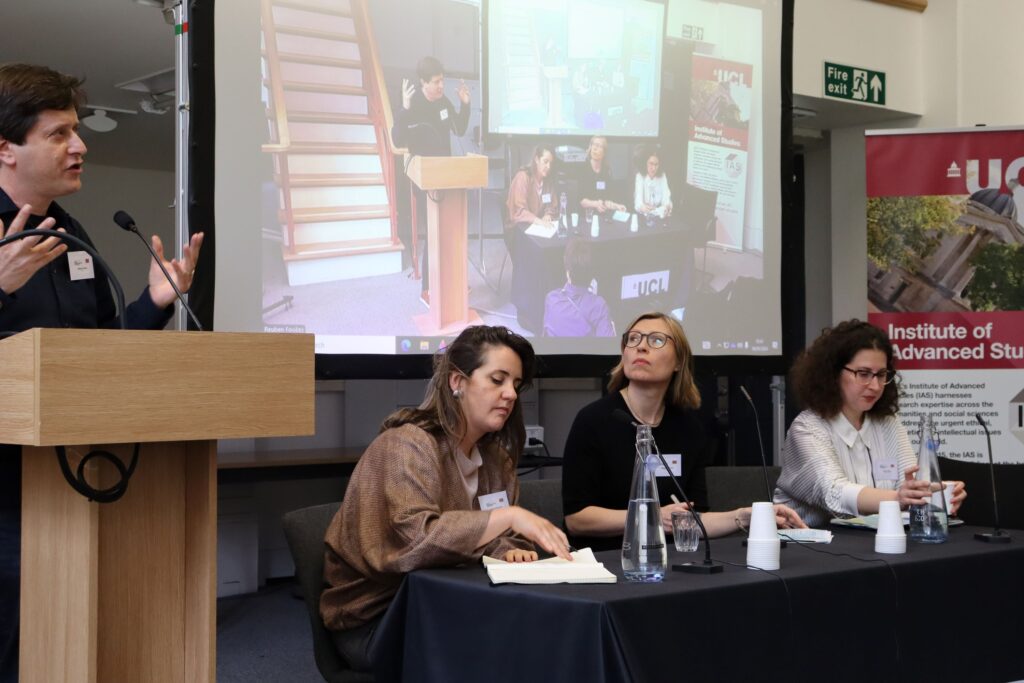
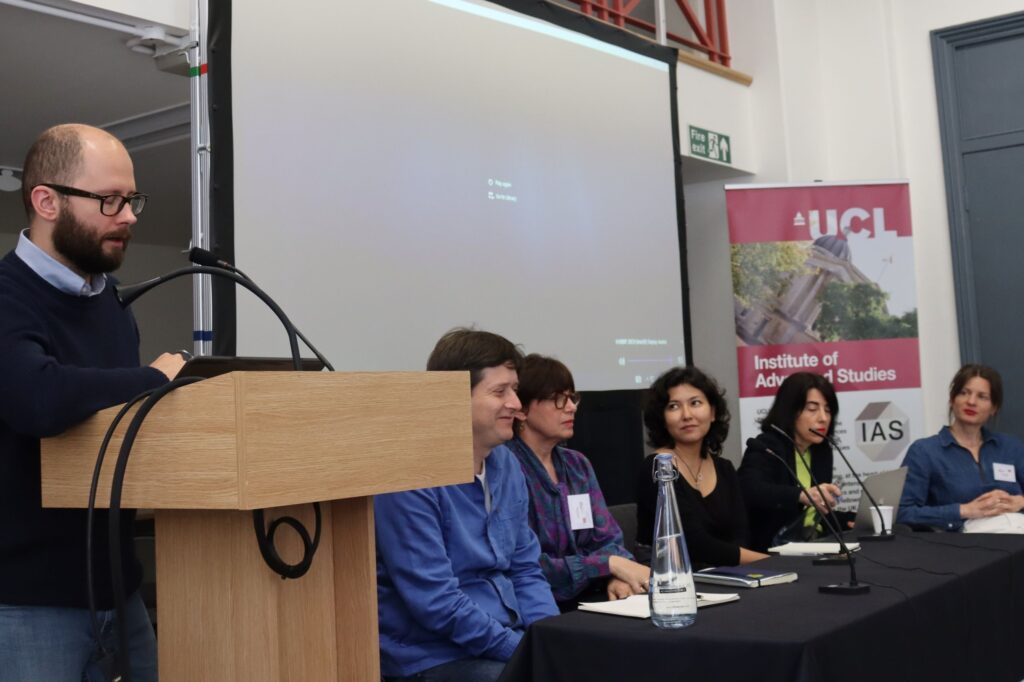
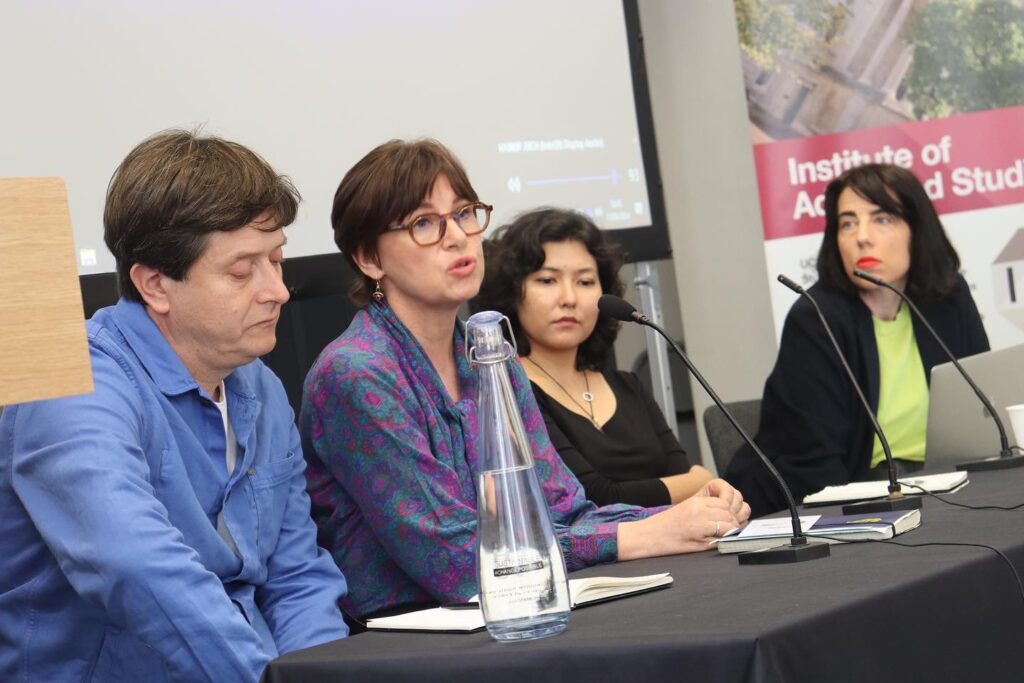
He works on art and architecture in different socialist countries. His current research project focuses on rural architecture in Poland and Bulgaria. He published the book Réalisme et égalité. Une histoire sociale de l’art en République Démocratique Allemande 1949-1990 (2015) and edited with Pascal Dubourg Glatigny and Piotr Piotrowski Art beyond borders. Artistic Exchanges in Communist Europe (2016). He curated with Joanna Kordjak the exhibition Cold Revolution/Zimna rewolucja at the National Gallery Zacheta in Warsaw in 2021 – the exhibition included a section devoted to landscapes painted in the 1950s.
Jan Burek is a Research and Teaching Fellow at the Faculty of History of the University of Warsaw. His research explores the forms of individual and group agency state socialist dictatorships allowed for and, in some cases, facilitated. His research methods draw heavily on Italian microhistory and the Alltagsgeschichte. Hence, he focuses on the microscale analysis of the everyday experiences of life and work. Jan received his BA and MA in History from the University of Warsaw. In November 2021, he defended his PhD dissertation in History and Civilization at the European University Institute in Florence. In his dissertation, he examined the complexities of relationships between the workers, the communist party, and the state administration and factory management in a Polish industrial town in the 1940s and 1950s. The dissertation underscored how workers used the often-overlooked ideological and organizational divisions within the communist party to further their personal and group agendas.
Graduated in art history from the Faculty of Management of Visual Culture at the Academy of Fine Arts in Warsaw. Currently works in the Museum of Modern Art in Warsaw as the Curator of Public Programs. In his research work and writing he focuses on postartistic practices, the relationship between technology and art, art in the face of the planetary climate and environmental crisis and contemporary ecological thought. Jakub is one of the creators of the Atlas of the Anti-fascist Year – a social archive of anti-fascist and anti-war activities and attitudes in culture, art and other walks of life, and duckrabbits.com – the archive of postartistic practices in Poland. He is a member of the Konteksty – Postartistic Congress team, as well as a co-founder of the Office for Postartistic Services and ”Sunflower” Solidary Community Cent
My current research is on the industrial history and heritage of the Ukrainian East, also known as Donbas, questions of heritage management and manipulation and the role of the industrial past in forming community identities and politics. I teach on several modules that intersect with these research interests, including my honours modules on Soviet and post-Soviet cultural memory politics, and the city in Soviet and post-Soviet cinema, and co-taught modules in the environmental and energy humanities. I am the co-author with Darya Tsymbalyuk of Limits of Collaboration: Art, Ethics and Donbas (Rosa Luxemburg Stiftung, 2022), and co-editor with Iryna Sklokina of “Donbas Imaginaries: Heritage, Culture, and Community,” a special collection published with REGION: Regional Studies of Russia, Eastern Europe and Central Asia in 2021. Before I began my research in Ukraine, I worked on Russian cultural nationalism and heritage politics in the historic northwest of the country. My monograph, Chronicles in Stone: Preservation, Patriotism and Identity in the Russian Northwest was published with NIUP imprint at Cornell in 2019. My research also makes contributions to emerging debates in the public, civic and engaged humanities, and my writings in this area have been published with Modern Languages Open and Canadian Slavonic Papers. My next monograph Monotown: Tales of Resistance from the Ukrainian East is forthcoming with Daunt Books Publishing in 2024.
She holds a PhD in the history of architecture (2006) and researches 20th-century architecture, socialist Modernism and industrial heritage. She has authored a book Baltic Modernism: Architecture and Housing in Soviet Lithuania (Berlin: DOM Publishers, 2017) and edited Lithuanian Architects Assess the Soviet Era: The 1992 Oral History tapes (together with John V. Maciuika, Vilnius: Lapas, 2020). From 2024 she is also a PI at the newly established research centre (Post)Authoritarian Landscapes.
ORCID: https://orcid.org/0000-0001-6109-343X
Nikolay Erofeev is a Postdoctoral Fellow at the University of Kassel, whose work focuses on the history of socialist architecture and urban planning. Erofeev received his D.Phil (PhD) in History from the University of Oxford in 2020 and his specialist degree in the History of Art from Moscow State University in 2014. Erofeev had fellowships at the Department of Urban Studies at the University of Basel and at the Jordan Center for the Advanced Study of Russia at New York University. Erofeev’s research project focuses on the urbanisation processes in socialist Mongolia, exploring how exchanges with Eastern European countries, the Soviet Union and China fundamentally reshaped urban space and daily life in the country. Erofeev’s current fellowship is funded by the Alexander von Humboldt Foundation.
They are the author of (in Serbian) Ars ahumana: Anthropocene ontographies in 21st century art and culture (2022), Conditio ahumana: Immanence and the ahuman in the Anthropocene (2019), and monographs on Brian Massumi (2016) and Gilles Deleuze (2015). Their articles appeared in Sexualities, European Journal of Cultural Studies, Journal of Homosexuality, Contemporary Social Science, NORMA, and a number of edited volumes most recently in Plastics, Environment, Culture and the Politics of Waste (Edinburgh University Press, 2023), Sound Affects: A User’s Guide (Bloomsbury, 2023), and The Routledge Companion to Gender and Affect (Routledge, 2022). Their research interests include environmental humanities, queer studies and philosophy. They are Executive Editor of AM: Journal of Art and Media Studies. ORCID: https://orcid.org/0000-0001-5913-3017
Jakub Gawkowski is a curator, writer, and a PhD student at the History Department of Central European University in Vienna. He worked as a curator at the Modern Art Department of the Muzeum Sztuki in Łódź, and as the head of Textile Art Department of the Central Museum of Textiles in Łódź. He recently curated, among others, The Work That Textile Does (with Marta Kowalewska and Anne Szefer Karlsen, Central Museum of Textiles in Łódź, 2023), Wacław Szpakowski. Riga Notebooks (with Inga Lāce and Daniel Muzyczuk, Latvian National Museum of Art, 2023), Erna Rosenstein, Aubrey Williams. The Earth Will Open Its Mouth (Muzeum Sztuki, 2022), The Earth is Flat Again (Muzeum Sztuki, 2022). Together with Marysia Lewandowska he co-edited a volume of selected critical writings of Ewa Mikina. He was 2022 fellow of DAAD MuseumsLab program. His essays and interviews were published in, among others, Krytyka Polityczna and e-flux, as well as in exhibition catalogues.
I am an interdisciplinary scholar working on the intersection of memory studies, art history and theory, contemporary curatorial practices, and the post-socialist visual cultures, with a particular focus on the geo-political region of the Balkans.
Following postgraduate studies in Curating (Department of Fine Arts, Goldsmiths University of London) and Cultural Management (Panteion University of Social and Political Sciences, Athens), I completed a PhD in Visual Cultures at Goldsmiths, University of London. My doctoral research analysed collective art practices in Southeast Europe and it was funded by the Onassis Foundation.
I have worked as an Associate Lecturer in Visual Cultures at Goldsmiths, University of London and a Module Leader in Fine Art – Critical and Cultural Studies at the University of Hertfordshire. In 2019, I was a Research Assistant on the Arts and Humanities Research Council (AHRC) funded project The Museums + AI Network. From 2021-2023 I was the Alexander Nash Research Fellow at the School of Slavonic and East European Studies (SSEES), University College London (UCL), where I explored the legacy of (post)industrialism in Albania.
I hold a Postgraduate Certificate in Learning and Teaching in Higher Education and I am a Fellow of the UK Higher Education Academy.
Outside academia, I have collaborated with non-for-profit organisations, including the British Council in Athens and the Institute of Contemporary Arts (ICA) in London. Common to all my research projects and practice is a set of values based around using culture and contemporary art as a force for social change, to redress inequalities and increase understanding and cohesion in the society.
I am currently a Lecturer in Curating and Cultural Leadership at Winchester School of Art, University of Southampton where I teach on the MA programmes Arts and Cultural Leadership, and Contemporary Curating.
Philipp Goll studied Media Studies, Slavic Studies and European Ethnology in Siegen, Wrocław and Berlin. He works as a researcher and freelance writer and lives in Berlin. In his research, he focuses on artistic research and knowledge production in literature and film and most recently published the reader “Harun Farocki’s Didactics” (ed. with Anne Röhl, 2024, Spector Verlag Leipzig). Since the Russian war of aggression against Ukraine, he has increasingly devoted himself to the history of the German-Russian gas trade and it’s colonial context, organising events such as “Resisting Russian petro-aggression. Indigenous rights in Siberia, Extractivism, Ukraine war” (ZK/U Berlin, 2022), academic seminars and translations for “die tageszeitung” of Oleksiy Radynski’s essays on the subject. In 2023 he co-organized the online lecture series „Research at Risk: Fossil Authoritarianism and Climate Catastrophe“.
Dr Sarah Edith James has published extensively on the former East Germany and the visual cultures of the Cold War, writing two monographs: Paper Revolutions: An Invisible Avant-Garde (MIT, 2022) and Common Ground: German Photographic Cultures Across the Iron Curtain (Yale, 2013). She is also a research-led curator, and recently co-curated Anti-Social Art Experimental Practices in Late East Germany at the Tweed Museum, Minnesota, with Prof Sara Blaylock (2022). She teaches at the Liverpool School of Art and Design, LJMU. She has contributed essays to major exhibition catalogues for institutions around the world and has written numerous academic essays, chapter and articles. Over the last twenty years she has published over 80 feature essays and reviews in the international art press, writing frequently for magazines including Art Monthly, Frieze, Frieze D/E and Photoworks. Her research and writing have been recognised by major grants and fellowships from international funding bodies including the AHRC, British Academy, Alexander von Humboldt Foundation, Gerda Henkel Foundation, and the Paul Mellon Foundation.
Her research focuses on the politics of the body, ecology, critical curating and transnational and decolonial feminism in recent and contemporary art. She is the curator of the Czech Pavilion of the Venice Biennale 2024. In 2021-22 she was a Fulbright-Masaryk Scholar at the Institute for Research on Women and CWAH at Rutgers University and the Brooklyn Museum, junior research scholar at University of York (2019) and taught at the University of Arts London, UK (2012-2019) and at the Centre for Audiovisual Studies, FAMU, Prague (2018-2023). Recent selected publications include Nature Red in Tooth and Claw (Tranzit, 2023), the collective monograph Multilogues on the Now (Display, 2022 ed.), ‘Cripping Curating’ in Radicalizing Care: Feminist and Queer Activism in Curating (Academy of Art, Vienna, 2021), Animal Touch (ArtMap 2021, ed.), the research project The Body and Performative Strategies in Contemporary Art (GAUK, Charles University, 2018-2021) and Diagnosis, (Artalk Revue, 2018). She is a member of the Internal Evaluation Board of the Academy of Performing Arts, AMU, a jury member of The Jindřich Chalupecký Award for Emerging Artists, a union representative and the Academy of Fine Arts and a member of the editorial board of Flash Art Czech and Slovak edition. She was on the Board of Trustees of National Gallery Prague (2020-2023). Her first monographic book, Feminist Alliances and Politics of the Body, is forthcoming.
Karolina Kolenda is an art historian and literary scholar, educated at the Jagiellonian University in Krakow, Poland. Assistant professor at the Institute of Art and Design, University of National Education Commission in Krakow. Author of Na (nie) swojej ziemi. Tożsamość kulturowa i sztuka w Wielkiej Brytanii po 1945 (2016) [In a land that is (not) one’s own. Cultural identity and art in Great Britain after 1945] and Englishness Revisited: Contemporary Literary Representations of English National and Cultural Identity (2019), as well as co-editor of An Inverted World: Reconfigurations of Spaces of Memory in Krakow’s Kazimierz (2021). Among her current research interests are environmental art history, landscape studies, and cultural geography.
She was C-MAP Central and Eastern Europe Fellow at MoMA, New York (2020-2023). She has been curator at the Latvian Centre for Contemporary Art since 2012 and curator of the Latvian Pavilion at the Venice Biennale 2019 with the artist Daiga Grantina (co-curated with Valentinas Klimašauskas). She has also been part of the curatorial team of the Kyiv Biennale (2021), and co-curator of the 7th-10th editions of the contemporary art festival SURVIVAL KIT (with Jonatan Habib Engqvist in 2017 and Angels Miralda and Solvita Krese in 2018-19, Riga) and is currently its advisor. She was co-curator of a research and exhibition project Portable Landscapes which examined art and life of the Latvian exile and emigrant communities throughout the 20th century with exhibitions at Villa Vassilieff, Paris, Latvian National Art Museum, Riga (2018), James Gallery at CUNY, New York (2019), and works on its upcoming publication. She has curated exhibitions Riga Notebook: Following the Lines of Wacław Szpakowski at Muzeum Sztuki (Łódź, Poland, 2020), It Won’t Be Long Now, Comrades! at Framer Framed, Amsterdam (2017, co-curated with Katia Krupennikova) and Performing the Fringe at Konsthall C, Stockholm (co-curated with Jussi Koitela, 2020) and Pori Art Museum, Finland (2021) exploring the relationship between ecology and economy, the urban and rural, the human and non-human in Baltic and Nordic cities. Lāce was curatorial fellow at de Appel, Amsterdam (2015-2016) organizing a program and editing a publication on intersection of art and ecology Instituting Ecologies.
Marie Meyerding holds a PhD with summa cum laude in the History of Art of Africa from Freie Universität Berlin and an MA with Distinction in the History of Art from the Courtauld Institute of Art. Her dissertation examined the representation of women in the history of photography in apartheid South Africa. Meyerding’s research has appeared in African Arts, Third Text, Critical Arts, Safundi and sehepunkte. Her first book Sights of Struggle, which tells the history of the women of Tambo Village through her texts and Mavis Mtandeki’s photographs, was recently published with Lecturis (2023). She curated Defiant Visions at apexart in New York, an Open Call winning exhibition, in June 2023. Meyerding’s research has been supported by the German Academic Exchange Service, the Alfried Krupp von Bohlen und Halbach-Stiftung, the Peter E. Palmquist Foundation, the Photography Network and the Smithsonian National Museum of African Art.
Agata Pietrasik is an art historian with degrees from the University of Warsaw and Freie Universität in Berlin, where she completed her doctorate about art in the 1940s in Poland, focusing on interrelations between the decade’s aesthetics, ethics and politics. With Piotr Słodkowski, she co-edited the book Czas debat. Antologia krytyki artystycznej z lat 1945–54 [Time of Debate. An Anthology of Polish Art Criticism, 1945–1954], and her PhD project is due to be published under the title Art in a Disrupted World: Poland 1939–1949, in the English language series New Art History by the Museum of Modern Art in Warsaw in 2021. Her research interests include postwar modernism in Europe, visual representations of the Holocaust and World War II, and the sociopolitical contexts of these events. She has received fellowships from the German Academic Exchange DAAD, the Polish Ministry of Culture and National Heritage, the German Forum for Art History in Paris. In 2019 she was a chercheuse invitée at the Institut National d’Histoire de l’Art in Paris and worked on her project dedicated to the representation of the Second World War in the visual arts of the 1940s.
Alexander Petrusek is a historian of modern Germany, the environment, and the global Cold War. He completed his PhD in History at Rutgers University in January 2022, and holds a BA in History and a BA in Political Science from Arizona State University. His work draws upon methodologies in history, sociology, and social psychology to engage more deeply with the ideals that drove socialist activism, and this activism’s role in shaping our contemporary world. Alexander’s first book project, Real Existing Ideals: East Germany and the Socialist Imaginary, 1945-1991, examines how socialist ideals, drawn from and developed through a broader socialist imaginary, shaped social, political, and cultural practices in the German Democratic Republic (GDR, or East Germany). This project pays special attention to the tensions between socialist ideals of economic growth and environmental protection, especially in the GDR’s last two decades. His second book project examines East German support for the Namibian independence movement during the Border War in southern Africa, and how the East German practices of solidarity criticized, and at times uncomfortably reflected, the South African state’s self-designated “civilizing mission” in Namibia and its underlying exploitative extractivism.
Oleksiy Radynski is a filmmaker and writer based in Kyiv. His films experiment with documentary forms and practices of political cinema. They have been screened at film festivals and in art contexts worldwide, including International Film Festival Rotterdam, Kurzfilmtage Oberhausen, the Institute of Contemporary Arts (London), e-flux (New York), Docudays (Kyiv), Sheffield Doc Fest, Krakow IFF, DOK Leipzig etc. His latest film Chornobyl 22 won the Grand Prix at Kurzfilmtage Oberhausen in 2023. His texts have been published in e-flux journal, The Atlantic, and Die Tageszeitung, among others. Currently, his work is focused on investigating the toxic legacies of settler colonialism in North East Eurasia, with a focus on the rise of Russian fossil fascism and its multiple imperial wars, including the ongoing Russian invasion of Ukraine. He collaborates with The Reckoning Project, a forensic media project aimed at documenting and prosecuting Russian war crimes in Ukraine. Based on the newly discovered film archives and in collaboration with decolonial scholars and activists, Oleksiy Radynski’s research is investigating the “toxic legacies of infrastructural colonization of Siberia in the context of the emergence of Russian fossil fascism and its multiple imperial wars.”
She is working on her dissertation “Precarious Routes and Logistical Topographies: the Episteme of Mobility in the Making of Central Asian Modernities”. Her research dives into the history and present of railway construction and operation in Central Asia: its geographic imaginaries, resource drives, and the logic of movability. In those topographic and logistical interventions, she is invested in the politics, practices, and memories of people’s mobilities in the reconceptualization of environment, labor, and sociality. In the academic year 2023-2024, she is conducting fieldwork in Central Asia, working in the state archives, traveling to the frontiers of railway projects, and conducting ethnography on the road and along its pathways.
Bogna Stefańska
Graduated in art history from the Faculty of Management of Visual Culture at the Academy of Fine Arts in Warsaw. Currently works in the Museum of Modern Art in Warsaw as a researcher and coordinator of the international project “The Museum of the Commons” realized by the confederation of art museums and cultural organizations L’Internationale. In her research work she is concerned with rewriting the canon of artistic and activist actions towards the climate crisis, feminist art and online feminist actions as well as theories and practices of degrowth. Bogna is a member of Konteksty – Postartistic Congress team, co-creator of HER Docs Film Festival and ”Sunflower” Solidary Community Center as well as a co-founder of the Office for Postartistic Services. She is one of the creators of the Atlas of the Anti-fascist Year – a social archive of anti-fascist and anti-war activities and attitudes in culture, art and other walks of life, as well as duckrabbits.com – the archive of postartistic practices in Poland.
Rita Süveges is a visual artist based in Budapest, her interdisciplinary, research-based practice is twofold: either in community-knowledge-sharing projects or white cube installative shows she deals with the feminist critique of technoscientific imaginaries. She was awarded the TÓTalJOY Award, Smohay Award, Derkovits Grant, New National Exception Grant, Visegrad Scholarship, and was nominated for the Strabag and the Esterhazy Art Awards. Her past residencies include Cité Paris, ISCP New York, Meetfactory Prague, MQ AIR Vienna, shows in Ludwig Museum Koblenz, Off- Biennale Budapest and CHB Berlin etc. She is a co-founder of xtro realm artist group, editor and author of extrodæsia and the Climate Imaginary Reader. Enrolled in the Doctorate program of HUFA.
Lenka Vráblíková is a lecturer in Fine Art and Visual Cultures and a member of Critical
Ecologies Research Stream at Goldsmiths, University of London (UK). She is also a member
of Woods Community for Cultivation, Theory and Art (Czechia ) and a co founding member
of transnational Feminist Readings Network. Lenka’s work lies at the intersection of
contemporary art and visual culture studies with transnational feminisms, political ecology,
feminist deconstruction , new materialisms and critical whiten ess studies. Her current research
focuses on feminist visual ethnomycology that she has been developing in collaboration with
Elspeth Mitchell since 2017.
Centering the embodied experience of association, her sensual, analytical and often participatory practice questions systems of domination, and invites new connections to emerge at sites of loss and damage. This work results in films, books, radio plays, installations and live formats. Since 2018, her research focus has been the emotional grid of state socialism and the chaos it left behind, which lead to the development of the collaborative format “Postsocialist Group Improvisation” and the recent film “Afraid doesn’t exist”. Since 2014, Zett’s work has been shown internationally in the context of art, research, film and performance, for example at Berlinische Gallerie, Berlinale Forum Expanded, Serpentine Gallery London, Whitney Museum New York, Haus der Berliner Festspiele, HKW, Goethe Institute Bejiing, Sonic Acts Festival Amsterdam. Her publications include two radio plays for German public broadcast and the literary text collection “Artificial Gut Feeling” (Divided Publishing, 2019). Anna Zett holds an MA in Cultural Anthropology, Gender Studies and Philosophy from Humboldt University, and lives in Berlin.