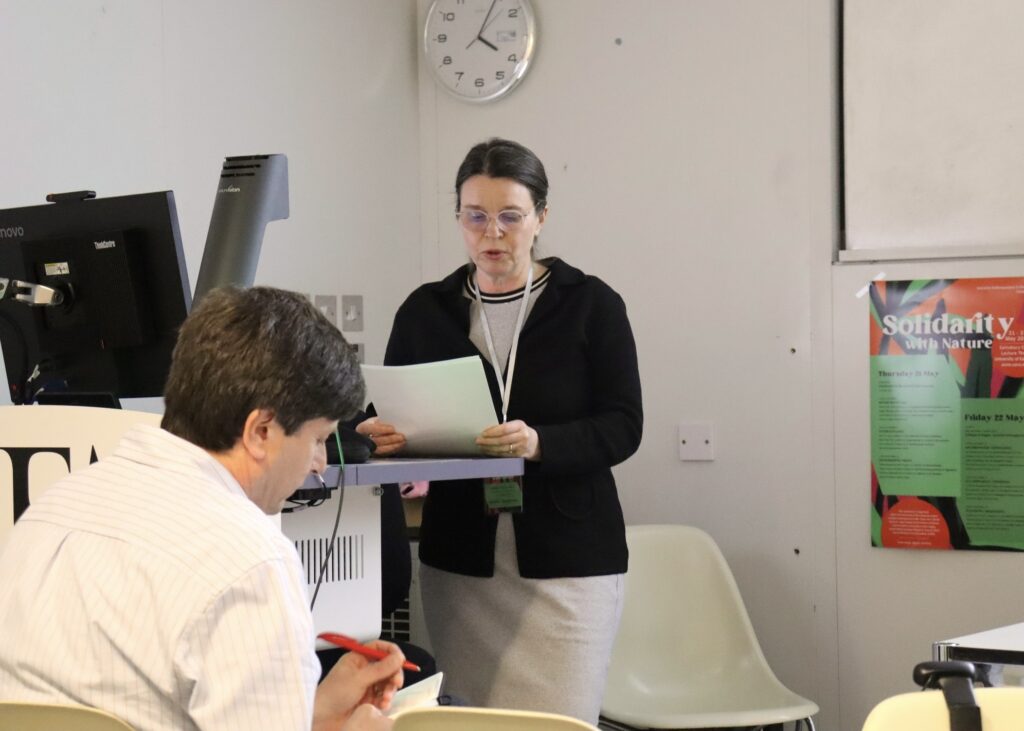
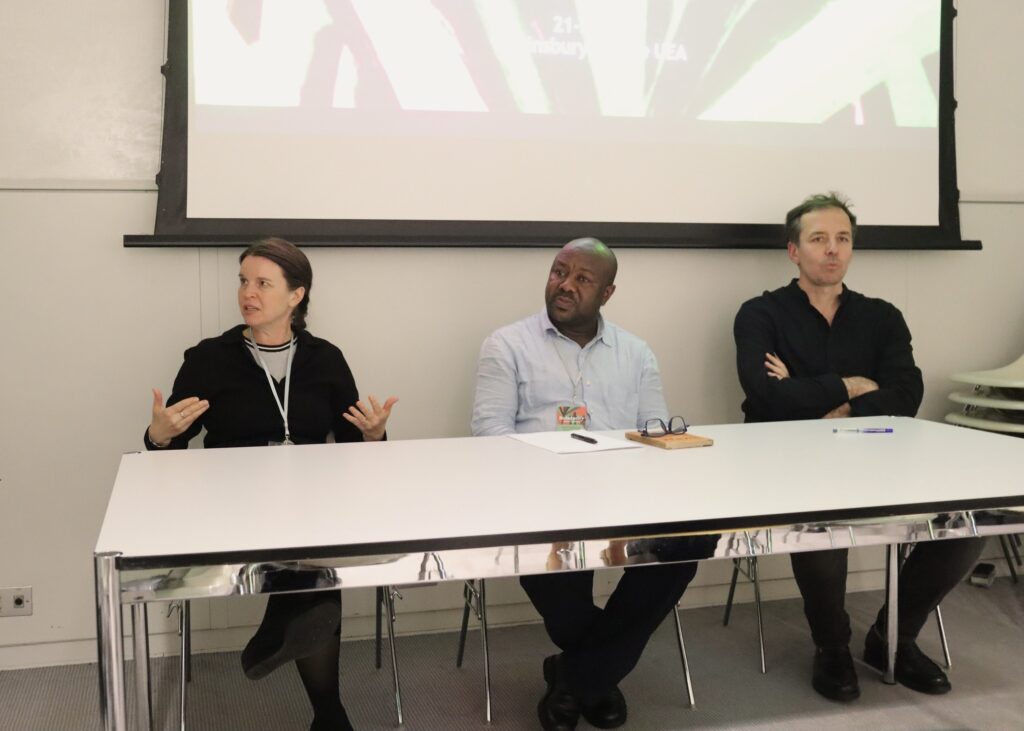
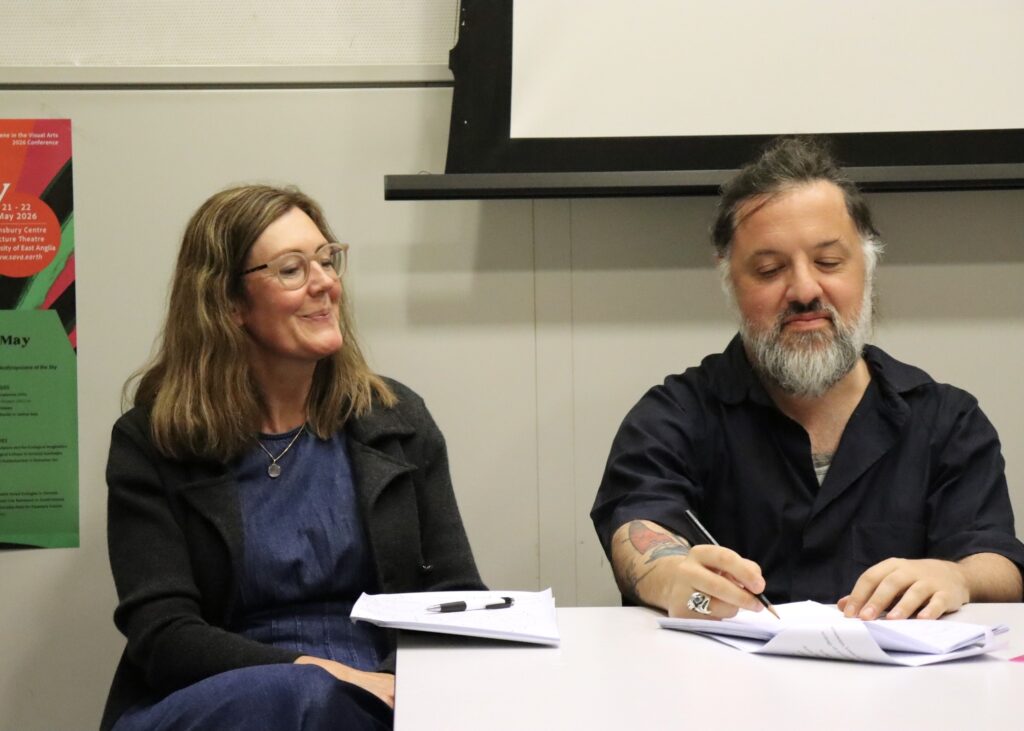
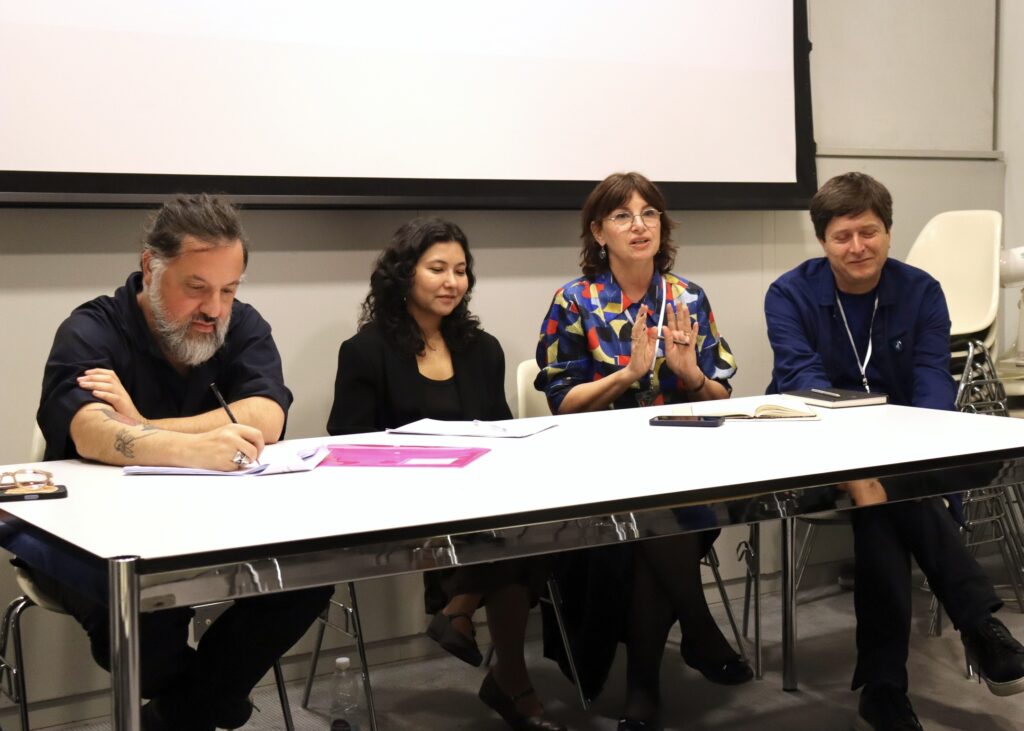
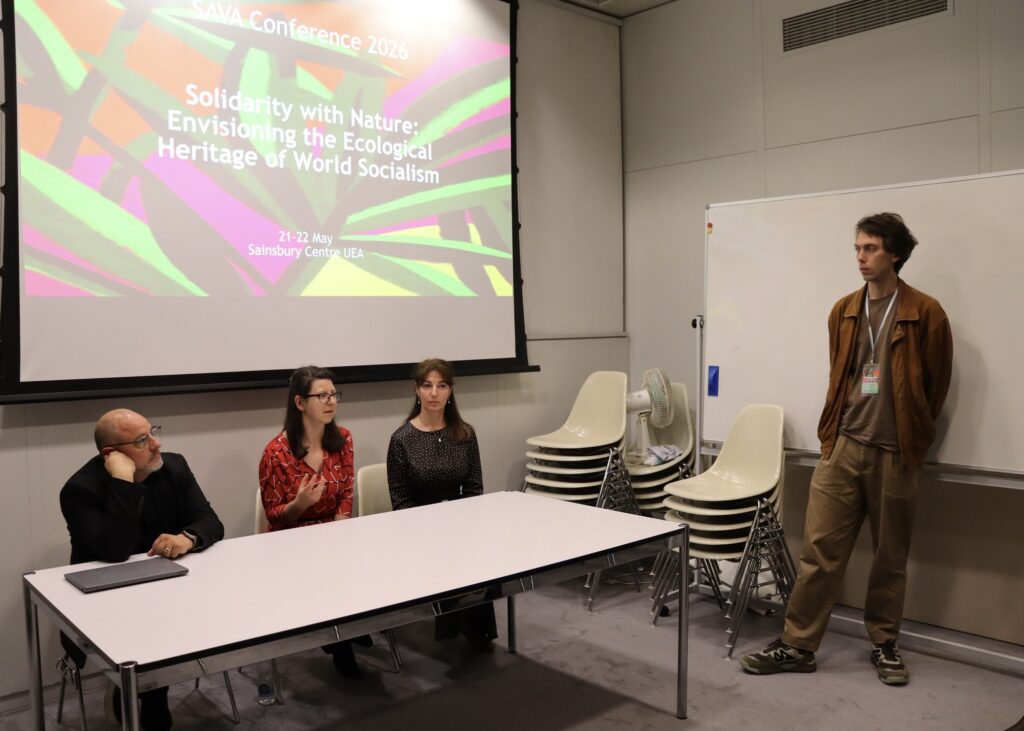
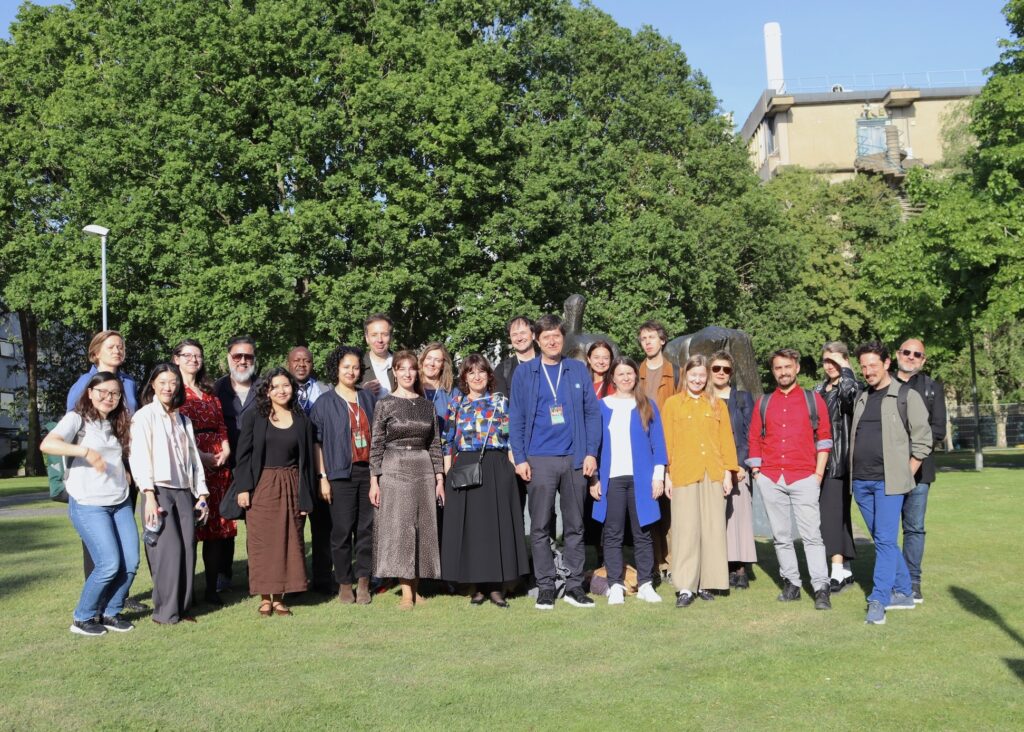
The progressive ecological heritage of socialism is routinely overshadowed by visions of pollution billowing from smokestack industries and occluded by the eco-catastrophist filter imposed on its environmental legacies by residual Cold War thinking. Nevertheless rising environmental awareness from the 1960s saw socialist states declare their commitment to the protection of nature, perceptible in ambitious environmental legislation, international scientific cooperation and the establishment of mass societies for the defence of natural heritage. At the same time, non-state forms of socialist environmentalism also emerged, with an ecological consensus bringing together radical currents of dissident environmentalism, alternative and faith-based eco-circles, as well as proponents of ecocentric worldviews at the confluence of ecosocialism and ancestral beliefs. The SAVA Conference on Solidarity with Nature asks how art history could be unlocked as a repository of the ecological heritage of socialism, explores the role of art practitioners in environmental movements, and considers how experimental art practices performed beyond-human solidarities and expanded the system’s ecological horizons.
PROGRAMME
Thursday 21 May
10.00 Introduction to the Socialist Anthropocene
The SAVA Team
PANEL I: NATURE PROTECTION
Chaired by Maja Fowkes (SAVA UEA)
10.30 Daniel Grúň (Institute of Art History, Slovak Academy of Sciences, Bratislava)
Ecological Solidarity and Planetary Thought: Activist–Artist Interactions in Late Socialist Czechoslovakia
11.00 Megija Mīlberga (Institute of Fine Arts, New York University)
“Where will you sleep? Under the spruce!” The Great-Tree Liberation Group and counterpublic environmentalism in Soviet Latvia
11.30 Preeti Kathuria (Academy of Fine Arts, Vienna)
Stubble Burning and Rural Ecologies: Contemporary Artistic Interventions in India
12.00 Discussion
12.30 Lunch
PANEL II: SYSTEM ECOLOGIES
Chaired by Meg Bernstein (UEA)
13.30 Anna Pronina (Central European University, Vienna)
Seeing the Socialist Subtropics in Soviet Uzbekistan
14.00 Nikola Bojić (Academy of Fine Arts, Zagreb)
Diagramming the Socialist Anthropocene
14.30 Peter Szalay (Slovak Academy of Science)
Between Pannaturalistic Socialism and Degrowth
15.00 Discussion
15.30 Coffee break
PANEL III: ENVIRONMENTAL PRAXES
Chaired by Reuben Fowkes (SAVA UEA)
16.00 Pavlína Morganová (Academy of Fine Arts, Prague)
Out of Town – Land Art and ordinary Life in Czechoslovakia in 1970s
16.30 Tihomir Topuzovski (Museum of Contemporary Art, Skopje)
De/Territorializing Nature: Socio-Ecological Assemblages in Yugoslav and Post-Yugoslav Contexts
17.00 Dominicus Zimanimoto Makukula (University of Dar es Salaam)
‘Ujamaa’ Art Remnants in Tanzania: A Critical Review of Selected Murals and Monuments in Dar es Salaam
17.30 Discussion
18.00 End
.
Friday 22 May
10.00 Ethereal Ecologies: Socialist Anthropocene of the Sky
Maja and Reuben Fowkes (SAVA UEA)
PANEL IV: ANTHROPOCENE COSMOLOGIES
Chaired by Sorcha Thomson (SAVA UEA)
10.30 Lia Dostlieva (artist, cultural anthropologist, and essayist)
Soviet Anthropocene 1933
11.00 rebecca empson (UCL) & christian sorace (University of Cambridge)
Lenin on the Steppe: Ecologies of Infinity
11.30 Anel Rakhimzhanova (New York University)
18,000 Worlds: Towards a Theory of Re-montage
12.00 Discussion
12.30 Lunch
PANEL V: ECO-SPIRTUALIST TENDENCIES
Chaired by Makar Tereshin (SAVA UEA)
13.30 Eva Skopalová (National Gallery, Prague)
Bird in Space: Sculpture and Ecological Imagination in 1960s Czechoslovakia
14.00 Shirin Melikova (Azerbaijan National Museum of Art, Baku)
Non-conformist Art and the Ecological Critique of Late Socialism in Azerbaijan
14.30 Cristian Nae (George Enescu National University of the Arts, Iasi)
Of Earth and Plants: Ecological Posthumanism in Romanian Art of the 1980s
15.00 Discussion
15.30 Coffee break
PANEL VI: ECOCENTRIC IMAGINARIES
Chaired by Marleen Boschen (Tate Modern)
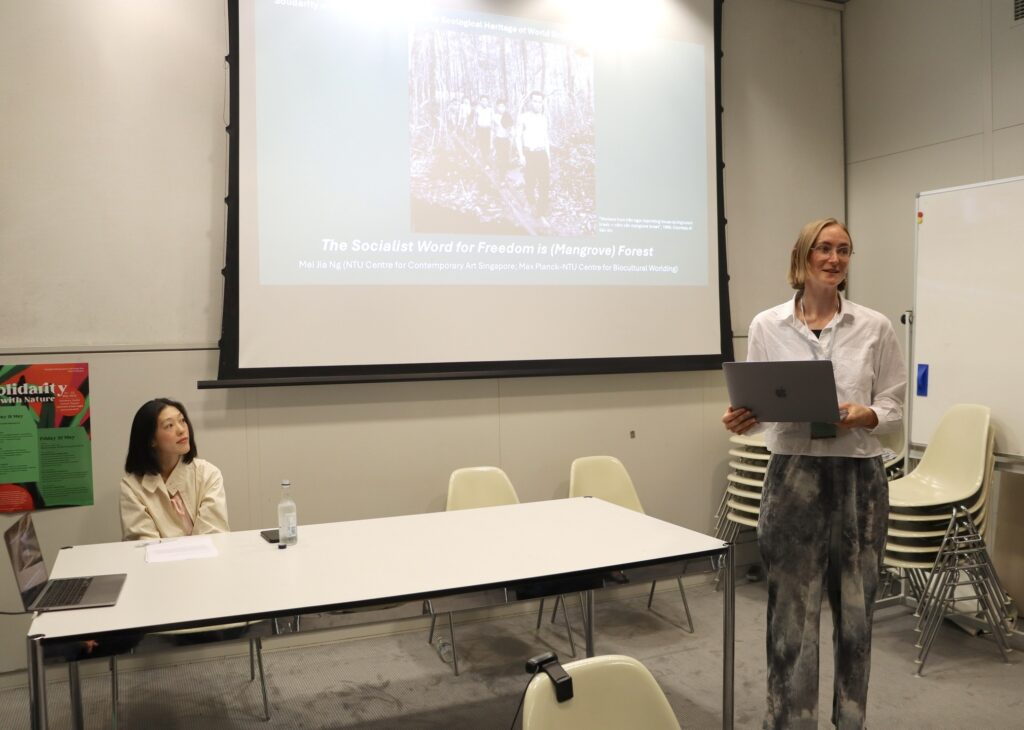
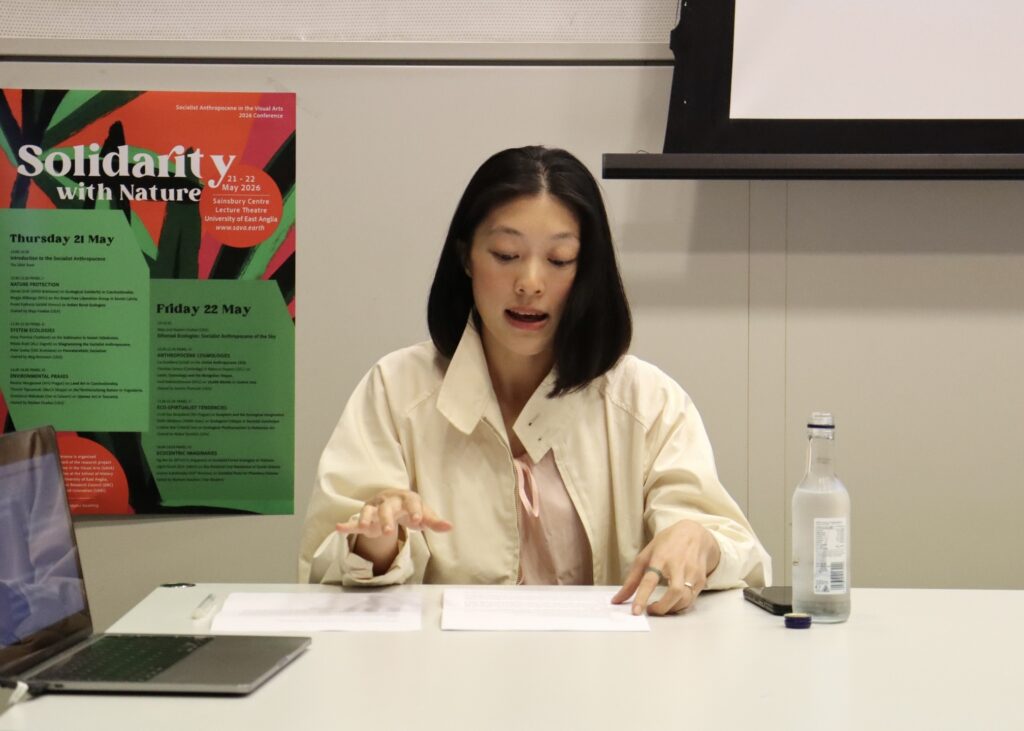
16.00 Ng Mei Jia (NTU Centre for Contemporary Art, Singapore)
The Socialist Word for Freedom is (Mangrove) Forest
16.30 Ingrid Ruudi (Institute of Art History, Estonian Academy of Arts)
Vaike Lubi and her ‘stick palaces’: eco-feminist crip resistance in Late Soviet Estonia
17.00 Joanna Sokołowska (University of Wrocław)
Socialist Pasts for Planetary Futures: Art as a Cosmopolitical Practice in Post-socialist Central and Eastern Europe
17.30 Discussion
18.00 End
ABSTRACTS
PANEL I: NATURE PROTECTION
Ecological Solidarity and Planetary Thought: Activist–Artist Interactions in Late Socialist Czechoslovakia
Daniel Grúň (Institute of Art History, Slovak Academy of Sciences, Bratislava)
In 1987, the eco-activist brochure Bratislava/nahlas (Bratislava/Out Loud), compiled by Ján Budaj with Mikuláš Huba and Juraj Flamík, appeared as a landmark articulation of ecological crisis in late socialist Czechoslovakia. Bringing together 84 signatories, it served as both a diagnostic report on environmental degradation and a catalyst within the political discourse that preceded the 1989 transformations. The ecological movement of the period was heterogeneous, encompassing scientific, activist, and artistic actors. Artists in particular contributed not only through conceptual reflection but also through concrete interventions—participating in the production of environmental magazines such as Ochranca prírody (Nature Protector), distributing informational materials, and engaging directly in the preservation of threatened cultural and natural sites. This paper investigates the convergences between eco-spiritual sensibilities in contemporary art and the practical environmental agendas that emerged across late socialism. It focuses on key concerns such as the protection of wooden folk architecture in the Carpathians, resistance to the Gabčíkovo–Nagymaros hydroelectric project, and responses to suburban ecological deterioration. It also identifies planetary-ism, asceticism, and archeo-environmentalism as three influential strands of ecological thinking that shaped conceptual and performative practices between 1969 and 1989. Independent ecological initiatives fostered horizontal networks of solidarity and knowledge exchange, bridging activism and artistic practice. The paper proposes three analytical lenses for understanding these entanglements:
a) shifting humanistic paradigms and planetary consciousness under world socialism;
b) articulations of solidarity with non-human entities and their habitats; and
c) critiques of environmental degradation within socialist modes of landscape and resource extraction.
“Where will you sleep? Under the spruce!” The Great-Tree Liberation Group and counterpublic environmentalism in Soviet Latvia
Megija Mīlberga (Institute of Fine Arts, New York University)
This paper examines the emergence of an arboreal protection and surveying initiative – the “great-tree” (dižkoks) movement – in Soviet Latvia. It locates the movement’s origin in June 1961, when the dendrologist Staņislavs Saliņš first introduced the term dižkoks to designate exceptionally large and old trees. Through a series of articles, and most notably his landmark 1974 survey, Saliņš transformed the great-trees from an abstract literary epithet into a systematic database of 626 “living monuments”. Mobilizing the Soviet propensity for exhaustive classification, the great-tree survey demonstrates how the socialist anthropocene unfolded not only through material transformations of the environment, but also through bureaucratic reconfigurations that cultivated alternative ecological imaginaries. In 1976, Saliņš’s research inspired the formation of the “Great-Tree Liberation Group” (Dižkoku atbrīvotāju grupa), founded by members of the Latvian cultural intelligentsia. Their excursions to clear up areas around these trees often blurred the boundaries between environmental activism and performance, generating a folklore of their own. Drawing on the archive of the group’s activities and tracing the echoes of the great-tree cult across architecture and visual art of the period, I explore how the movement facilitated the convergence of ecological consciousness and counterpublic formation. By situating the initiative within a broader institutional milieu, this paper explores how the project of formalizing great-tree records into a bioinformatic system was shaped in equal measure by the processes of heritage-making and state-led tourism infrastructure development. I argue that together, these developments generated the epistemic conditions that enabled the anthropomorphization of nature in the 1970s and later informed Baltic environmental protest movements of the late 1980s.
Stubble Burning and Rural Ecologies: Contemporary Artistic Interventions in India
Preeti Kathuria (Academy of Fine Arts, Vienna)
Stubble-burning, locally referred to as ‘Paraali’ is an age-old practice employed to clear paddy crop remnants and straw from the fields in the preparation of planting wheat. This is a predominantly observed agricultural practice in the northern Indian states of Punjab and Haryana and is commonly undertaken between the last week of September and November, every year. Stubble is the left-over portion of rice plants after harvesting the fields and farmers for the sake of convenience, tend to burn this massive left-over as it is of no practical use to the farmer. The discourse around stubble-burning is often framed through the legal and environmental lens, because of its frequent association with the seasonal spikes in air pollution in Delhi. A growing number of contemporary artists are engaging with agrarian ecologies not merely as subjects of critique, but as sites of personal, and material connection. Two Indian artists, Kulpreet Singh and Shweta Bhattad (Gram Art Collective) reimagine the agricultural field as both subject and medium, using the land and its residue, particularly ‘paraali’, to forge new aesthetic vocabularies rooted in their familial lived rural experience. Their artistic practice takes an emancipatory step to redo-undo the dichotomies of rural-urban, village-city, and food-waste. By bringing the residues of agricultural produce into the exhibition space, the practices scale and channel them into the discourse of radical ecology. Through process-oriented exploration, the two artists interrogate themes of erasure, memory, and dissent, transforming gestures into critiques of socio-ecological repression. This paper examines how these artistic interventions claim visibility for rural ecologies and attempt to transform the burning of wasteful burden of industrial agriculture into acts of ecological resistance, environmental consciousness, and embodied place-based consciousness.
PANEL II: SYSTEM ECOLOGIES
Seeing the Socialist Subtropics in Soviet Uzbekistan
Anna Pronina (Central European University, Vienna)
In 1934, the Soviet state established Subtropkom, the All-Union Committee on Subtropics, with the ambitious goal of transforming the USSR’s southern territories into productive subtropical zones. Conceived as part of a broader socialist project of remaking nature, Subtropkom sought to acclimatize exotic plants, reduce dependence on imports of fruits and other species, demonstrate socialism’s capacity to reorganize ecological relations, and provide an Orientalized vision of Soviet luxury for Soviet citizens. Central Asia, and particularly southern Uzbekistan, was reimagined within this agenda as a future landscape of irrigated abundance: a “dry subtropics” laboratory. This paper examines how Subtropkom’s ecological program was translated into visual form, focusing on how magazines, artists, and architects depicted subtropical Uzbekistan from the 1930s to the postwar period. Drawing on illustrated journals such as Sovetskie subtropiki and dozens of albums and books produced by the Committee, as well as photographs, posters, exhibition designs, and architectural projects, I analyze how visual media shaped public perceptions of future nature. These images portrayed orchards, experimental gardens, canals, modern agricultural infrastructure, and the products of these innovations as symbols of harmony between human labor and natural processes. At the same time, they relied on transnational visual references, especially to California and Florida, reworked through socialist aesthetics. By foregrounding visual culture, the paper argues that new ecological thinking was not only enacted through scientific planning and research but also imagined and circulated through images.
Diagramming the Socialist Anthropocene
Nikola Bojić (Academy of Fine Arts, Zagreb)
This paper examines the ecosystemic diagrams of Croatian architect and planner Branko Petrović (1922–1975) as an overlooked contribution to the ecological heritage of socialism and a systemic, futurological visualisation of the Anthropocene. Published in 1971, “Sistematizacija fenomena čovjekove sredine” (Systematisation of the Phenomena of the Human Environment) was produced shortly after six years of Petrović’s professional engagement in Ethiopia within the framework of Non-Aligned cooperation. Developed in the same historical moment as Margulis and Lovelock’s Gaia hypothesis and the Club of Rome’s Limits to Growth, this study departs from both natural-scientific ecological holism and computational, growth-based predictive modelling. Rather than producing statistical forecasts, it integrates philosophy, social, technological, biological, and geological processes within a heterogeneous, non-linear, spatio-temporal system. At the policy level, the study became the conceptual foundation for the Spatial Plan of SR Croatia, the first of its kind in Socialist Yugoslavia (1974). It was also conceived as an alternative preparatory study for the pioneering UN Conference on the Human Environment in Stockholm (1972). I argue that Petrović’s study constitutes a diagrammatic experiment in ecosocialist planetary imagination that resists technocratic environmentalism. Positioned within the geopolitics of Non-Alignment, the paper approaches socialist spatial planning as a site of futurological speculation that anticipated contemporary critiques of productivism, linear futurity, and human exceptionalism, expanding the archive of socialist environmental thought toward planetary solidarities and plural ecological futures. Finally, the paper also considers a series of exhibitions that have presented and recontextualised Petrović’s diagrams, reflecting on how various curatorial frameworks extend their interpretive scope and reactivate their relevance within contemporary theoretical, artistic and design debates.
Between Pannaturalistic Socialism and Degrowth
Peter Szalay (Slovak Academy of Science)
At the end of the Second World War and in the first post-war years, Europe went through dark times. Cities and entire countries were severely affected by the ravages of war, demonstrating for the first time that humans were capable of destroying life on a planetary scale. At the same time, the reconstruction of devastated Europe marked the beginning of a sharp increase in anthropogenic impact on the Earth. In this paper, I present the ideas and visions of a group of architects and art theorists who, in late-1940s Czechoslovakia, formulated the Necessism movement advocating for rational consumption. The movement aimed to establish “pannaturalistic socialism” in opposition to the technocratic direction of post-war reconstruction. The group entered public debate as a critical voice against the planned mining of the Chraberecký Chlum basalt hill in northern Bohemia. The dynamiting of this romantic hill became a symbolic gesture, showing that the communist regime had chosen the path of “planned destruction of the essence of the landscape”, as described by one of the group’s members, urban planner Ladislav Žák. The aim of this contribution is not limited to historical analysis. Drawing on current public debates, and my own engaged research and activism in protecting Lido, a unique terrain vague in the centre of Bratislava, I examine intellectual and socio-political parallels between the Necessists and current degrowth movement and more-than-human perspectives, and what can be learned from this comparison in the present dark times.
PANEL III: ENVIRONMENTAL PRAXES
Out of Town – Land Art and ordinary Life in Czechoslovakia in 1970s
Pavlína Morganová (Academy of Fine Arts, Prague)
One of the most significant phenomena of Czechoslovak art in the 1970s was a pronounced artistic turn toward nature. During this decade, a remarkable number of works emerged at the intersection of land art, body art, and site-specific practices, as artists increasingly shifted their activities beyond institutional frameworks and into natural environments. This paper outlines the broader political, social, and cultural context of this development. The withdrawal of Czechoslovak artists into nature was not merely a consequence of the Soviet-led invasion of 1968 and the subsequent changes artistic operation. It was also rooted in the liberal atmosphere of the 1960s, when Czechoslovak society became more internationalized and receptive to transnational impulses, including new artistic strategies as well as an emerging ecological consciousness. The abolition of censorship in the spring of 1968 briefly enabled open discussion of environmental degradation and served as an important impulse for the growing ecological awareness within Czechoslovak society. These early concerns were subsequently further shaped by initiatives such as the Brontosaurus movement, which originated as an informal, youth-driven effort aimed at protecting nature and preserving historical monuments. Declared under the auspices of the Socialist Youth Union during the United Nations Year of the Environment in 1974, the movement drew on suppressed traditions of Czech scouting (Junák) and the subculture of tramping, a distinctive practice of free wandering and camping in the open air that became intertwined with ecological awareness. The paper focuses on the relationship between this evolving environmental sensibility and artistic production situated in nature or thematically engaged with the natural world. Examining figures such as Štembera, Ságlová, Steklík, Sikora, Želibská, Titlová Ylovsky, Ruller, and Šejn, it argues that even when these works rarely articulated explicit ecological activism, they must be understood within the broader social climate of environmental concern and cultural retreat.
De/Territorializing Nature: Socio-Ecological Assemblages in Yugoslav and Post-Yugoslav Contexts
Tihomir Topuzovski (Museum of Contemporary Art, Skopje)
Under socialist Yugoslavia (1945–1992), diverse landscapes and ecological systems were formally unified within a holistic sovereign imaginary of “nature,” in which ecological spaces were systemically aligned with centralized state ideology. Territorialization entailed the strategic arrangement and symbolic endowment of nature, including mastery over it through the siting of industrial infrastructure and processes of extraction. Rapid industrial expansion unfolded in the absence of systematic environmental assessments and regulatory oversight, resulting in the direct discharge of heavy metals and toxic substances into air, water, soil, and local ecosystems—legacies that continue to shape post-socialist landscapes. The 1990s were marked by profound deterritorialization linked to the dissolution of the Yugoslav federation and wider systemic transformations across Eastern Europe, as newly established borders fractured long-standing environmental continuities, conditions, and interdependencies. The global economy reassembled “nature” through intensified practices of resource extraction and commodified tourism, operating across regulatory regimes as a way of organizing nature. These changes give rise to new ecological and political visions connected to narrations of loss, adaptation, and resilience. The paper concludes with a case study of an artistic practice oriented toward fostering environmental engagement and reimagining ecological topographies, demonstrating how degraded landscapes can be perceived, narrated, and addressed in innovative ways.
‘Ujamaa’ Art Remnants in Tanzania: A Critical Review of Selected Murals and Monuments in Dar es Salaam
Dominicus Zimanimoto Makukula (University of Dar es Salaam)
‘Ujamaa,’ an African brand of socialism, conceived and lived in Tanzania from the 1960s to the early 2000s, has fallen amidst the forces of neo-liberalism. Yet the Tanzanian populations nostalgically still cherish the ideals and promises it engendered. ‘Urafiki’, the national textile mill in Dar es Salaam that Tanzania built with aid from China, became an Indian private enterprise, whereas the National Housing Corporation, has morphed into rental estates for the affluent. Subsequently, the CCM’s autocracy dissolved into fragmented politics. Meanwhile, Art for art’s sake creeps in rapidly, with the ‘dimoongo’ no longer the Ujamaa’s sacred symbol but “a tree of life”—a tourist’s souvenir. Paradoxically, numerous murals and monuments, created in most regions to commemorate achievements of the Ujamaa policy in the 1960s to the late 1980s, still stand in many public places and on buildings. Against this background, the research seeks to investigate the stimuli behind their resilience, resurrection and paraphrasing stories they convey to the seemingly unwary young Tanzanians, oblivious of meanings attached to these artefacts as well as the need of hosting authorities to preserve them as cultural heritage for current generations and posterity. The research will be conducted in Dar es Salaam city, whose fast changing lifestyle and infrastructure since the early 1990s has seen the roots hitherto maligned capitalism supersede Ujamaa, Tanzanian’s socialism, which paradoxically remains entrenched in the country’s constitution.
Ethereal Ecologies: Socialist Anthropocene of the Sky
Maja and Reuben Fowkes (SAVA UEA)
The dramatic transformations brought by industrial development to the natural landscape, from the excavating of vast open-pit mines to the constructing of metallurgical complexes, the building of proletarian cities, the carving of hydraulic infrastructures and the irrigating of monocultural fields, were favoured themes in official depictions of the building of socialism. But looking up from the lithosphere, what transformations were being wrought on the sky and how did they feature on the canvases of socialist artists? In other words, was the Socialist Anthropocene just as areological as it was geological? In this presentation we will consider the extent to which the atmosphere was also subject to anthropogenic change, examining the place of the sky in socialist realist art, and the extent to which artists also projected alternative visions onto the atmosphere, finding in ethereal realms an escape from landlocked realities. At issue also is how artistic depictions of the sky in official art shed light on the environmental impact of socialist development on the natural world.
PANEL IV: ANTHROPOCENE COSMOLOGIES
Soviet Anthropocene 1933
Lia Dostlieva (Artist, Ukraine)
Soviet Anthropocene 1933 is a research-based art project that looks into the notion of the Earth as the source of history and knowledge and as the method of concealing it. Taking as the starting point the book “Trilobites of Donetsk Basin”, it follows interconnections between colonial extractivism, nature, science, and human and non-human violence. The year 1933 was devastating for Soviet Ukraine, as the Soviet government starved to death with an artificial famine up to 4 million people, mostly peasants. Eastern regions, the Donetsk region included, were among the most affected — about one-quarter of the total population died from the famine. The book “Trilobites of the Donetz basin” by Russian paleontologist Valerian Nikolaevich Veber was also published in 1933: so, tiny prehistoric creatures emerged from the surface of Earth while thousands of unidentified dead bodies had been buried in secret in order to erase any trace of a crime. Soviet Anthropocene 1933 focuses on the parallel gestures of uncovering, unearthing, and burning, hiding, following the interconnection of human and non-human history, firmly knotted together by the soviet project of industrialization, which relied on Ukrainian coal and metal. The rapid growth of heavy industry and excessive extraction of fossil fuels and other minerals attracted paleontologists and moved science forward, but heavily damaged the natural environment and caused unrecognizable changes in the natural landscape of the Donbas region; at the same time, industrialization involved the process of collectivization, which caused mass hunger and consequent mass death by starvation.
Lenin on the Steppe: Ecologies of Infinity
rebecca empson (UCL) & christian sorace (University of Cambridge)
In the Mongolian People’s Republic (1924–1990), Lenin’s image was ubiquitous and multivalent. He was most commonly associated with the mythic origins of Mongolian independence and Soviet modernity, and appeared in countless works of art alongside the Mongolian revolutionary leader Sükhbaatar, visually asserting that Mongolia’s existence depended on Soviet friendship. Yet, when examined closely, these works are rich with syncretic detail: Mongolian Buddhist clouds, lotuses, and silk scarves (khadag). Such visual motifs do more than render Lenin legible to local audiences; they transform him in the process. This paper argues that socialist representations of Lenin in Mongolia ecologized and syncretized him as part of the Mongol steppe and its cosmology. While our analysis spans the twentieth century, we focus in particular on artworks created for—or curated in preparation for—the centenary of Lenin’s birth in 1970. These include the poetry anthology Lenin More Alive Than the Living, Ürjingiin Yadamsüren’s painting Lenin in Exile, and archival materials documenting official commemorative events. Together, these artistic images reveal a virtual reality of steppe communism and an infinitely ecological Lenin—forms of political imagination that could not be fully articulated within the dominant discourse of socialist development.
18,000 Worlds: Towards a Theory of Re-montage
Anel Rakhimzhanova (New York University)
In Soviet modernity, montage functioned as a foundational logic for reorganizing social, spatial, and environmental reality. Mirroring the industrial assembly line, directors and cinema theorists like Sergei Eisenstein, Vsevolod Pudovkin, and Dziga Vertov fragmented the “old world”—often the raw landscapes of the Soviet periphery—into a totalizing visual narrative of revolutionary development. In this paper, I introduce the concept of re-montage: the intentional act of repurposing older Soviet chronicles of progress to generate new and contradictory meanings, challenging the original teleology of the state. I analyze how Soviet archives are subverted through the re-montage strategies of contemporary artists Almagul Menlibayeva and Saodat Ismailova. Although they employ distinct narrative rhythms and visual vocabularies, both artists utilize re-montage to build post-industrial, futuristic worlds rooted in Central Asian myths and historical traumas. The title draws on Ismailova’s engagement with the 12th-century mystic Shihab al-Din Yahya al-Suhrawardi, whose cosmology of 18,000 simultaneous, layered realms offers a way to recover ecological and spiritual knowledge suppressed by Soviet formalism. While the original montage theories partitioned the landscape into raw units for extraction, I argue that “re-montage” acts as a metabolic reversal. By weaving archival “debris” with Indigenous cosmologies, these artists cultivate affinities that extend into the more-than-human realm. In doing so, they transform the Soviet record of extraction into a site of ecological recovery, establishing alternative visual futurisms that replace the socialist mandate of environmental mastery with a recognition of interconnectedness across species and strata.
PANEL V: ECO-SPIRTUALIST TENDENCIES
Bird in Space: Sculpture and Ecological Imagination in 1960s Czechoslovakia
Eva Skopalová (National Gallery, Prague)
This paper examines the transformation of the relationship between art, landscape, and ecological consciousness in 1960s Czechoslovakia as a distinct historical moment within the Socialist Anthropocene. The decade marked not only political liberalization but also a growing environmental awareness within socialist society. Landscape began to be understood as a shared ecological habitat rather than merely a productive resource, reflected in the establishment of the first national parks and in emerging public debates on environmental protection. Rachel Carson’s Silent Spring was quickly discussed in Czechoslovakia and contributed to increasing awareness of pesticides and the human impact on ecosystems. In sculpture, this shift manifested itself in the search for organic form. While often interpreted through the lens of phenomenology, particularly in relation to Jan Patočka’s reflections on space and embodied perception, organic abstraction can also be read as an implicit critique of industrial rationality and technocratic interventions into nature. Sculptural practices of the 1960s articulated alternative imaginaries of coexistence between human and non-human environments within a socialist framework. The Warsaw Pact invasion of 1968 interrupted this reform-oriented ecological horizon. The exploration of organic form soon became depoliticized, and monumental works entered public space stripped of explicit environmental critique. By situating these sculptural practices within their intellectual and institutional context, the paper argues that 1960s Czechoslovak art provides a historically specific case of socialist ecological imagination, one that reveals how environmental consciousness and artistic experimentation intersected during a brief yet significant moment of reform socialism. The title Bird in Space metaphorically links the iconic sculpture that inaugurated organic abstraction with the utopian idea of sharing space with other than-human species as a horizon for renewed collective ecological thinking.
Non-conformist Art and the Ecological Critique of Late Socialism in Azerbaijan
Shirin Melikova (Azerbaijan National Museum of Art, Baku)
This paper proposes a re-reading of Azerbaijani nonconformist painting of the 1960s–1980s as a form of ecological critique embedded within late socialism. Drawing on works from the collection of the Azerbaijan National Museum of Art, it argues that artists such as Javad Mirjavadov, Rasim Babayev and Ashraf Murad articulated an alternative vision of nature that diverged from the productivist ethos of industrial modernity. While official socialist aesthetics often celebrated technological progress and extractive landscapes, nonconformist painters turned to myth, archaic symbolism and hybrid beings that dissolved the boundary between human and non-human realms. Their canvases evoke steppes, animals, fire and primordial matter not as resources to be mastered, but as autonomous forces and spiritual presences. In this sense, Azerbaijani nonconformism can be interpreted as an early articulation of eco-spiritual socialism, foregrounding more-than-human solidarities within a system commonly associated with anthropocentric developmentalism. Situating these artistic practices within the broader framework of the Socialist Anthropocene, the paper demonstrates that ecological imaginaries were not external to socialism but emerged from within its cultural margins. By mobilizing local mythologies and pre-industrial cosmologies, Azerbaijani artists produced a visual language that both resisted homogenized Soviet modernism and reimagined the relationship between society and nature. Through close visual analysis and institutional context, this study contributes to expanding the geography of socialist ecocriticism and highlights the ecological potentialities of South Caucasian art within global debates on world socialism and planetary thought.
Of Earth and Plants: Ecological Posthumanism in Romanian Art of the 1980s
Cristian Nae (George Enescu National University of the Arts, Iasi)
A protean, yet understudied figure of the Romanian neo-avant-garde, Wanda Mihuleac has frequently imbued her graphic and sculptural work with a profound sense of ecological communion. Mihuleac has relentlessly explored ways of inhabiting the natural world as an extension of the living organism through diverse media: drawings of conceptual landscapes infused with cosmological and spiritual undertones; video and film performances where her buried body animates the earth; participation in mail art projects such as Messaggio Terra; and sculptural earthworks like the Moebius bands created for the 1982 Paris Biennale. In this presentation, I examine Mihuleac’s artistic activities within the broader context of socialist ecological thought, specifically looking at the intersection between the environmentalism officially endorsed by socialist authorities and an eclectic spiritualism. I will contrast her approach with contemporaries such as Stefan Bertalan and Constantin Flondor. While the SIGMA group artists employed a scientific approach to nature—viewing it as an environment to be examined for models applicable to a non-industrial, rationalistic systematization of social life under state socialism —Mihuleac offered a different perspective. Similar to the later process-based performative works of Bertalan (such as I lived for 130 days with a Sunflower), Mihuleac identified the individual organism as a mere extension of natural elements. In doing so, she constructed hybrid entities that transcended the binary distinctions between nature and culture, as well as human and non-human life.
PANEL VI: ECOCENTRIC IMAGINARIES
The Socialist Word for Freedom is (Mangrove) Forest
Ng Mei Jia (NTU Centre for Contemporary Art, Singapore)
The paper’s title is adapted from Ursula K. Le Guin’s The Word for World Is Forest, written when she was confronted with the atrocities unfolding in Vietnam during the Second Indochina War. In this paper, I turn to Võ An Khánh’s series of photographic works depicting resistance fighters and medics; students and teachers; farmers and print workers; and families and foes residing in the mangrove forests of the Cà Mau Peninsula, to revisit a plausible socialist society founded upon nature—one existing outside the logics of state socialism. Accounting for the failed attempts of cadre management in far-flung terrains and considering the mangroves as a precondition for social activity, the paper explores how moral freedom emerges, operating relationally and reciprocally with multiple species. Rather than ossifying mangroves as mere backdrops for insurgencies or as ecological graveyards following Agent Orange, the paper attends to a contradiction in Viet Cong triumph: dense forest actively enabled resistance, doing more than merely shielding fighters from aerial surveillance. Taking the mangals seriously as an interrelated pole of society—as companion species and comrades enacting political agency—the paper looks toward the horizon of the forest skyline and asks what it means to pursue collective freedom unconstrained by national borders. As with the aftermath of warfare, the world—once in every embodied contact with the forest—is reclaimed, yet not the same as the world before. Through close analysis of Võ’s Making the Năm Căn Mangrove Forest Green Again After The Americans Sprayed Toxic Chemicals (1970), the paper contrasts enduring political, geographical, and material inequalities shaped by statist and international conservation injunctions with persistent forms of mangrove kinship, to query whether acts of repair are motivated by altruistic ethical commitment or enacted in anticipation of future productivity.
Vaike Lubi and her ‘stick palaces’: eco-feminist crip resistance in Late Soviet Estonia
Ingrid Ruudi (Institute of Art History, Estonian Academy of Arts)
The proposed paper uses a case study of Vaike Lubi’s experimental amateur architecture in rural Soviet Estonia to explore the intersections of eco-feminism, affective materialism and crip theory for interpreting a highly idiosyncratic practice as a case of personal resistance on many levels. Vaike Lubi was a neurodivergent woman who instead of institutionalisation opted for dwelling in the woods of Viljandi county, constructing structures of found wood and repurposed scrap material in combination with living trees. Over the 1970s-1980s she erected a cluster of six ‘houses’ of astonishing dimensions, up to 8 metres high, and transformed the landscape with sculptures, structures and an unfinished river bridge. In the Late Soviet context, her project obtained a surprising cultural and social significance. Her ‘stick palaces’ started to attract large crowds who came to see a woman daring to live outside the conventions of the Soviet everyday; but Estonian cultural elites also paid regular visits. Tõnis Mägi, one of the most significant figures of the so-called singing revolution of the 1980s, filmed a music video there. The buildings have graced the cover of architecture theory journal Ehituskunst, and the diploma of Kreis Family Foundation who grants annual awards for Estonian architects. Addressing both personal and social dimensions of Lubi’s phenomenon, I interpret her case as a search for an alternative relationship to ecological resources and a possibility to cohabit with natural environment; and as a refusal to participate in patriarchal power structures, constructing a living environment better suited for her neurodivergent spatial needs.
Socialist Pasts for Planetary Futures: Art as a Cosmopolitical Practice in Post-socialist Central and Eastern Europe
Joanna Sokołowska (University of Wrocław)
This paper examines how socialist heritage is critically reprocessed and reactivated in contemporary artistic practices emerging from post-socialist Central and Eastern Europe to envision planetary futures. It focuses on artists who do not view the socialist past as a closed historical legacy, or through nostalgic lens but as contested source of ideas, imaginations, and material practices. Drawing on the work of artists such as Tamás Kaszás, Anna Hulačová and Mona Vătămanu & Florin Tudor, I analyze how they mobilize socialist symbols, materialities, infrastructures, technologies, and cultural practices to articulate speculative visions of post-capitalist, eco-centric planetary futures and possible worlds. Within this framework, I explore specific themes and historical references in the artists’ work, such as agriculture, cosmism, architecture, labour, public art, pedagogy, and community. While exposing contradictions and ecological limitations inherent to the socialist model, such as extractivism and productivism, the artists reactivate modes of thinking that are also rooted in this heritage, including collectivity, responsibility, cooperation, and solidarity. Through critical and creative reworking, they rearticulate these logics, extending them to non-human natures and situating them within planetary boundaries and the Earth’s metabolic processes. I interpret these practices through the concept of cosmopolitics developed by Bruno Latour and Isabelle Stengers. Cosmopolitics asks how a shared world can be composed anew by accounting for both human and non-human actors. In this sense, socialist heritage becomes a resource for multiple cosmopolitical compositions, reconfiguring dominant Capitalocene worldviews and resististing the catastrophic foreclosure of the future.
Speakers
Marleen Boschen is a curator, researcher and artist working at the intersections of art and ecology. She is Adjunct Curator of Art and Ecology at the Hyundai Tate Research Centre: Transnational. She is also a post-doctoral fellow at the Royal Botanic Gardens, Kew, with the research project Future Ecologies of Art, which examines botanical organisations as sites of artistic research.
Nikola Bojić, PhD, is a researcher, artist, and curator whose work explores the relationships between space, technology, and politics. He earned degrees in art history and museology from the Faculty of Humanities and Social Sciences at the University of Zagreb and completed a postgraduate master’s degree at the Harvard Graduate School of Design. His collaborative research projects have been presented at Kunsthalle Baden-Baden, Moderna Museet in Stockholm, the Taipei Biennial 2020, The Critical Zone at ZKM Karlsruhe, the 16. Venice Architecture Biennale, and the 11. Milan Triennale, among others. Nikola served as guest editor of the 96th issue of Life of Art magazine, focusing on experimental cartography, and as a contributing editor to Vibraception, a transdisciplinary volume on spatial sound, vibration, and waves. Doctoral research he conducted at the Institute of Art History in Zagreb examined the production of space and planning practices in Socialist Yugoslavia. Bojić has been a visiting lecturer at MIT (ACT), where he taught Advanced Studio on Models and Modeling (with Gediminas Urbonas). He is currently an assistant professor and Head of the Theory Department at the Academy of Fine Arts in Zagreb.
Lia Dostlieva is an artist, cultural anthropologist, and essayist. Her art and research practice engage with notions of collective trauma, decolonial narratives, and agency and visibility of vulnerable groups. She was a participant of the National Pavilion of Ukraine at the 60th Venice Biennale. She has exhibited her works at various international venues, including the Malta Biennale, Akademie der Künste (Berlin, Germany), Kunstinstituut Melly (Rotterdam, the Netherlands), Kolumba Museum (Cologne, Germany), Ludwig Museum (Budapest, Hungary), National Gallery of Art (Vilnius, Lithuania), Tbilisi Photography and Multimedia Museum (Tbilisi, Georgia), National Museum of Fine Arts (Bishkek, Kyrgyzstan), and the Latvian National Museum of Art (Riga, Latvia), among others. Her curatorial projects include the 10th Triennale of Young Polish Art (Centre of Polish Sculpture in Orońsko, Poland, 2023) and Reconstruction of Memory (DOX, Prague, Czech Republic, 2017; IZOLYATSIA, Kyiv, Ukraine, 2016). She is a 2024 CEC ArtsLink International Fellow, a 2023 Jan van Eyck Academie alumna (Maastricht, Netherlands), and a 2019 Visiting Fellow of the Institute for Human Sciences (Vienna, Austria). She writes for e-flux Journal, Dwutygodnik, Eurozine Magazine, Kajet Journal, Blok Magazine, and others. She is currently a PhD researcher at Adam Mickiewicz University, Poznań, Poland. Member of the RUTA association, founding member of the Young Network TransEurope by Berlin-Brandenburgische Akademie der Wissenschaften.
Professor Rebecca Empson works on the way people negotiate, shape and live in sites of extraction, but also potential and flourishing. She has written about the mobilization of past prophets in times of crisis in the Mongolian cultural region, recalling past futures for the present (2006).
Daniel Grúň (1977) is an art historian and curator with a specialization in the theory and history of modern and contemporary art. He is senior research fellow at the Institute of Art History, Art Research Centre of Slovak Academy of Sciences and lectures at the Academy of Fine Arts and Design in Bratislava. He is in charge of the Július Koller Society and co-curated the artist’s first international retrospective, Július Koller One Man Anti Show, MUMOK, Vienna (2015 – 2016). He is the recipient of several awards: the White Cube, the Slovak Council of Galleries Award for Contribution to Gallery Activities (2018) and the Igor Zabel Award for Culture and Theory (2010). He is the editor and co-editor of several bilingual books including: Haptic Echo. Nature, Body, Politics and Art in Former Yugoslavia and Czechoslovakia (Bratislava City Gallery, 2024); White Space in White Space, 1973−1982. Stano Filko, Miloš Laky, Ján Zavarský (Vienna: Schlebrügge.Editor, 2021); Subjective Histories. Self-historicisation as Artistic Practice in Central-East Europe (Bratislava: Veda, 2020); Tomáš Štrauss. Beyond the Great Divide : Essays on European Avant-gardes from East to West (Dijon: Les presses du réel, 2020).
Dr. Preeti Kathuria is an art historian, curator, and writer whose work sits at the intersection of critical inquiry and contemporary visual culture. She holds a PhD from the University of Applied Arts, Vienna; a postgraduate degree in Curating Contemporary Art from the Royal College of Art, London, where she studied as a Charles Wallace India Trust Scholar; and an MA in Art History from the National Museum Institute, New Delhi. Currently an Early Postdoctoral Research Fellow at the Academy of Fine Arts, Vienna, she brings over fifteen years of experience in critical writing, editorial practice, and university teaching across India. Her research has been presented at leading international platforms, including the Association for Art History’s Global New Voices 2024 (UK); The Courtauld Institute of Art, UK; Tranzit Iași, Romania; the University of Toronto, Canada; and the Angewandte Research Week, Vienna. Her scholarship draws on agrarian and food studies, subaltern theory, and the politics of artistic production and consumption — probing how communities and global contemporary art worlds are made, sustained, and contested.
Dominicus Zimanimoto Makukula is a Senior Lecturer in Art History, Cultural Studies, as well as Visual and Performing Arts at the Department of Creative Arts in the University of Dar es Salaam, Tanzania. He is also a painter, sculptor, art researcher, critic, and curator. He holds a Ph.D. in African Art History and Cultural Studies from the Free University of Berlin, an MA in Visual Communication, a BA in Fine and Performing Arts from the University of Dar es Salaam, a Certificate and Diploma in Arts from Bagamoyo College of Art, Tanzania. Teaching Visual Arts, African Art History and Cultural Studies, Consulting on Cultural Policy Issues, and Arts and Culture Research, Promotion and Management are the core competencies of his professional career.
Shirin Melikova was appointed Director of the Azerbaijan National Museum of Art in Baku in November 2023. Previously, she led the Azerbaijan National Carpet Museum (2016–2023) and chaired the ICOM Azerbaijan National Committee (2016-2022). She specializes in preserving and promoting Azerbaijan’s cultural heritage, spearheading projects such as reviving ancient weaving techniques and developing a national museum strategy; she introduced Azerbaijan’s first inclusive museum programs and enhanced museum resilience during COVID-19. An active curator and art expert, she has expanded international collaborations, organized major exhibitions, and lectured at leading institutions. Since 2007, she has taught at the Academy of Art and authored over 20 scholarly publications. Her contributions have been recognized with the title of Honored Worker of Culture of Azerbaijan (2018), the French Order of Arts and Letters (2022), and a medal for her contributions to the TURKSOY Union of Museums (2023).
Megija Mīlberga is a third-year Ph.D. candidate at the New York University’s Institute of Fine Arts, specializing in modern art and architecture in Eastern Europe. Her research interrogates site-conscious architectural practices in Soviet-era Baltic States, tracing the points of convergence between environmental and architectural history. Methodologically, she is interested in transimperial histories of ecocentric cultural development and microhistory as a historiographical approach. She holds a B.Sc. from the Stockholm School of Economics in Riga and an M.A. from KU Leuven. Her research has been supported by the Association for the Advancement of Baltic Studies. She is the recipient of the Fulbright Foreign Student Fellowship. She has presented her research at the Association for Slavic, East European, and Eurasian Studies conference, as well as the Frick Symposium for Art History, representing New York University. She has worked as the co-managing Director of the Kim? Contemporary Art Centre in Riga and has contributed to organizing Latvia’s National participation at the Venice Art Biennale. In 2026 she was nominated for the Annual Art Award of Latvia in the category “Text of the Year”.
Pavlína Morganová, Ph. D. is an art historian and curator, based in Prague, Czech Republic. Works as a director of the Research Center at the Academy of Fine Arts in Prague. She specializes in the Central and Eastern European art history, performance art and exhibition histories, lectures on Czech and Eastern European Art of the 20th century. Author of the Czech Action Art / Happenings, Actions, Events, Land Art, Body Art and Performance Art Behind the Iron Curtain (Karolinum Press 2014), A Walk Through Prague: Actions, Performances, Happenings, 1949−1989 (VVP AVU 2017), co-author and co-editor Výstava jako médium. České umění 1957−1999 [The Exhibition as Medium. Czech Art 1957−1999] (AVU 2020), České umění 1980−2010. Texty a dokumenty [Czech Art 1980‑2010. Texts and Documents] (VVP AVU 2011); České umění 1938 – 1989. Programy, kritické texty, dokumenty, [Czech Art 1938‑1989. Manifestos, Critical Texts and Documents] (Academia 2001). Contributed to a number of books, including Plural and Multiple Geographies of Modern and Contemporary Art in East-Central Europe (Routledge, 2025); State Construction and Art in East, Central Europe 1918–2018 (Routledge 2022); The Avant-garde and the State (Muzeum Sztuki, Łodz 2018); Kateřina Šedá ‑ UNES-CO company catalog and interim report on the organization’s activities (La Biennale di Venezia 2018), Fluxus East. Fluxus–Netzwerke in Mittelosteuropa (Künstlerhaus Bethanien, Berlin 2007).
Cristian Nae is professor of aesthetics and contemporary art at George Enescu National University of the Arts in Iasi, Romania, where he also leads the Institute for Multidisciplinary Research in the Arts. He was a Fulbright Visiting Scholar at the University of California at Santa Barbara (2023). His recent studies were published in journals such as Third Text or Artmargins (MIT Press) and included in publications like Curating Socialism (forthcoming, University of Toronto Press, 2026), Globalizing the Avant-Garde (De Gruyter/Brill, 2025), Plural and Multiple Geographies of Modern and Contemporary Art in East-Central Europe (Routledge, 2024), State Construction and Art in East Central Europe 1918-2018 (Routledge, 2022), Art History in a Global Context: Methods, Themes and Approaches (Wiley Blackwell, 2020); Realisms of the Avant-Garde (De Gruyter, 2020); and Performance Art in the Second Public Sphere: Event-based Art in Late Socialist Europe (Routledge, 2018).He edited the publication (In)Visible Frames. Rhetorics and Experimental Exhibition Practices in Romania 1965-1989 (2019, Idea) and co-edited the publication Contemporary Romanian Art 2010-2020 (2020, Hatje Cantz).
Ng Mei Jia is a researcher and a Scientific Coordinator at the Max Planck–NTU Centre for Biocultural Worlding, hosted jointly by NTU Centre for Contemporary Art Singapore and the Max Planck Institute for the History of Science, Germany. Her research focuses on the intersection of artistic and cultural practices, spirituality and religions, and their entanglements with the natural environment.. She recently co-authored “Beyond Service: Reimagining Care, Autonomy, and Exchange in Artistic Projects” in the ISSUE journal: Service, published by LASALLE College of the Arts, and presented a paper “Performing Gods: Spiritual Rituals as Cosmo-Ecological Intervention” at the International Association for Media and Communication Research 2025: Communicating Environmental Justice: Many Voices, One Planet. She holds an MA in Southeast Asian Studies from the National University of Singapore.
Anna Pronina is an interdisciplinary researcher, curator, and historian of the Soviet Union, with an emphasis on Central Asia, currently based between Tashkent and Vienna. She just received her PhD degree in History at Central European University with her thesis “”. Her research interests include architecture, fine and performing arts, cultural policy, and environmental history in Soviet Uzbekistan. She is also a contributor and research member in various projects, including the exhibitions Clouds, Power and Ornament – Roving Central Asia (Centre for Heritage, Arts and Textile, Hong Kong, 2023), the research project Global Borderlands Project (AUCA, Bishkek, 2023), and exhibition Split Together – Merged Apart (GES-2, Moscow, 2025).
Anel Rakhimzhanova is a Performance Studies PhD candidate at New York University, researching modernity, mobility, and performance in Central Asia. She is an investigator in the Getty-supported travelling seminar on Central Asian art history and
edited Almagul Menlibayeva: I Understand Everything exhibition catalogue (Almaty Museum of Arts, 2026). She contributed to
Soviet Materialities (Manchester University Press, 2026), Artforum, a special issue of ARTMargins on the Socialist Anthropocene.
Ingrid Ruudi is a senior researcher at the Estonian Academy of Arts, Institute of Art History and Visual Culture. Her most recent publications include Disability Activism in Audiovisual Media and the Built Environment in Late Soviet Estonia in Hana Gründler (ed.) Re-Thinking the Post-Soviet Body (forthcoming 2026); Spaces for Spiritual Transformation: New Age-Inspired Architecture in Late and Post Soviet Estonia in Kamila Dworniczak (ed.) Enchanted Socialist Modernity. Art of Central and Eastern Europe 1945-1989 in the Face of Alternative Spirituality (DeGruyter Brill, 2025); Spaces of Care and the Construction of Marginalised Subjectivities in Late Soviet Estonia in Kunstiteaduslikke uurimusi/ Studies on Art and Architecture, 3/4, 2023; and Estonian entries for The Bloomsbury Global Encyclopedia of Women in Architecture (edited by Karen Burns and Lori Brown, London: Bloomsbury, 2025). She has curated research exhibitions at the Estonian Museum of Architecture, like Unbuilt: Visions for a New Society 1986–1994 (2015) and A Room of One’s Own. Feminist’s Questions to Architecture (2019), as well as Estonian exhibition Gas Pipe at the 11th Venice Architecture Biennale (2008). Since 2021 she is also editor-in-chief of Estonian art history journal Kunstiteaduslikke Uurimusi / Studies on Art and Architecture.
Eva Skopalová, Ph.D., has been a curator in the Collection of Art after 1945 at the National Gallery Prague since 2021. She contributed as both author and curator to the permanent exhibition 1939–2021: The End of the Black-and-White Era at the Trade Fair Palace, where she was responsible for the period 1939–1963. Her current research explores the concept of discontinuous space in relation to nonlinear time. She recently curated the project Silent Spring: Art and Nature 1930–1970 (National Gallery Prague, 2025), which combined a critique of space with a reflection on affectivity and the ethical-ecological bond to landscape, and was accompanied by a publication of the same title.
Joanna Sokołowska is a curator, art historian and PhD candidate in Art History at the University of Wrocław. She teaches at the Academy of Fine Arts in Wrocław. Her research focuses on energetic transformations as reflected in and envisioned in post-socialist art. From 2010 to 2021, she worked as a curator in the Muzeum Sztuki in Łódź. She has curated and co-curated numerous exhibitions addressing issues such as post-socialist transformations of urban space, global transformations of labour, feminist emancipations, the contemporary potential of avant-garde utopias, and speculative futures in the face of the planetary ecological crisis. Her major curatorial projects include Renewal/Odnowa. Biennale Zielona Góra 2022 (with Marta Gendera and Bartek Lis); Pangea United (Muzeum Sztuki, 2019), For beyond that horizon lies another horizon, (Edith-Ruß-Haus für Medienkunst, Oldenburg, 2017) Exercises in Autonomy: Tamás Kaszás featuring Anikó Loránt (ex-artists’ collective) (Muzeum Sztuki, 2016); All Men Become Sisters, Muzeum Sztuki, Workers Leaving the Workplace (Muzeum Sztuki, 2011), Another City, Another Life (with Benjamin Cope, Zachęta Narodowa Galeria Sztuki, Warsaw, 2008)
Christian Sorace is an Associate Professor in Politics and International Studies at the University of Cambridge. His work explores political concepts and practices in China and Mongolia, spanning the study of ideology, discourse, urban planning, air pollution, and aesthetics. He is also interested in the histories and legacies of communism in Asia.
Peter Szalay is an architectural historian based in Bratislava Slovakia. He works at the Department of Architecture of the Institute of History of the Slovak Academy of Sciences and at the Department of Art History of the Faculty of Arts, Comenius University in Bratislava. His research focuses on 20th- and 21st-century architecture and town planning from art-historical, heritage, environmental as well as broader social and political perspectives. He is the author of numerous scholarly publications in national and international journals and the co-author of several academic monographs, such as The Modernist Ideal of Socialist Mass Housing Reconsidered: The Revival of Petržalka. In Europe-Asia Studies, 2025; Urban development for whom? Bratislava’s Lido between terrain vague and the expansion of the city centre. Bratislava: tranzit.sk, 2023; Enlightenment, Culture, Leisure: Houses of Culture in Czechoslovakia. Prague: VI PER Gallery, 2023; Bratislava (Un)planned City. Bratislava: Slovart, 2020; Peter Szalay is the executive editor of the scholarly journal Architektúra & Urbanizmus and a member of DOCOMOMO International.
Tihomir Topuzovski teaches at the Institute of Social Sciences and the Humanities and Faculty of Fine Ars in Skopje, North Macedonia and he is the interdisciplinary program director of the Museum of Contemporary Art, Skopje. He was a postdoctoral researcher at the Centre for Baltic and East European Studies in the Södertörn University in Stockholm. His research interests lie at the intersection of philosophy, politics, environmental sciences, and the visual arts. Tihomir’s most recent work includes the article The Landscape of our situation: Visual Narratives of Environmental Transformations (2026 – forthcoming), the monograph Postanarchism and Critical Art Practices (2024) and The Posthuman Pandemic (ed. with Saul Newman, 2021). His other recent articles include “Aesthetic Technique and Spatial Occupation in Hybrid Political Regimes” (2021), and the chapter “Political Protest, Temporary Urbanism and the Deactivation of Urban Spaces” (with L. Andres, 2020). He has organized and contributed to a number of artistic projects, including “Dis/Ordering the Art World” and “Landscape of Anxiety.” Tihomir is editor-in-chief of The Large Glass, a journal for contemporary art, culture, and theory.
Documentation