SAVA Research Week III: Infrastructures of Progress

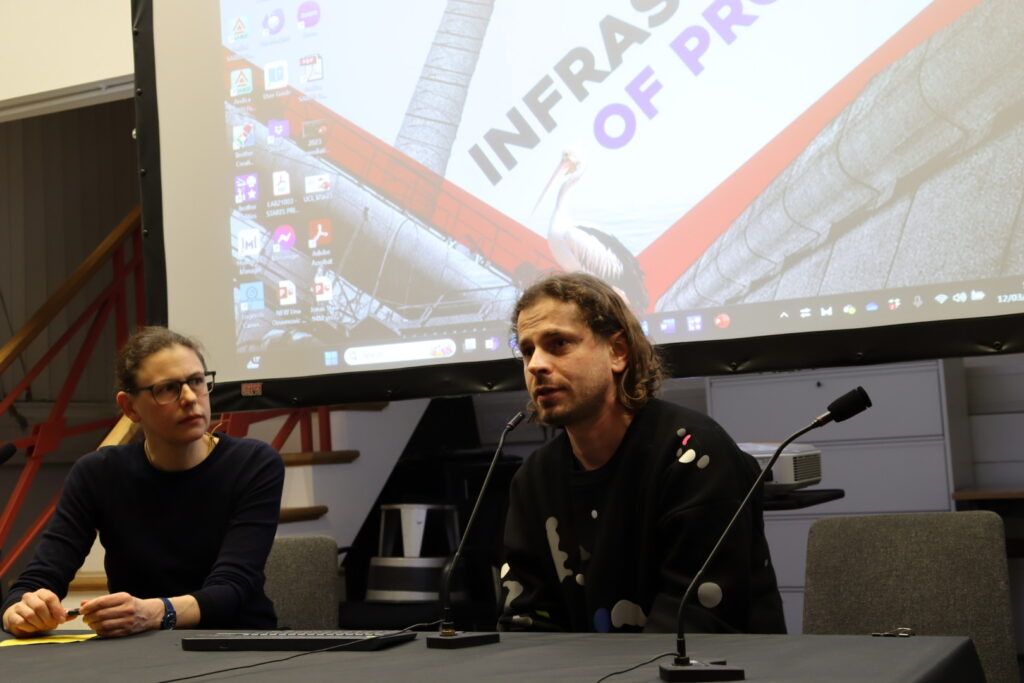
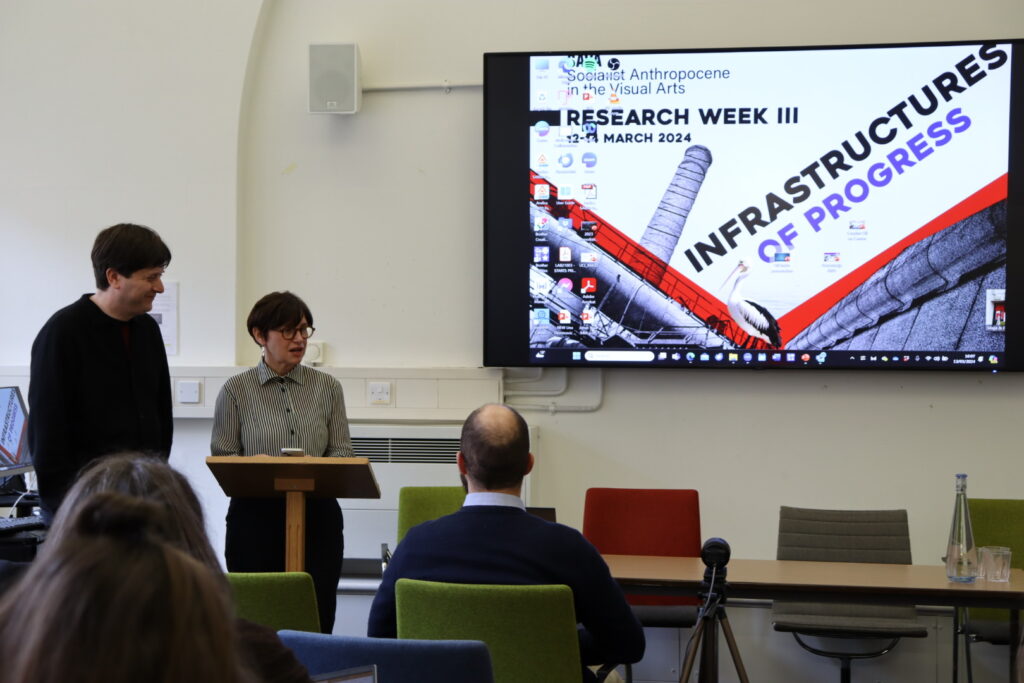
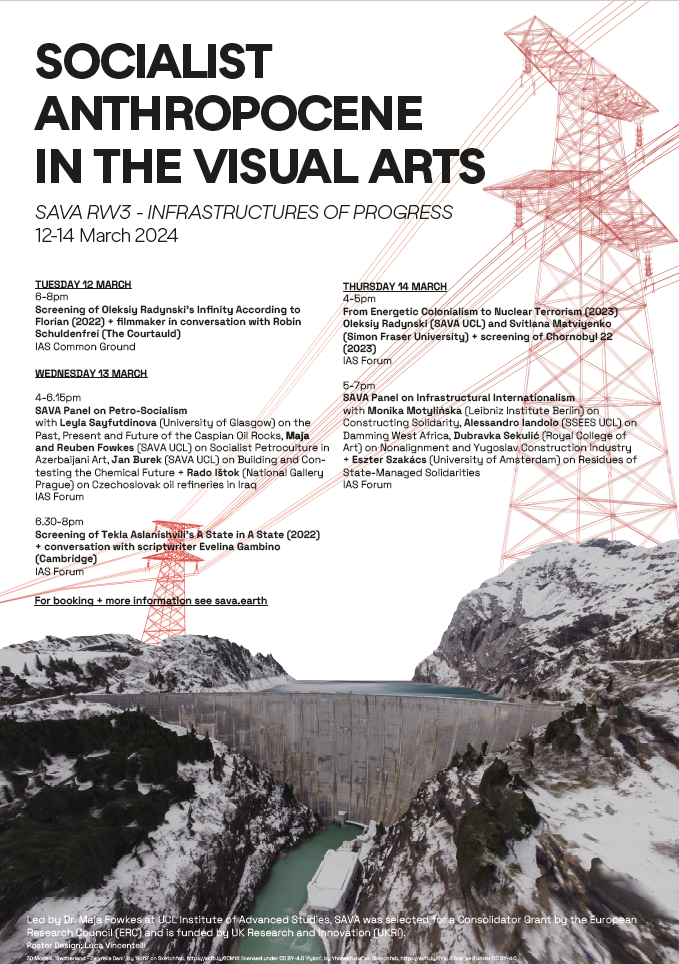
The third SAVA Research Week deals with the infrastructures of progress, investigating underlying networks, structures and systems of socialist modernity, including oil, concrete, nuclear and cultural complexes in progress-oriented developmentalist models and the logistics of socialist internationalism, through film screenings, panel discussions and roundtables.
The Research Week launches with a screening of Oleksiy Radynski’s film Infinity According to Florian (2022) and also includes the showing of Tekla Aslanishvili’s A State in A State (2022), introduced by scriptwriter Evelina Gambino. A public panel on Petro-Socialism addressing the infrastructures of oil extraction, petrobartering, the chemicalization and the naturalization of petroculture in the visual arts, with presentations by Leyla Sayfutdinova (University of Glasgow), Maja and Reuben Fowkes (SAVA UCL), Jan Burek (SAVA UCL) and Rado Ištok (National Gallery Prague). Svitlana Matviyenko (Simon Fraser University) will be in conversation with Oleksiy Radynski (SAVA UCL) about energy colonialism and renewed nuclear threat in Chornobyl. A panel on Infrastructural Internationalism brings together Monika Motylińska (Leibniz Institute Berlin), Alessandro Iandolo (SSEES UCL), Dubravka Sekulić (Royal College of Art) and Eszter Szakács (University of Amsterdam) for presentations on the economic and cultural infrastructures of socialist solidarity. Closed roundtables deal with topics of socialist cybernetics, the Soviet space programme in Kazakhstan, the time-space dimensions of infrastructure and city building for the working class.
Public events
Roundtables
Speaker biographies
Documentation
Programme
Public events
Tuesday 12 March 2024
6-8.00 pm
Screening of Oleksiy Radynski’s Infinity According to Florian
A screening of SAVA Creative Fellow Oleksiy Radynski’s film Infinity According to Florian (2022) with a Q&A with the filmmaker and response by Robin Schuldenfrei (Courtauld Institute of Art).
Location: IAS Common Ground
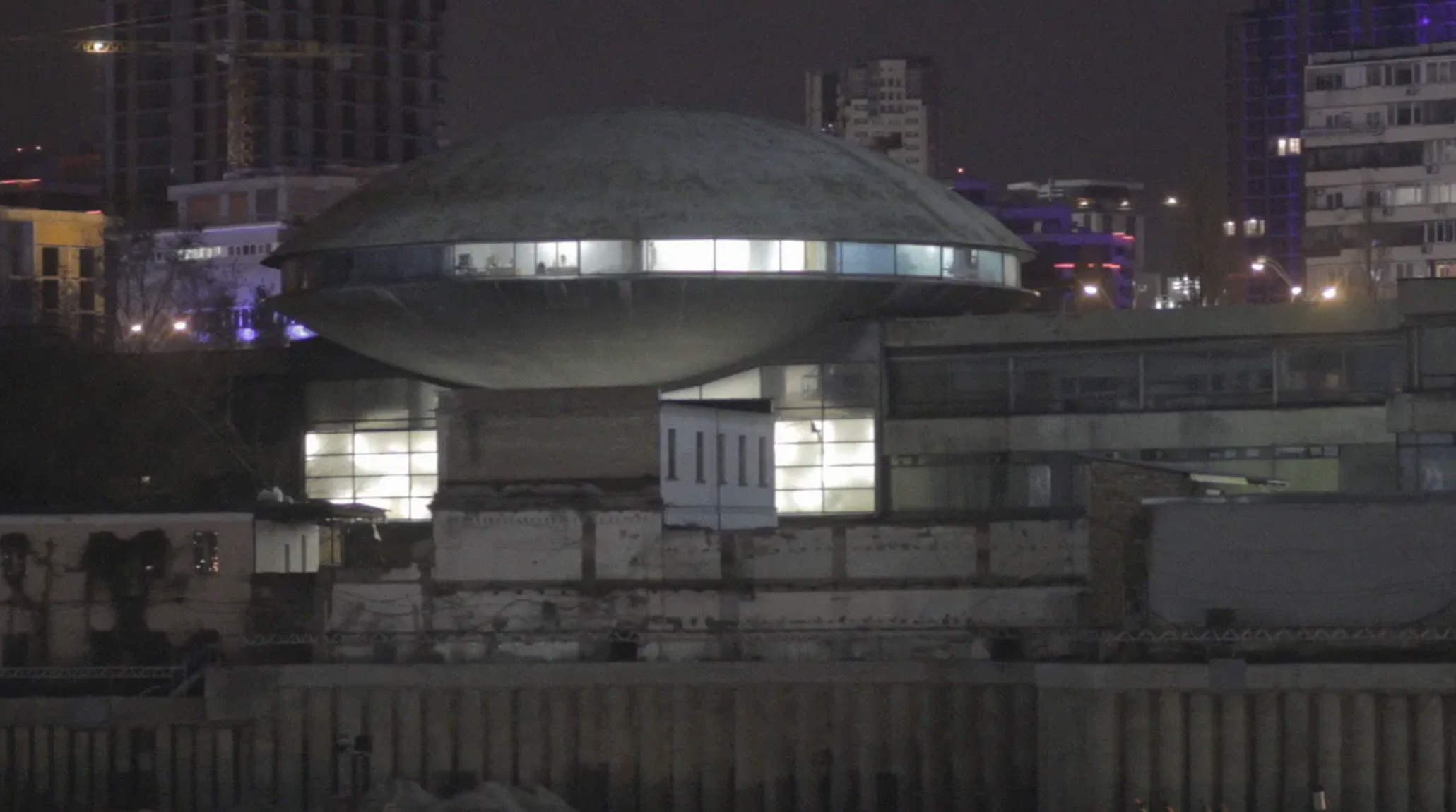
What is Earth? What is a solar system? What is humanity? Who is Florian Yuriev? Why did he build a UFO building in Kyiv? Will we be able to use it for its intended purpose in the future? SAVA Creative Fellow Oleksiy Radynski’s Infinity According to Florian (2022, 70 minutes) deals with these questions, related to the legendary figure of Kyiv-based architect Florian Yuriev. This film also recounts why capitalism is a thing of the past, and what happens when you divide one by infinity.
Wednesday 13 March 2024
4-6.15pm
SAVA Panel on Petro-Socialism
Location: IAS Forum
With Leyla Sayfutdinova (University of Glasgow), Maja and Reuben Fowkes (SAVA UCL), Jan Burek (SAVA UCL) and Rado Ištok (National Gallery Prague) IAS Forum
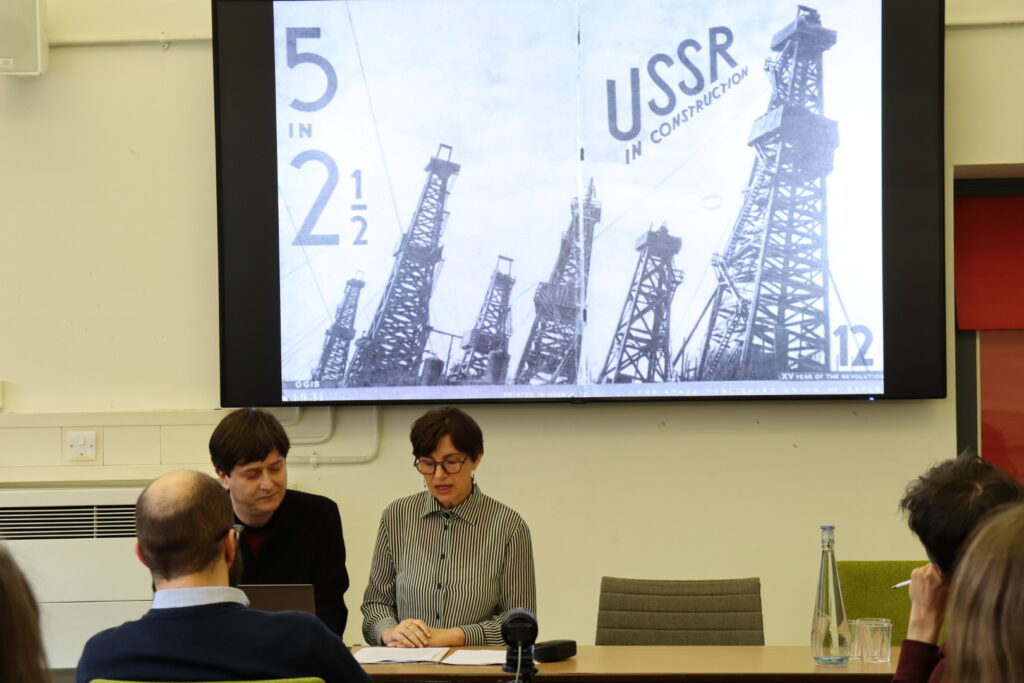
The SAVA panel on Petro-Socialism addresses the infrastructures of oil extraction, from the politics of pipelines to the construction of the first off-shore oilrigs, petrobartering in the transfer of technology and expertise, the operations and environmental impacts of chemicalization, and the naturalization of socialist petroculture in the visual arts.

In her talk From here to eternity: past, present and future of the Caspian Oil Rocks, Leyla Sayfutdinova (Senior Lecturer in Critical Area Studies, University of Glasgow) examines the history of the Soviet Union’s first offshore extraction facility, Oil Rocks, which was built in 1949-1958 in the Caspian Sea some 100 km away from Baku. Celebrated at the time as yet another instance of the Soviet conquest of nature, it soon became technologically outdated with the development of semi-submersible drilling platforms in 1960s. But despite this, Oil Rocks remain a site of active, if diminishing production of oil and gas, ongoing ecological disaster due to poorly sealed wells, and a late industrial ruination prone to technogenic accidents. Her presentation explores the temporality of this project of high Soviet modernity, and discuss how Oil Rocks are inscribed in the narratives of the past, present and future of oil in Azerbaijan.
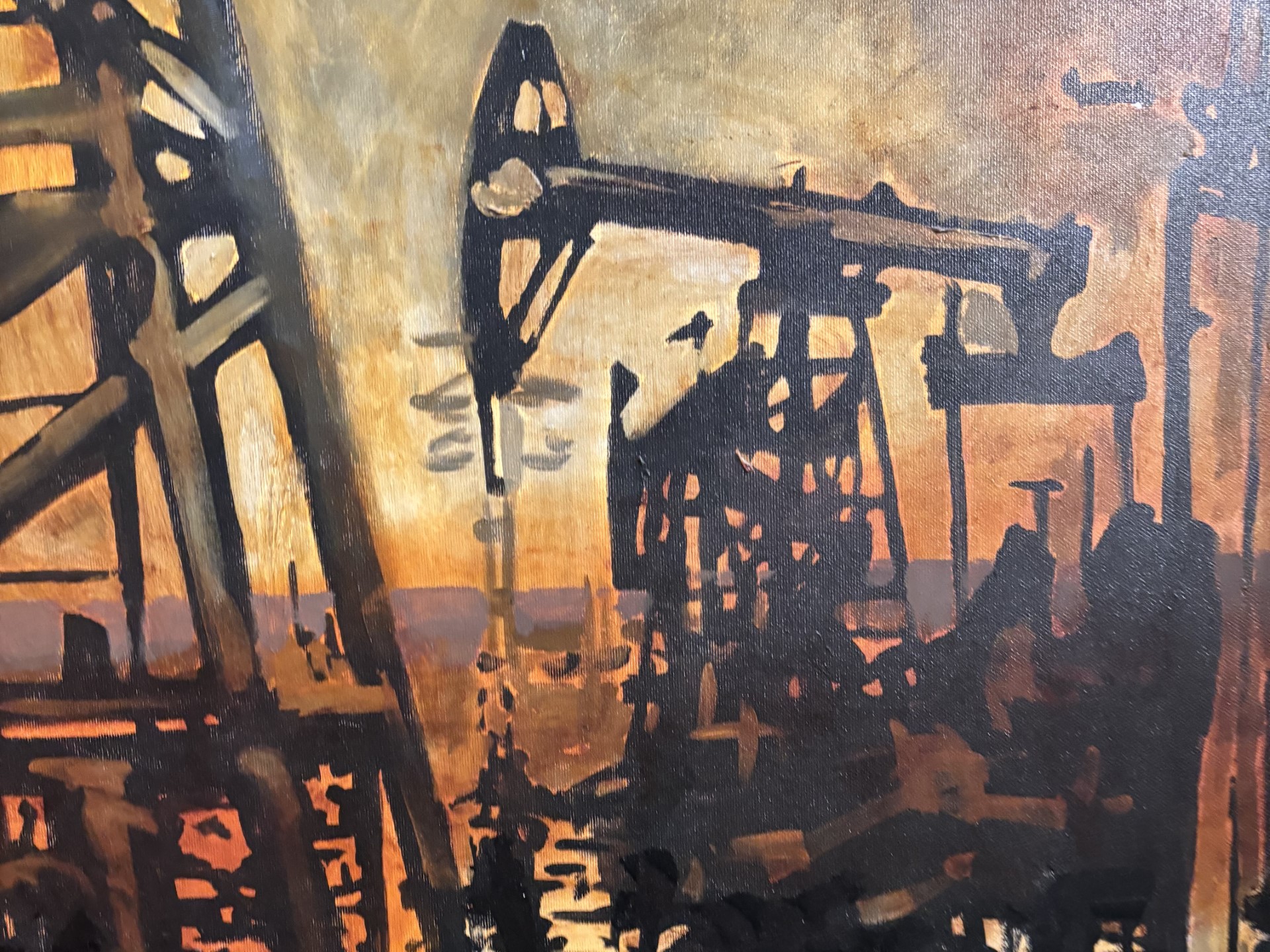
The presentation Caspian Oil on Canvas: Socialist Petroculture in Azerbaijani Art by Maja and Reuben Fowkes (SAVA UCL) investigates the environmental art history of oil exploitation in Soviet Azerbaijan. What do artistic representations of the industry reveal about the status of the oil worker within the petroculture of fossil socialism? How did artists celebrate oil-powered social and industrial progress, articulate the ethos of ‘commanding the Earth to serve Socialism’, discover in the severe style a match for the harsh struggles of the Caspian oil pioneers, capture the sublime of socialist modernity and naturalize the unique oil heritage of the Absheron Peninsula? And in the year that Baku is set to host the COP29 Climate Summit, is techno-utopianism the only pathway for green transition?
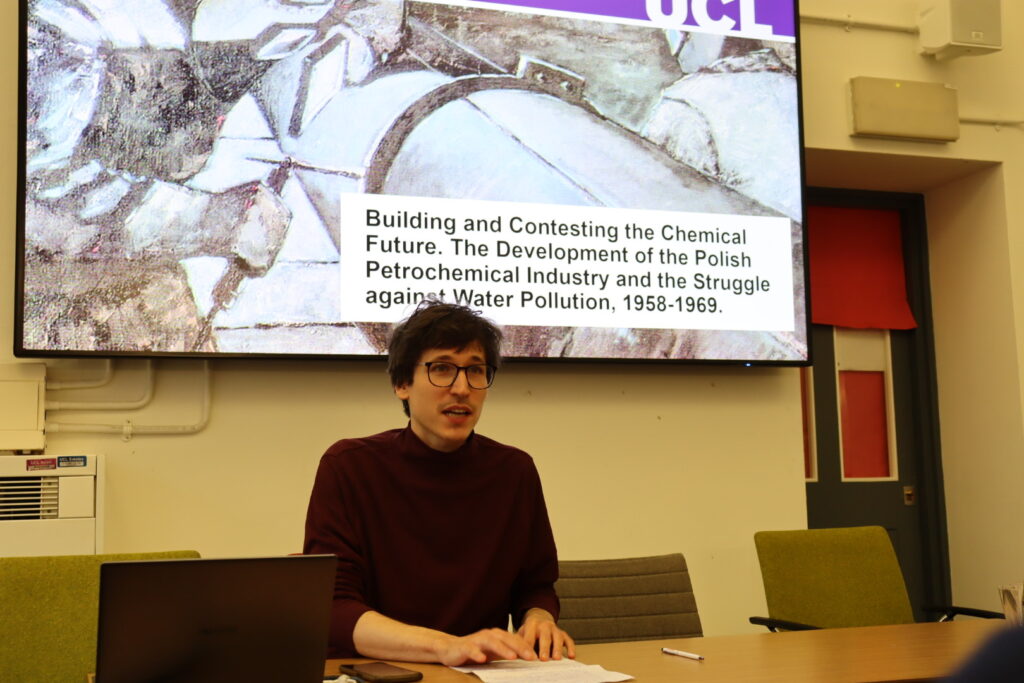
SAVA Research Fellow Jan Burek will speak on Building and Contesting the Chemical Future: the Development of the Polish Petrochemical Industry and the Struggle against Water Pollution, 1958-1969. The decision to construct the Druzhba pipeline significantly altered the plans for the development of the Polish economy in the late 1950s. Thanks to Soviet oil, Poland was supposed to enter a new era of prosperity and modernity with synthetic materials made from cheap petrochemicals not only fulfilling local needs but becoming extremely profitable exports. The sleepy, medieval town of Płock where a refinery and petrochemical plant connected to the pipeline was erected was to become a beacon of this bright chemical future. Around the same time, however, the pollution of water connected with the progressing chemicalization of the economy became a cause of concern for various state and non-state actors. A problem that the construction of the pipeline and Płock plant only exacerbated and brought to the attention of the wider public due to the conspicuous olfactory nature of petrochemical pollution.
Curator Rado Ištok (National Gallery in Prague) will give a presentation entitled From Basra to Kralupy: Czechoslovak oil refineries in Iraq. In the history of the oil industry, the year 1976 was marked by two events in Czechoslovakia: first, the oil refinery in Kralupy near Prague was put into permanent operation, and second, the book Černé miliardy [Black Billions] on the history and politics of oil extraction by the Czech journalist Jiří Hronek was published. Interestingly, the oil refinery in Kralupy benefited from some of the expertise which the Brno-based company Chepos developed during the construction of the oil refinery in Basra in southern Iraq, launched in 1974, as also observed by Hronek. Since 1969, during the last two decades of the Cold War, Czechoslovakia – alongside other socialist countries – was instrumental in the development of Iraq’s nationalised oil industry – until then dependent on the British and US-American expertise – in exchange for convertible currencies or petrobarter. His presentation is based on collaborative work with visual artist Jiří Žák and draws on materials from the archives of Czech television.
6.30-8pm
Screening of Tekla Aslanishvili’s A State in A State
Location: IAS Forum
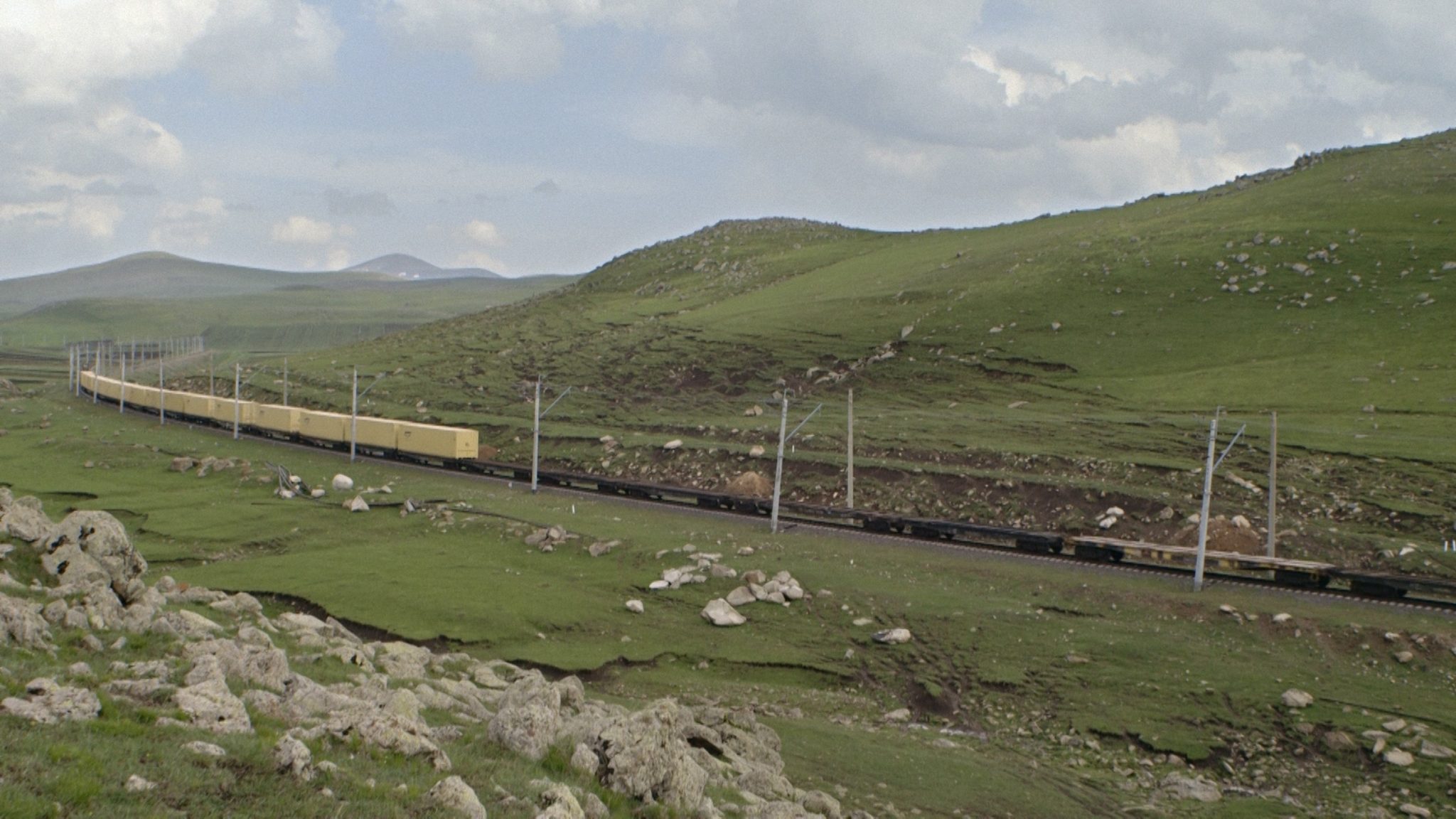
A screening of Tekla Aslanishvili’s A State in A State (2022) introduced by scriptwriter Evelina Gambino (University of Cambridge).
A State in a State (2022, 47’) is an experimental documentary film by Georgian artist Tekla Aslanishvili that follows the construction, disruption, and fragmentation of railroads in the South Caucasus and Caspian regions. It examines railways as the technical materialisation of the fragile political borders that have reemerged after the collapse of the Soviet Union. Revolving around the scenes of delay and waiting that constitute cargo mobility, the film reads the optimistic narratives about the New Silk Road against the grain. It observes how the iron foundation of connectivity can be used as a weapon of exclusion and geopolitical sabotage. Dotting the same lines, other forms of sabotage are deployed by workers to disrupt the political violence. Looking at historic and current practices of resistance A State in a State explores the potential of railroads for building a different, infrastructural consciousness and the lasting, transnational, kinship among the people who live and work around them. The film is developed in artistic-scientific collaboration with Dr. Evelina Gambino, Margaret Tyler Research Fellow in Geography at Girton College, University of Cambridge.
Thursday 14 March 2024
4-5pm
From Energetic Colonialism to Nuclear Terrorism
Location: IAS Forum
Svitlana Matviyenko (Simon Fraser University) and Oleksiy Radynski (SAVA UCL) in conversation on the militarization of nuclear infrastructures.
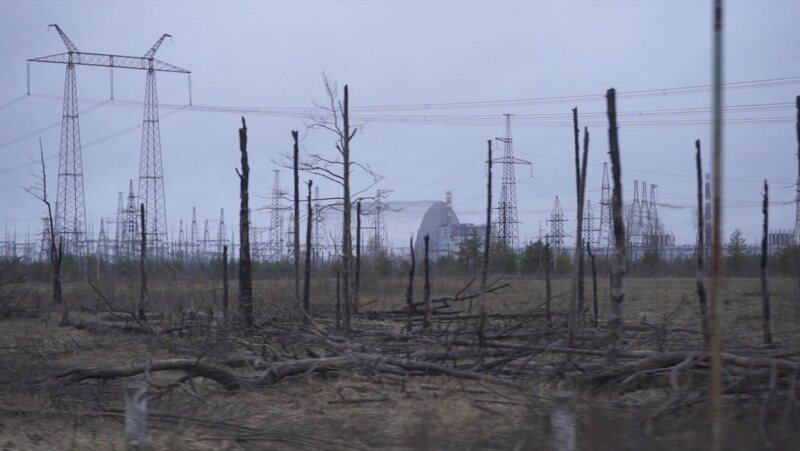
In the early stages of Russian invasion of Ukraine in 2022, the Russian troops had occupied the Chornobyl Nuclear Power Plant, the site of the worst nuclear disaster in history, and the Zaporizhzhia Nuclear Power Plant (Europe’s largest), which remains Russia-occupied to this day. This marks a new development not only in terms of ways of war (never had a nuclear facility of this kind been occupied by an invading army before), but also in decades-long colonial tactic of weaponising energy resources – first by the USSR, then by the Russian Federation. This development also posits nuclear terror as an element of information warfare, with radiation as a global mass medium (Svitlana Matviyenko). This talk is based on our joint experience of travelling to and researching the Chornobyl Zone of Exclusion both before the Russian occupation and in its aftermath, and will include evidence collected during the documentation of this war crime (Chornobyl 22 documentary by Oleksiy Radynski).
5-7pm
SAVA Panel on Infrastructural Internationalism
Location: IAS Forum
With Monika Motylińska (Leibniz Institute Berlin), Alessandro Iandolo (SSEES UCL), Dubravka Sekulić (Royal College of Art) and Eszter Szakács (University of Amsterdam)
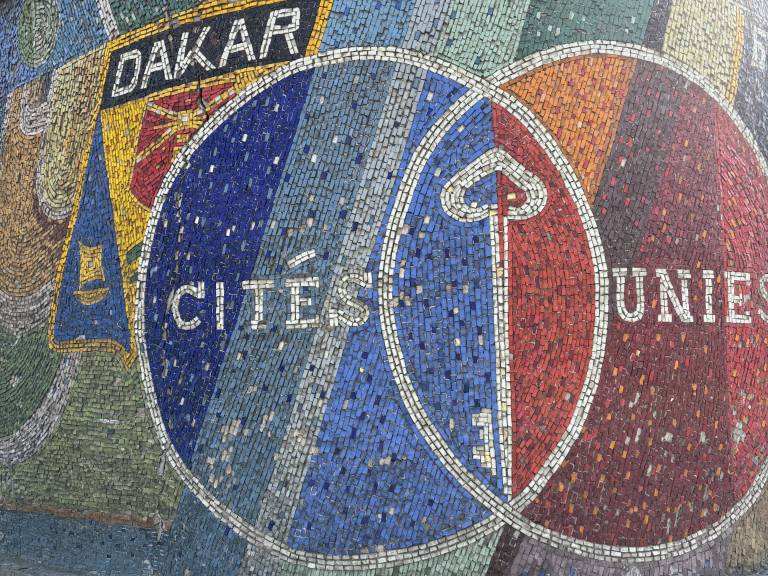
This SAVA panel will consider the physical and cultural infrastructures of socialist internationalism, from flagship histories of East-South industrial collaboration and dam-building as a symbol of modernity for the Third World and site of Cold War competition, to the alternative networks for economic development of the non-aligned movement and the residues of state-managed solidarity campaigns.
Monika Motylińska (Leibniz Institute for Research on Society and Space (IRS), Erkner, Germany) will give a presentation on Constructing Solidarity? Comecon Joint Ventures in Cuba and Ethiopia. In the official discourse of the Eastern Bloc, the nickel plant ‘Las Camariocas’ in Cuba or the cement plant ‘New Mugher’ in Ethiopia were depicted as flagships of socialist collaboration under the label of the Comecon (Council for Mutual Economic Assistance). Focussing on these two spectacular projects, she will scrutinise the joint Comecon effort, looking at several layers of the entanglements between Cuba, Ethiopia and the European socialist states and the German Federal Republic in particular. This is an attempt to provide a suitable framework for addressing issues like the policies of the Comecon in the building industry towards non-European countries and to identify actors playing a crucial role in the knowledge production and transfer across the Comecon in the context of architecture and urban planning. The materialised results of the Comecon joint ventures enable us to consider the broader question of industrial infrastructures within global socialisms. At the same time, the focus on contractors is an opportunity to rethink the role of the builders. This talk is based on the extensive archival research and oral history collection in Germany as well as on the results of the ongoing PhD project by Juliane Richter on the architectural circulations between the GDR and Cuba, of which she is co-supervisor.
Alessandro Iandolo (SSEES UCL) will speak on Damming West Africa: The Politics of Hydroelectric Energy in Ghana, Guinea, and Mali. Dams were the ultimate symbol of Cold War modernity. Since the early 1950s, most postcolonial states in Africa and Asia harbored the ambition of building new dams and establishing energy self-sufficiency through hydroelectric power. West Africa was no exception. In Ghana, Kwame Nkrumah dreamed of making the Akosombo dam a pillar of economic modernization. Ahmed Sékou Touré in Guinea and Modibo Keïta in Mali hoped to revive dam projects from the colonial era to empower the economies of their anti-colonial states. In all cases, their ambitions needed to overcome numerous challenges – geographical, scientific, financial, and, above all, political. How to design, build, finance, and manage a dam presented a series of complex political choices, often forcing governments to choose between stark alternatives: collective or individual, state or market, industrial or commercial, ultimately socialism or liberalism. This paper explores these dilemmas, arguing that political preferences were at the heart of the push for economic modernization in West Africa.
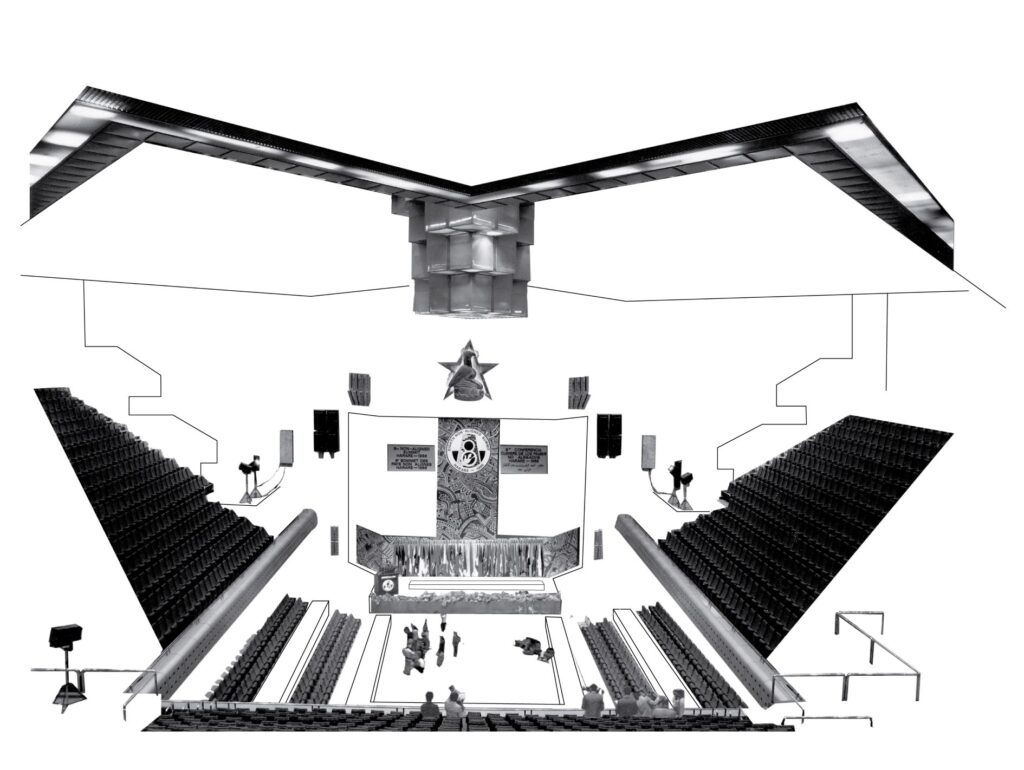
Dubravka Sekulić (Royal College of Art) will present on Infrastructures between Solidarity and Debt – Nonalignment and Yugoslav Construction Industry. Looking at the infrastructure projects constructed by Energoprojekt, Yugoslav construction company from Belgrade in non-aligned countries mostly in Africa, can be a useful lens for understanding of the complexities of post-independence state building and the role of infrastructure in these processes. Timothy Mitchell stresses how infrastructure building is inherently connected to the issues of debt and how they foreclose future. From the contemporary vantage point of compound environmental, economic, and societal problems, many infrastructure projects across the world especially those built in the period between early 1960 and late 1980 seem irrational, however reading these projects in the context of the struggles and failures to establish different more equitable world international economic order can offer a more nuanced understanding not only of past processes but also future attempts for worldmaking. In my paper I will try to offer a reading along these lines following projects of Energoprojekt in Zambia and Zimbabwe.
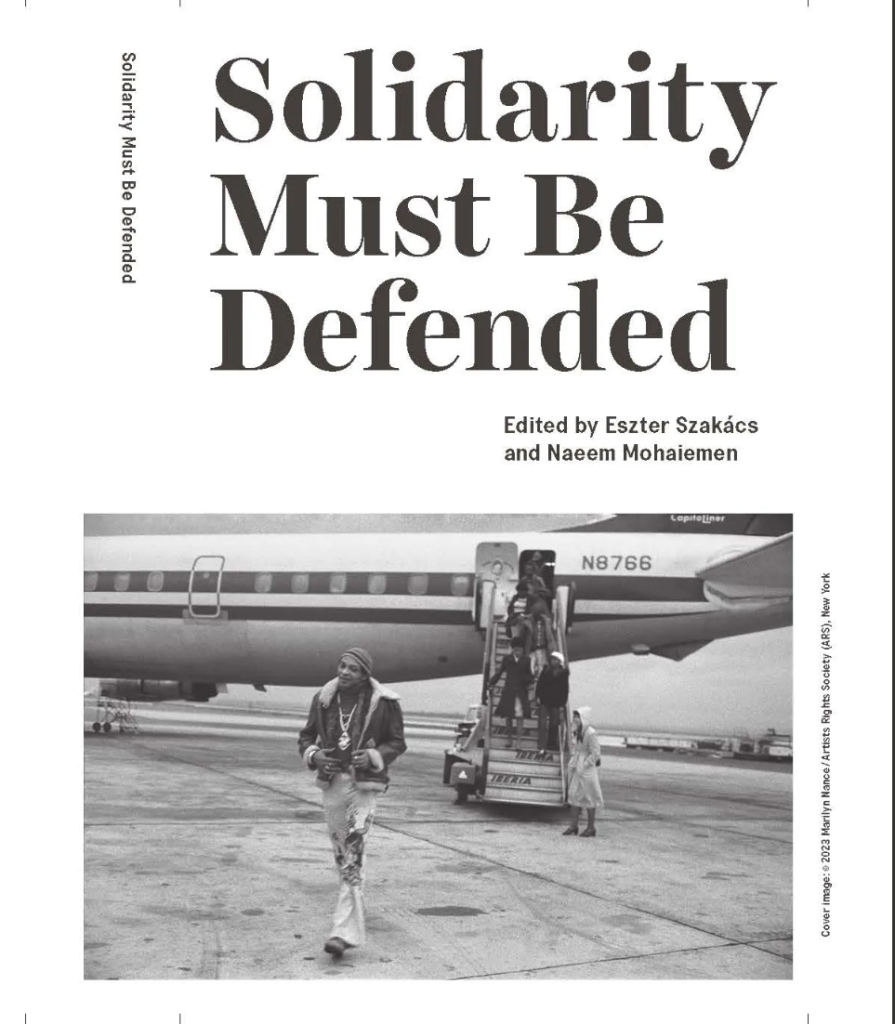
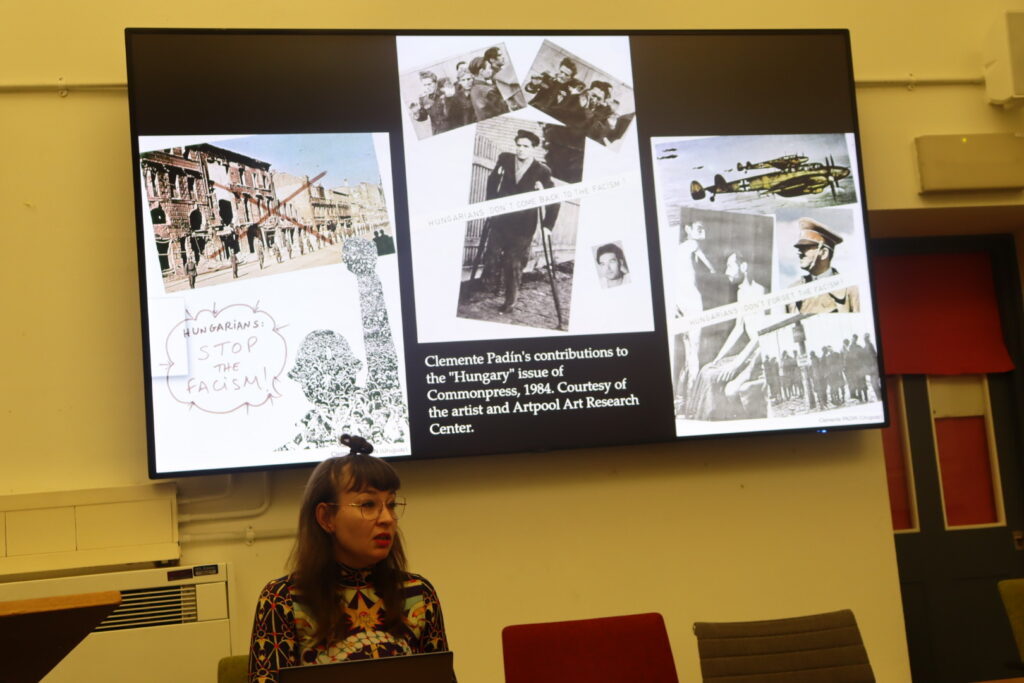
In her presentation titled Residues of State-Managed Solidarities, curator and researcher Eszter Szakács (University of Amsterdam) will speak about the role of the state in Cold War solidarity projects in art and culture, examining their remnants from the perspective of the archive and surviving institutions. Based on the recently published anthology Solidarity Must Be Defended which she co-edited with Naeem Mohaiemen on visual arts projects exploring solidarity, realised and failed, within the Cold War era, in her talk she will contrast state-managed forms of solidarity organising with grassroots solidarity projects. She will examine these through the lens of several contributions to the anthology: Hungarian propaganda publications from the socialist era about the ‘Arab World,’ as well as through the histories of state-initiated Pan-African festivals and artistic campaigns in Latin America.
Roundtables
To request to join one or more of these closed workshops designed for the SAVA Team, invited speakers and a limited number of additional participants, please email ias.pact@ucl.ac.uk
Wednesday 13 March
11.30am-1.00pm.
Workshop on Socialism as Metasystem: Cybernetics, Infrastructure, and Utopia in the GDR
Led by Alex Petrusek (SAVA UCL)
Throughout the 1960s, East German leaders and economic planners embraced cybernetics to systematize socialist production and infrastructure in the GDR. Cybernetics also served as a new discourse of socialist utopia, promising a more rational, prosperous future communist society. Together we will read and discuss key figures and sources, and evaluate the impact and limits, of cybernetic practice in the GDR.
2.00pm-3.30pm
Workshop on the Baikonur Cosmodrome
Led by Makar Tereshin (SSEES UCL)
Workshop on the mastering of the Soviet hinterlands in Central Asia and the Soviet conquest of space and how these two discourses intersect in and around Baikonur Cosmodrome. Based on fieldwork, personal testimonies and memoirs of the Soviet military working on the construction of the Cosmodrome, as well as popular cinema depictions of the Central Asian steppe/desert environments as extraterrestrial environments.
Thursday 14 March
11.30am-1pm.
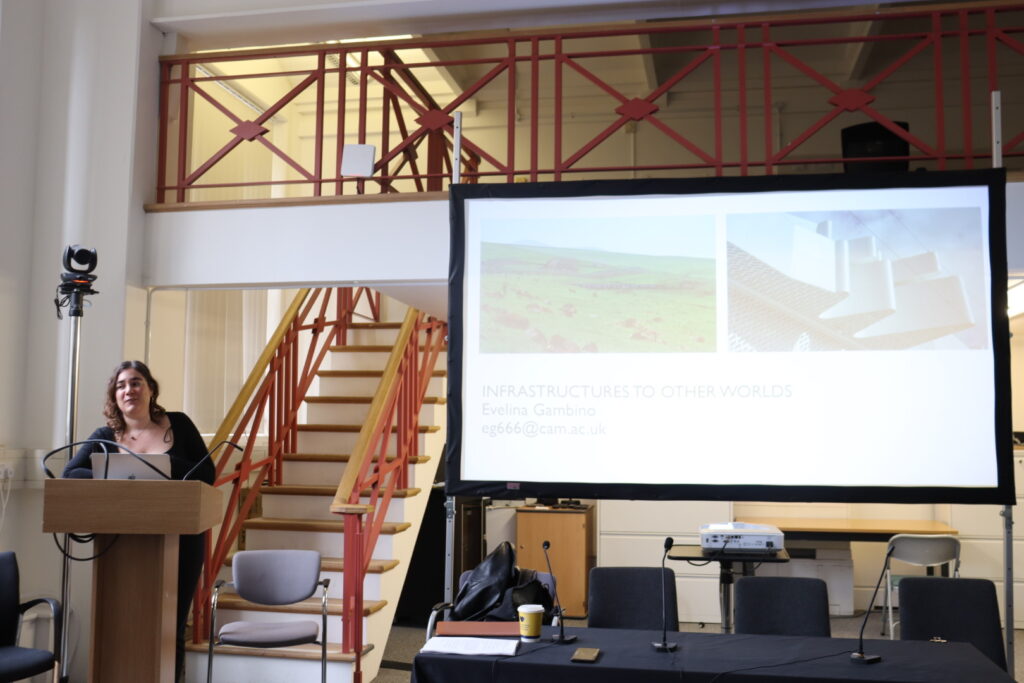
Workshop on Infrastructures to Other Worlds
Led by Evelina Gambino (University of Cambridge)
Today, the infrastructures that bind together former socialist territories are the sites where new and old visions of development accrete, sometimes in surprising ways. Despite often being described as new, revolutionary, projects, railways, dams, ports pipeline and others are sites where a heterogeneous simultaneity of disparate spatio-temporal visions meet. In this workshop, participants will be encouraged to think through the histories of specific infrastructures in order to map out the heterogeneous space/times that that coexist within them.
2.00-3.30pm
Workshop on Maroje Mrduljaš’s Slumbering Concrete / Zenica – City for the Working Class
Led by Maja and Reuben Fowkes (SAVA UCL)
This workshop will have as its starting point an episode of the documentary series Slumbering Concrete by Croatian historian of architecture Maroje Mrduljaš dealing with the remnants of Yugoslav concrete infrastructures, in this case the industrial town of Zenica in Bosnia. It will explore the principles of city-building around the ironworks with attention to the social, cultural and ecological needs of the working class.
Speaker biographies
Tekla Aslanishvili (b. Tbilisi, 1988) is an artist, filmmaker and essayist based between Berlin and Tbilisi. Her works emerge at the intersection of infrastructural design, history and geopolitics. Tekla graduated from the Tbilisi State Academy of Arts in 2009 and she holds a MFA from the Berlin University of the Arts—the department of Experimental Film and New Media Art. Aslanishvili’s films have been screened and exhibited internationally at PACT Zollverein, Neue Berliner Kunstverein, Baltic Triennial, Short Film Festival Oberhausen, Kasseler Dokfest, Kunsthalle Münster, EMAF—European Media Art Festival, Videonale 18, Tbilisi Architecture Biennial. She is a 2018–2019 Digital Earth fellow, the nominee for Ars-Viva Art prize 2021 and the recipient of the Han Nefkens Foundation—Fundació Antoni Tàpies Video Art Production Award 2020.
Evelina Gambino is Margaret Tyler Research Fellow in the Department of Geography at the University of Cambridge. Her research is concerned with a situated analysis of global logistics. Working across large infrastructures in the Republic of Georgia and the South Caucasus, she seeks to map the ways in which planetary projects of circulation, such as the Belt and Road Initiative, are translated into local contexts. In dialogue with feminist critiques of capitalism, her analysis highlights the different kinds of work that this translation entails. Recent publications include a co-authored entry on ‘Infrastructure’ in the Cambridge Encyclopaedia of Anthropology (2023) and a chapter on ‘Big Dick Energy at the End of the World: Technopolitics for a Global Hustle’ in an edited volume on Gendering Logistics (2021). She has collaborated as scriptwriter on the video works A State in a State (2022) and The Stone of Hell (2021).
Oleksiy Radynski is a filmmaker based in Kyiv and SAVA Creative Fellow at the UCL Institute of Advanced Studies. His films have been screened at the International Film Festival Rotterdam, the Oberhausen International Short Film Festival, DOK Leipzig, Kurzfilmtage Winterthur and other festivals, and received awards at Docudays UA, Molodist IFF, and the Kyiv International Short Film Festival. Selected Filmography: Infinity According to Florian (2022), Circulation (2020), Facade Colour: Blue (2019), The Film of Kyiv. Episode One (2017), Landslide (2016), People Who Came to Power (2015), Integration (2014), Incident at the Museum (2013).
The research of Robin Schuldenfrei (Courtauld Institute of Art) focuses on the history and theory of modern architecture. She is interested in broad questions—theoretical and practical—of how discourses and practices of design are shaped by a given period’s own cultural and theoretical critique of its media and objects. Her work interrogates the ways in which architecture and its objects relate to other products of society’s design: to works of art, to the production of images, to media, and to technology. She is the author of Objects in Exile: Modern Art and Design across Borders, 1930–1960 (2024).
Svitlana Matviyenko is an Associate Professor of Critical Media Analysis in the School of Communication and Associate Director of the Digital Democracies Institute at Simon Fraser University, Canada. Her research and teaching, informed by science & technology studies and history of science, are focused on information and cyberwar, media and environment, critical infrastructure studies and postcolonial theory. Matviyenko’s current work on nuclear cultures & heritage investigates the practices of nuclear terror, weaponization of pollution and technogenic catastrophes during the Russian war in Ukraine. Matviyenko is a co-editor of two collections, The Imaginary App (MIT Press, 2014) and Lacan and the Posthuman (Palgrave Macmillan, 2018). She is a co-author of Cyberwar and Revolution: Digital Subterfuge in Global Capitalism (Minnesota UP, 2019), a winner of the 2019 book award of the Science Technology and Art in International Relations (STAIR) section of the International Studies Association and of the Canadian Communication Association 2020 Gertrude J. Robinson book prize.
Leyla Sayfutdinova is a Senior Lecturer in Critical Area Studies at the University of Glasgow. She holds PhD in Sociology from the Middle East Technical University in Ankara, Türkiye. Her research has focused on the post-socialist transition in Azerbaijan, particularly urban change, nationalism, and social consequences of the post-Soviet industrial restructuring. Her most recent project “Turning oil into stone”, funded by the European Commission through Marie Sklodowska-Curie Actions, examines the multiple ways in which oil industry and urban space have been co-produced in Baku, one of the world’s earliest oil cities. Leyla’s research has been published in Journal of Eurasian Studies, Labor History, Work, Employment and Society, and Nationalities Papers.
Maja and Reuben Fowkes are art historians, curators and co-directors of the Postsocialist Art Centre (PACT) at the Institute of Advanced Studies, University College London. Their publications include Art and Climate Change (Thames & Hudson, 2022), Central and Eastern European Art Since 1950 (Thames & Hudson, 2020), Ilona Németh: Eastern Sugar (Sternberg Press, 2021), The Green Bloc: Neo-avant-garde Art and Ecology under Socialism (CEU Press, 2015) and a special issue of Third Text entitled Actually Existing Artworlds of Socialism (2018). Recent curatorial projects include the exhibitions Colliding Epistemes at Bozar Brussels (2022) and Potential Agrarianism at Kunsthalle Bratislava (2021). Maja is Principal Investigator of the Socialist Anthropocene in the Visual Arts (SAVA) and Reuben Fowkes is a SAVA Research Fellow. www.translocal.org
Jan Burek is a social and cultural historian of state socialism. He is a SAVA Research Fellow at PACT, UCL Institute of Advanced Studies. He is a Research and Teaching Fellow at the Faculty of History of the University of Warsaw. His research explores the forms of individual and group agency state socialist dictatorships allowed for and, in some cases, facilitated. His research methods draw heavily on Italian microhistory and the Alltagsgeschichte. Hence, he focuses on the microscale analysis of the everyday experiences of life and work. https://www.ucl.ac.uk/institute-of-advanced-studies/jan-burek
Rado Ištok is a curator, art writer, and editor. He is the curator of the Collection of Art since 1945 at the National Gallery in Prague, Czech Republic, and a PhD candidate at the Institute of Art History at Charles University in Prague. Recent exhibitions include Eva Koťátková: My Body Is Not an Island, National Gallery Prague (2022–2023, co-curated with Sandra Patron); All That Is Solid Melts into Water, Uppsala Art Museum, Uppsala, Sweden (2022); and Ala Younis: High Dam: Modern Pyramid, VIPER Gallery, Prague (2020). He contributes to Artforum, Flash Art, Art+Antiques, as well as academic publications, most recently to Cultures of Silence: The Power of Untold Narratives (Routledge 2023) edited by Luísa Santos.
Monika Motylińska is head of the research group ‘Histories of the Built Environment’ at Leibniz Institute for Research on Society and Space (IRS) in Erkner. She is interested in global cycles of architectural production in the long 20th century and investigating flows of capital, labour and ideas. Her current research is dedicated to overlooked actors such as construction companies (within the framework of the Freigeist Fellowship of the VolkswagenStiftung). As a Mellon Fellow for the Canadian Centre for Architecture’s Centring Africa project, her collaboration with Rachel Lee resulted in the publication Fugitive Archives: A Sourcebook for Centring Africa in Histories of Architecture (2023). Recently, she also co-edited the volume Between Solidarity and Economic Constraints (de Gruyter, 2023).
Alessandro Iandolo is a historian of the Soviet Union and the world, and lecturer in Soviet/Post-Soviet History at the School of Slavonic and East European Studies UCL. His research interests cover the USSR’s economic, intellectual, and political interactions with external ideas, states, and people. His current project investigates intellectual exchanges between Soviet and Latin American economists on theorizing “backwardness” and “dependency.” His first book Arrested Development: The Soviet Union in Ghana, Guinea, and Mali, 1955-1968 (2022) explored the Soviet Union’s economic partnership with three newly-independent countries in West Africa during the Nikita Khrushchev era.
Dubravka Sekulić is an architect, educator and writer whose work focuses on politics of space and questions of justice and solidarity. She is a Programme Lead for MA City Design at the Royal College of Art, London (UK). She holds a PhD from ETH Zurich, Switzerland with a thesis “Constructing Non-alignment: Yugoslav Construction industry in the non-aligned world 1961-1989”.
Eszter Szakács is a curator, researcher, and Ph.D. candidate at the Amsterdam School for Cultural Analysis (ASCA) at the University of Amsterdam, where she is taking part in the project IMAGINART—Imagining Institutions Otherwise: Art, Politics, and State Transformation. Her research, writing, and practice engage with grassroots art organizing outside state infrastructures. Eszter is on the curatorial team of the grassroots art initiative OFF-Biennale Budapest, with whom they were lumbung members at documenta fifteen in 2022. She was a team member of the self-organised East Europe Biennial Alliance—co-founded by OFF-Biennale Budapest—that collectively curated the Kyiv Biennial in 2021. Between 2011 and 2020, she worked as curator and editor at tranzit/hu in Budapest. In 2023 she curated the exhibition Dóra Maurer–SUMUS–We Are Together at de Appel in Amsterdam, and together with Naeem Mohaiemen, Eszter co-edited the recently published anthology Solidarity Must Be Defended.
Makar Tereshin is a social anthropologist and documentary photographer. He is a PhD candidate at University College London, where he is part of the ETHNO-ISS project. His research interests concern material culture studies, environmental and visual anthropology with particular ethnographic focus on Russia and Kazakhstan. Currently, he is working on a project exploring politics and ecology of the Russian space programme in Central Kazakhstan.
Documentation